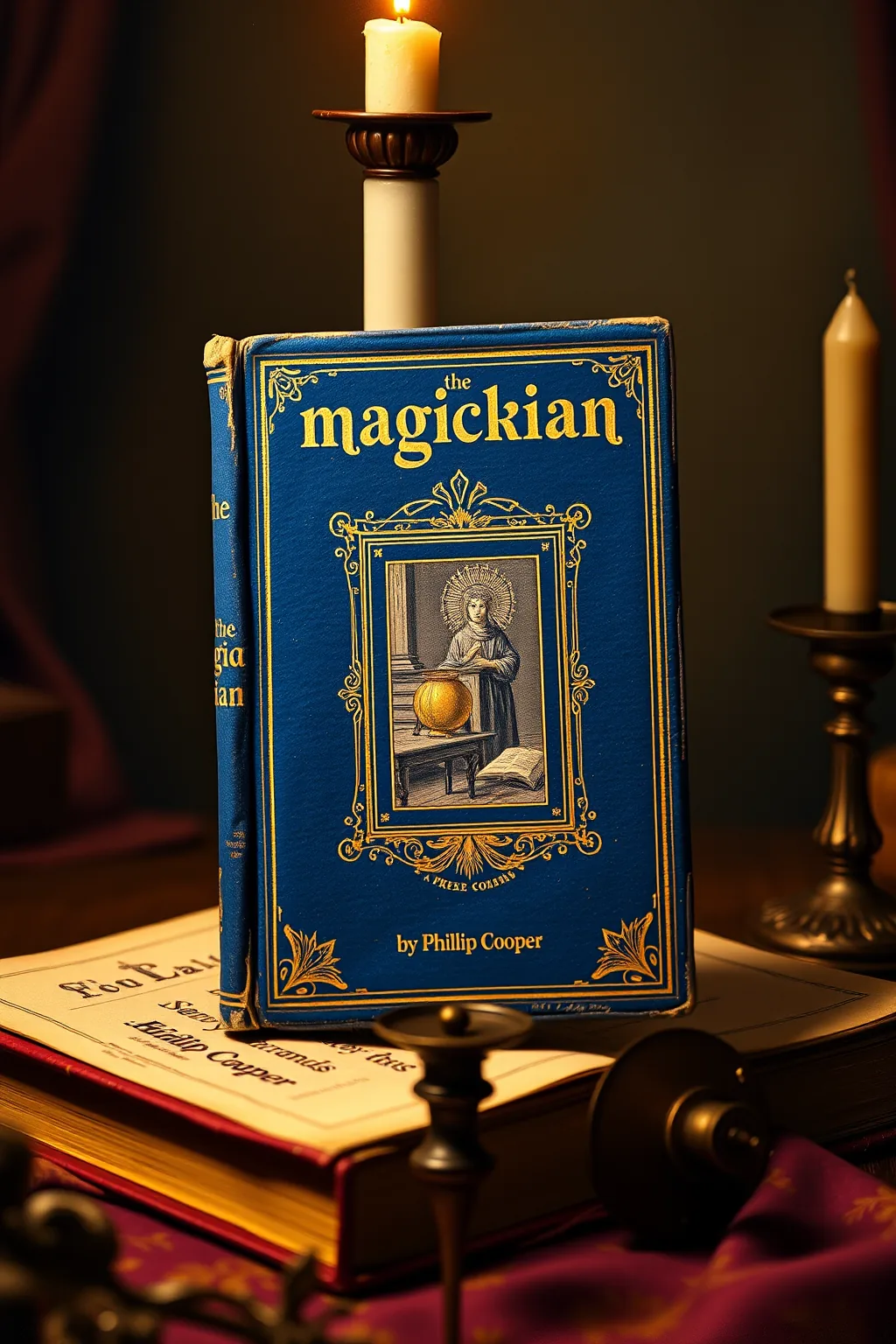
The magickian
 75
75

The magickian
Phillip Cooper’s *The Magickian*, first published in 1993, avoids the typical pitfalls of occult writing by grounding its exploration in a form of critical analysis. Rather than simply detailing rituals, Cooper interrogates the philosophical architecture that supports them. The book’s strength lies in its intellectual honesty, treating magick not as mere fantasy but as a complex system of psychological and symbolic operations. Cooper’s dissection of the magician's will, for instance, offers a compelling perspective on agency and intention within esoteric frameworks. However, the work's academic tone, while refreshing, can sometimes render its practical implications less accessible to those seeking immediate application. The passages discussing the construction of inner temples feel particularly insightful, highlighting how mental architecture mirrors physical reality. Ultimately, *The Magickian* serves as a valuable, albeit demanding, examination of the underpinnings of occult practice.
📝 Description
75
Phillip Cooper’s 1993 book, The Magickian, examines occult philosophy beyond sensationalism.
The Magickian is a study of occult philosophy that moves past sensational accounts to investigate the core principles and methods of esoteric traditions. Phillip Cooper’s book is not a simple historical overview; it actively engages with its subject matter, aiming to clarify the logic and psychological aspects of magickal thinking. It considers the practitioner's intent, the nature of consciousness, and how inner states relate to outer results.
The book analyzes various conceptual systems, providing a structured way to grasp how belief and practice operate across different traditions. It is written for serious students of the occult and esoteric fields, especially those who have moved beyond introductory material and want a deeper, more analytical grasp. The book appeals to people interested in the theoretical foundations of magick, the history of Western esotericism, and comparative studies of mystical practices.
Published in 1993, The Magickian entered a period of renewed interest in esoteric subjects. Cooper's work stands out for its academic rigor, engaging with the intellectual heritage of groups like the Hermetic Order of the Golden Dawn and figures such as Aleister Crowley. It critiques certain interpretations while examining the underlying logic of magickal thought.
💡 Why Read This Book?
• Gain a structured understanding of magickal will, moving beyond simplistic notions of desire to explore its role as a focused, directed force, as detailed in Cooper's analysis of practitioner intent. • Grasp the concept of the astral plane not as a separate dimension, but as a psychospiritual landscape influenced by consciousness, a perspective explored in the book's examination of inner worlds. • Appreciate the systematic nature of esoteric study by learning how symbolism functions as a tool for consciousness transformation, a key theme in Cooper's critique of occult frameworks.
⭐ Reader Reviews
Honest opinions from readers who have explored this book.
❓ Frequently Asked Questions
What is the primary focus of Phillip Cooper's 'The Magickian'?
'The Magickian' focuses on the philosophical and psychological underpinnings of magick, examining concepts like will, consciousness, and symbolism. Published in 1993, it offers a critical analysis rather than a purely practical guide.
Is 'The Magickian' suitable for beginners in occult studies?
While accessible, the book's analytical approach is best suited for those with some prior exposure to esoteric concepts. Beginners might find its depth challenging compared to introductory manuals.
What historical context is important for understanding 'The Magickian'?
Published in 1993, the book emerged during a period of renewed occult interest. It engages with traditions influenced by figures like Aleister Crowley and the Hermetic Order of the Golden Dawn, offering a more critical perspective.
Does the book provide practical magickal techniques?
Cooper's primary aim is conceptual clarity and philosophical exploration. While it illuminates the principles behind techniques, it does not function as a step-by-step grimoire for practical rituals.
What distinguishes 'The Magickian' from other occult books published around 1993?
Its distinguishing feature is its academic rigor and critical examination of magickal theory, contrasting with more popular, purely practical or historical accounts prevalent at the time.
What key esoteric concepts does 'The Magickian' explore?
The book delves into the nature of the magician's will, the function of the astral plane as a psychospiritual construct, and the transformative power of symbolism.
🔮 Key Themes & Symbolism
The Nature of Will
Cooper critically examines the concept of the magician's will, distinguishing it from mere desire or ego-driven intention. The work posits will as a focused, disciplined faculty essential for directing consciousness and manifesting change. It explores how this faculty is cultivated through esoteric training, emphasizing the importance of clarity, purpose, and sustained mental effort. This theme positions the magician not as a passive recipient of cosmic forces, but as an active agent capable of shaping reality through deliberate intent, a core principle often discussed in Hermetic philosophy.
Consciousness and the Astral Plane
Rather than treating the astral plane as a discrete external realm, Cooper discusses it as a psychospiritual dimension intricately linked to the magician's own consciousness. The book details how inner states, beliefs, and symbolic constructs shape one's perception and interaction with this 'plane.' It suggests that mastery involves understanding and navigating one's own inner landscape, which then reflects outwardly. This perspective challenges dualistic notions and emphasizes the subjective, yet potent, reality of esoteric experience, drawing parallels with psychological models of altered states.
Symbolism as a Transformative Tool
The work highlights the profound role of symbolism in the practice of magick. Cooper analyzes how symbols are not mere arbitrary signs but potent vehicles for conveying complex ideas and influencing the subconscious mind. Through the deliberate use and contemplation of specific symbols, the magician can effect internal shifts and external changes. This section unpacks the mechanics of symbolic language within esoteric traditions, demonstrating its power to encode spiritual principles and facilitate psychological evolution, a concept central to Hermetic and Kabbalistic studies.
The Magician's Discipline
A significant theme is the rigorous discipline required for serious occult practice. Cooper underscores that true magickal work demands more than theoretical knowledge; it necessitates consistent effort, self-awareness, and ethical consideration. This involves the meticulous cultivation of mental faculties, emotional control, and a deep understanding of one's motivations. The book argues that the path of the magician is one of continuous self-refinement, where the internal state directly correlates with the efficacy and integrity of one's work.
💬 Memorable Quotes
Direct passages from the work, attributed to the author.
“Will is the engine of manifestation.”
— This concise statement captures the book's view of will as the primary force driving magical outcomes. It suggests that intention, when properly focused and disciplined, possesses the power to alter circumstances and create desired realities.
“The inner temple is built before the outer work begins.”
— This highlights the foundational importance of mental and spiritual preparation. Cooper emphasizes that effective external magical operations depend on a well-structured and fortified inner psychic space.
“Symbolism provides the language for the soul.”
— This interpretation points to the deep connection between symbolic forms and the non-rational aspects of human experience. It suggests symbols are essential for communicating profound truths and facilitating inner transformation.
“Discipline is the crucible where potential becomes power.”
— This emphasizes the active role of consistent effort and self-control in developing magical ability. Cooper frames discipline not as restriction, but as the necessary process for refining raw potential into effective power.
“Understanding the map is crucial before charting the territory.”
— This serves as a metaphor for the need for theoretical knowledge and conceptual clarity. Cooper suggests that before engaging in complex magical operations, a thorough comprehension of the underlying principles and systems is vital.
🌙 Esoteric Significance
Tradition
The Magickian engages primarily with the Western Esoteric Tradition, particularly its Hermetic and ceremonial magickal branches. Cooper's work is situated within the lineage that analyzes the principles underlying practices popularized by figures like Eliphas Lévi and later developed by Aleister Crowley. It departs from purely devotional or dogmatic approaches by focusing on the psychological and philosophical mechanics of magick, treating it as a system of consciousness manipulation and symbolic interaction rather than solely a means to commune with external deities.
Symbolism
Key symbols explored include the magician's wand, representing directed will and authority; the concept of the inner temple, symbolizing the fortified psychic space essential for focused work; and the use of geometric forms and sigils as tools for imprinting intention onto consciousness. These symbols are presented not as arbitrary icons but as condensed expressions of complex energies and psychological states, integral to the Hermetic principle of 'as above, so below.'
Modern Relevance
Contemporary practitioners of ceremonial magick and chaos magic often draw upon Cooper's analytical approach to will and consciousness. His work provides a valuable counterpoint to purely intuitive or experiential methods, offering a framework for understanding the systematic nature of occult practice. Thinkers in the field of comparative religion and the psychology of religion also find value in his examination of belief systems and symbolic efficacy, making it relevant for academic study as well as personal esoteric development.
👥 Who Should Read This Book
• Serious students of Western Esotericism seeking a deeper philosophical understanding of magickal principles beyond introductory guides. • Practitioners of ceremonial magick or Hermeticism who wish to refine their concepts of will, consciousness, and symbolic interaction. • Scholars of comparative religion and the psychology of belief who are interested in the structure and function of occult systems.
📜 Historical Context
Phillip Cooper’s *The Magickian*, published in 1993, arrived during a burgeoning period for esoteric studies, following the popularization of occultism in the latter half of the 20th century. The intellectual climate saw a growing interest in Western esotericism, moving beyond simple ritualistic applications to explore deeper philosophical and psychological dimensions. Cooper’s work distinguished itself by its critical engagement with the lineage of magickal thought, referencing figures like Aleister Crowley and the Hermetic Order of the Golden Dawn, but offering a more analytical rather than purely devotional perspective. This contrasted with the more overtly spiritualist or Neo-Pagan movements also gaining traction at the time. The early 1990s were a transitional phase, with the internet beginning to emerge as a source of information, yet scholarly explorations of magick were still relatively scarce compared to anecdotal accounts or historical surveys. Cooper’s approach provided a much-needed intellectual framework for understanding the mechanics of magickal practice.
📔 Journal Prompts
The magician's will: Reflect on personal applications of directed intention.
Inner temple construction: Map out the mental architecture supporting your focus.
Symbolic language: Identify a personal symbol and its subconscious meaning.
The discipline of practice: Assess current routines for consistency and efficacy.
The nature of the astral: Consider how your inner state influences your perception of reality.
🗂️ Glossary
Will
In the context of *The Magickian*, 'will' refers to a disciplined, focused mental faculty employed by the magician to direct consciousness and effect change, distinct from mere desire or passive wishing.
Astral Plane
Conceptualized not as a separate physical realm but as a psychospiritual dimension directly influenced by the magician's consciousness, beliefs, and symbolic constructs.
Symbolism
The use of signs, images, and archetypes as vehicles for conveying complex ideas and influencing the subconscious mind, thereby facilitating transformation.
Inner Temple
A metaphor for the magician's internal psychic space, which must be consciously constructed, fortified, and organized to serve as a stable foundation for magical operations.
Manifestation
The process through which thoughts, intentions, and magical operations are brought into perceptible reality, often understood as a result of focused will and symbolic work.
Esoteric Discipline
The rigorous self-control, consistent practice, and focused study required for effective and ethical engagement with magickal principles and traditions.
Consciousness
The state of awareness and subjective experience, considered by Cooper to be the primary medium and instrument through which magical effects are generated.
🔮 Readers Also Liked
Browse all →







More by Phillip Cooper
All books →


More Free Magic & Ritual Books
View all →