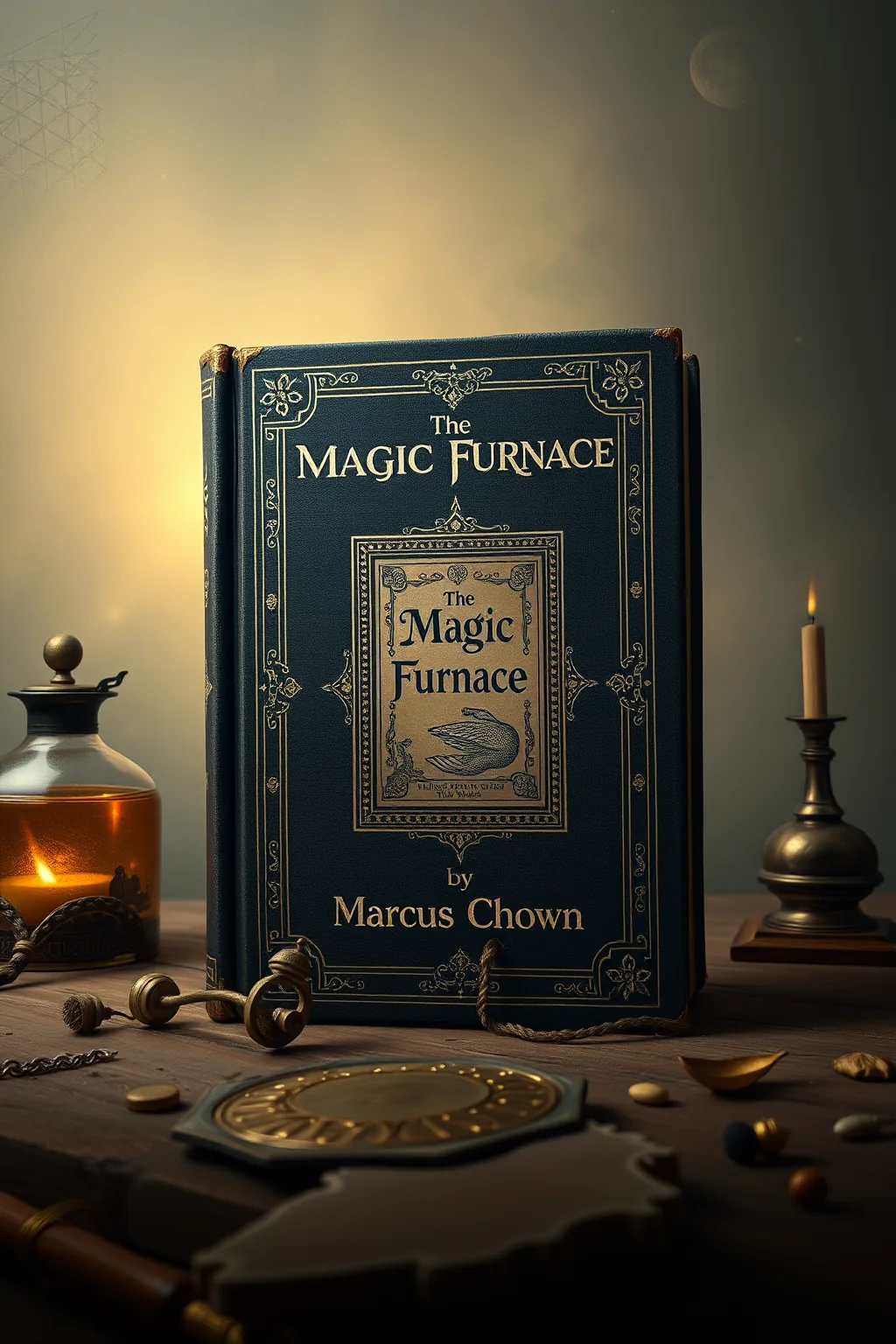
The Magic Furnace
 73
73

The Magic Furnace
Marcus Chown’s The Magic Furnace attempts to synthesize cosmology and the origins of life into a cohesive narrative, and largely succeeds by focusing on the elemental genesis of existence. Chown excels at translating abstract physics into tangible processes, particularly his extended metaphor of stellar nucleosynthesis as a cosmic forge. A passage detailing the supernova remnants seeding the cosmos with the iron in our blood is particularly evocative. However, the book occasionally leans too heavily on its central metaphor, sometimes blurring the lines between scientific processes and more speculative interpretations of creation. While the science is sound, the 'magic' aspect can feel somewhat stretched. Despite this, it remains a solid primer on how the universe built itself, leading to us.
📝 Description
73
Marcus Chown's 2001 book, The Magic Furnace, uses physics to explain cosmic origins.
The Magic Furnace examines the universe's beginning and development, explaining cosmic events through physics and chemistry. It looks at the conditions needed for life to appear, connecting how stars create elements with the building blocks of biology. Chown writes to make complex astrophysics understandable for everyone, showing how matter changes in ways that resemble old alchemical ideas.
This book is for curious people interested in the universe's big story. Readers who want to grasp the science behind existence, from the Big Bang to planets forming, will find it interesting. It appeals to those who want to understand the cosmos through natural laws and science, not just stories or symbols. It's for anyone wanting to understand the vast time spans and forces that shaped our world.
While framed in modern science, The Magic Furnace touches on an ancient human impulse to understand creation. The idea of 'cosmic alchemy' Chown discusses echoes historical traditions that sought fundamental transformations in matter and the cosmos. It connects the physical processes within stars to the very substance of life, a theme present in various mystical philosophies that see the universe as a unified, transformative entity. This perspective bridges scientific discovery with a deeper, almost spiritual, contemplation of existence.
💡 Why Read This Book?
• Gain a scientifically grounded understanding of how the elements essential for life, like carbon and oxygen, were created within stars, as detailed in the discussions of stellar nucleosynthesis. • Comprehend the scientific narrative of cosmic evolution from the Big Bang to the emergence of complex chemistry, appreciating the immense timescales involved. • Grasp the concept of 'cosmic alchemy,' understanding how scientific processes in stars and on early Earth mirror alchemical transformations in creating the building blocks of existence.
⭐ Reader Reviews
Honest opinions from readers who have explored this book.
❓ Frequently Asked Questions
What is the central metaphor of 'The Magic Furnace'?
The central metaphor is that stars act as cosmic furnaces, forging the chemical elements essential for life through nuclear fusion. This process is likened to an alchemical transformation, where common matter is converted into the building blocks of planets and living organisms.
When was 'The Magic Furnace' by Marcus Chown first published?
The Magic Furnace by Marcus Chown was first published in 2001, a period when popular science was actively exploring the origins of the universe.
Does the book discuss the Big Bang?
Yes, the book explores the origins of the universe, including the Big Bang, and traces the subsequent formation of elements and cosmic structures that eventually led to life.
What kind of audience is 'The Magic Furnace' aimed at?
It is aimed at a general audience with an interest in science, particularly cosmology, astrophysics, and the origins of life, presented in an accessible and engaging manner.
How does the book relate science to alchemy?
It uses the ancient concept of alchemy as a metaphorical framework to explain modern scientific understanding of element creation in stars and the chemical evolution of the universe.
What key scientific concepts are covered in 'The Magic Furnace'?
The book covers stellar nucleosynthesis, the life cycle of stars (including supernovae), the formation of elements, and the chemical conditions conducive to the origin of life on Earth.
🔮 Key Themes & Symbolism
Cosmic Alchemy of Elements
The book reinterprets the ancient pursuit of alchemy through the lens of modern astrophysics. It posits that stars are the true 'magic furnaces' where elements like carbon, oxygen, and iron—essential for all life—are forged through nuclear fusion. This process, occurring over billions of years within stellar cores and during cataclysmic supernova explosions, transforms primordial hydrogen and helium into the diverse atomic building blocks found throughout the cosmos. Chown illustrates how the very matter that constitutes our planet and ourselves originates from these stellar crucibles, connecting us directly to the grand cosmic cycle of creation and destruction.
Stellar Nucleosynthesis as Origin
Central to the narrative is the scientific process of stellar nucleosynthesis. Chown explains how stars act as vast nuclear reactors, fusing lighter elements into heavier ones. This includes the formation of elements up to iron in the cores of massive stars and the creation of even heavier elements during the intense conditions of supernova events. The book details the life cycles of stars, from their birth in nebulae to their eventual demise, highlighting how these celestial bodies are not just sources of light but are responsible for seeding the universe with the raw materials necessary for planetary formation and the eventual emergence of life.
The Genesis of Life from Cosmic Matter
The Magic Furnace traces the lineage of life back to its elemental origins in stars and the subsequent chemical evolution on Earth. It explores the conditions on early Earth, suggesting how the elements forged in stellar furnaces combined through complex chemical reactions to form the first organic molecules. This section bridges the gap between astrophysics and abiogenesis, presenting a scientific perspective on how the universe's material composition directly led to the possibility of life. The work emphasizes that the building blocks of life are not unique to Earth but are distributed throughout the cosmos, products of universal cosmic processes.
Universe as a Transformative Process
Chown frames the universe not as a static entity but as a dynamic, continuous process of transformation. From the initial conditions set by the Big Bang to the ongoing nuclear reactions within stars, matter is constantly being created, altered, and distributed. The 'magic furnace' concept expresses this idea of perpetual change and creation. The book encourages readers to view the cosmos as a grand, ongoing experiment where physical and chemical laws orchestrate the evolution of everything from subatomic particles to complex ecosystems, underscoring a deep interconnectedness across all scales of existence.
💬 Memorable Quotes
Direct passages from the work, attributed to the author.
“The elements that make up your body were forged in the hearts of stars.”
— This statement expresses the core idea of cosmic alchemy, emphasizing that the fundamental building blocks of all life, including human beings, originate from the nuclear processes within stars over vast cosmic timescales.
“Stars are the universe's furnaces, cooking up the elements.”
— This highlights the central metaphor of the book: stars are not just celestial lights but active chemical factories. They 'cook' or synthesize heavier elements from lighter ones, a process fundamental to the existence of planets and life.
“Supernovae scatter the ingredients for life across the galaxy.”
— This interpretation of stellar death underscores the role of supernovae in distributing the heavy elements, created within stars, throughout interstellar space. These elements then become available for the formation of new stars, planets, and ultimately, life.
“The early Earth possessed the necessary ingredients for life's genesis.”
— This points to the book's exploration of abiogenesis, suggesting that the chemical elements and conditions present on the primordial Earth were sufficient for the complex reactions that may have led to the first self-replicating molecules.
💡 Key Ideas
Editorial paraphrase of the work's core concepts — not direct quotes.
The universe has been engaged in a grand chemical experiment for billions of years.
This paraphrased concept suggests that the evolution of the cosmos is akin to a vast, ongoing scientific experiment, driven by physical laws and chemical reactions, leading to increasing complexity and the emergence of life.
🌙 Esoteric Significance
Tradition
While not directly a work of esoteric tradition, The Magic Furnace engages with themes that resonate with Hermetic and alchemical philosophies. It reinterprets the ancient alchemical quest for transformation and the creation of matter through a rigorous scientific framework. The book's exploration of how elements are forged in stars can be seen as a modern, scientific echo of the alchemical concept of transmutation, albeit operating on a cosmic rather than laboratory scale.
Symbolism
The central symbol is the 'magic furnace' itself, representing stars as crucibles of creation where base elements are transformed into the complex matter required for life. Another implicit symbol is the lineage of atoms, tracing the journey of matter from stellar cores through supernovae and planetary formation to living organisms, symbolizing a profound cosmic interconnectedness and the cyclical nature of existence.
Modern Relevance
Today, thinkers in fields ranging from astrobiology to speculative philosophy draw on the understanding of cosmic origins that books like Chown's popularized. The concept of our elemental origins in stars continues to inspire awe and inform discussions about life's place in the universe, influencing contemporary dialogues on panspermia and the search for extraterrestrial life.
👥 Who Should Read This Book
• Science enthusiasts interested in cosmology and astrophysics, who will gain a clear, metaphor-driven explanation of stellar nucleosynthesis and element formation. • Readers curious about the origins of life, who will appreciate the scientific narrative connecting cosmic processes to the chemical building blocks of biology. • Individuals seeking to understand complex scientific concepts presented accessibly, who will benefit from Chown's skill in translating intricate astrophysical phenomena into relatable ideas.
📜 Historical Context
Published in 2001, Marcus Chown's The Magic Furnace arrived at a time when popular science books were eagerly dissecting the universe's origins. Chown, a seasoned science communicator, placed his work within a tradition of accessible cosmology, following in the footsteps of figures like Carl Sagan. The early 2000s saw continued public fascination with astrophysics, spurred by ongoing discoveries and the popularization of concepts like the Big Bang and exoplanets. Chown’s approach of framing cosmic element creation as 'alchemy' offered a novel, engaging angle. While not a direct engagement with a specific contemporary philosophical or esoteric movement, the book implicitly responded to a broader cultural curiosity about humanity's place in the cosmos, offering a scientifically rigorous, yet metaphorically rich, narrative that resonated with readers seeking to understand existence beyond traditional mythologies.
📔 Journal Prompts
The concept of stars as furnaces for element creation.
Reflect on the journey of the carbon atoms in your body, from their stellar origin.
The universe's chemical evolution as a transformative process.
Early Earth's chemical conditions and the potential for life's genesis.
How the metaphor of 'cosmic alchemy' informs your understanding of scientific discovery.
🗂️ Glossary
Stellar Nucleosynthesis
The process by which elements are created within stars by nuclear fusion. Lighter atomic nuclei combine to form heavier nuclei, producing energy in the process.
Supernova
A powerful and luminous stellar explosion that occurs during the last evolutionary stages of a massive star or when a white dwarf is triggered into runaway nuclear fusion.
Big Bang
The prevailing cosmological model for the earliest known periods of the universe, describing how the universe expanded from an extremely hot, dense point.
Abiogenesis
The natural process by which life arises from non-living matter, such as simple organic compounds. It is the subject of study in abiogenesis research.
Hermeticism
A religious, philosophical, and esoteric tradition based on the purported teachings of Hermes Trismegistus, emphasizing the unity of all things and the principle of 'as above, so below'.
Cosmic Alchemy
A metaphorical concept using alchemical principles to describe the scientific processes of element creation and transformation occurring throughout the universe, particularly within stars.
Nucleus
The central and most stable part of an atom, consisting of protons and neutrons, which is the site of nuclear fusion.
🔮 Readers Also Liked
Browse all →









More by Marcus Chown
All books →
More Free Occult Philosophy Books
View all →