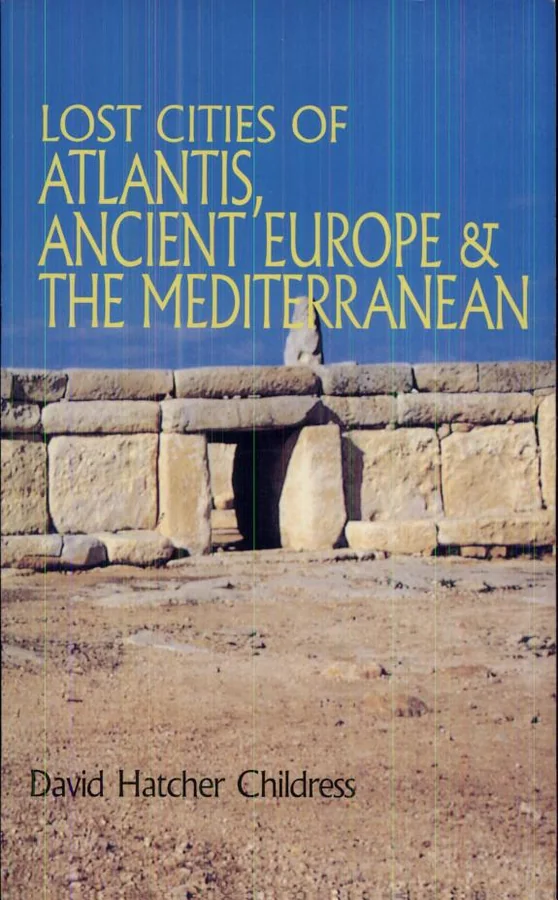
Lost Cities of Atlantis, Ancient Europe & the Mediterranean
 81
81

Lost Cities of Atlantis, Ancient Europe & the Mediterranean
Childress's persistent pursuit of Atlantis and its potential continental footprint across ancient Europe and the Mediterranean is commendable for its breadth. He courageously challenges established academic dogma, particularly regarding the timeline of advanced civilizations. The strength of the book lies in its extensive cataloging of anomalous sites and its synthesis of diverse geographical areas under a single speculative umbrella. However, the work occasionally suffers from an overabundance of assertion without sufficient empirical backing, a common pitfall in this genre. The section discussing megalithic sites in Ireland, for instance, presents intriguing possibilities but often relies on speculative links rather than concrete, universally accepted archaeological evidence. Despite these limitations, Childress provides a valuable compilation for those interested in the deeper, more mysterious layers of human history. It’s an energetic exploration that invites further, more rigorous investigation into the prehistoric past.
📝 Description
81
David Hatcher Childress questions accepted history by seeking Atlantis and other lost prehistoric civilizations.
In "Lost Cities of Atlantis, Ancient Europe & the Mediterranean," David Hatcher Childress investigates evidence for advanced prehistoric cultures. He focuses on the legend of Atlantis and its potential links to ancient settlements in Europe and the Mediterranean. The book challenges conventional timelines and archaeological assumptions, suggesting sophisticated societies existed long before accepted historical periods.
Childress examines megalithic structures, hints of advanced ancient technologies, and the role of prehistoric cataclysms in erasing early history. He proposes that regions like Ireland, Morocco, and the Black Sea may have hosted advanced societies that predated or influenced later civilizations. The work aims to re-evaluate the timeline of human development by connecting disparate sites through shared architectural styles and hypothesized engineering achievements.
This book is for readers interested in alternative histories and the Atlantis mythos. It appeals to those who question established narratives and are open to theories about lost civilizations, ancient technologies, and global cataclysms. Individuals fascinated by megalithic sites and unexplained ancient ruins will find Childress's arguments engaging.
This book fits within the esoteric tradition of searching for hidden histories and lost ancient wisdom. It aligns with authors who propose pre-diluvian civilizations and cyclical views of history, often challenging mainstream archaeological and historical consensus. The focus on Atlantis, megaliths, and forgotten technologies places it alongside works that explore ancient mysteries and the possibility of advanced societies predating recorded history, suggesting a continuity of esoteric thought across cultures and eras.
💡 Why Read This Book?
• Understand the geographical scope of Atlantis theories beyond Plato's description, exploring potential links from Ireland to Turkey, as detailed in Childress's regional surveys. • Learn about the proposed evidence for advanced prehistoric technologies and megalithic construction techniques that defy conventional explanations, as examined in his analysis of ancient sites. • Re-evaluate historical timelines by considering the impact of cataclysmic events on lost civilizations, a central theme explored throughout the book's exploration of Earth's deep past.
⭐ Reader Reviews
Honest opinions from readers who have explored this book.
❓ Frequently Asked Questions
What specific regions does David Hatcher Childress investigate in his search for Atlantis and related ancient civilizations?
Childress's research spans a wide geographical area, including Ireland, Morocco, Turkey, the Mediterranean islands, and Eastern Europe. He connects these diverse locations under the hypothesis of a widespread, ancient Atlantean influence or precursor civilization.
What is the primary argument Childress makes about ancient technology?
He argues that prehistoric civilizations possessed sophisticated technologies, possibly including advanced construction and engineering methods, far beyond what is typically acknowledged by mainstream archaeology. These technologies are often inferred from the scale and precision of megalithic structures.
How does the book explain the disappearance of these advanced civilizations?
The book frequently points to cataclysmic events, such as floods, earthquakes, or other geological upheavals, as the primary cause for the destruction and submergence of these advanced ancient cultures, leading to their subsequent obscurity.
Does Childress present Atlantis as a single continent or a broader cultural influence?
Childress explores both possibilities, presenting Atlantis not just as a physical landmass but also as a potential source of advanced knowledge and civilization that influenced cultures across Europe and the Mediterranean, leaving behind megalithic remnants.
What is the publication date of the original edition of 'Lost Cities of Atlantis, Ancient Europe & the Mediterranean'?
The original edition of David Hatcher Childress's 'Lost Cities of Atlantis, Ancient Europe & the Mediterranean' was first published in 1996.
What kind of evidence does Childress use to support his theories about lost civilizations?
He utilizes a combination of archaeological anomalies, megalithic site analysis, geological evidence of cataclysms, ancient myths and legends, and interpretations of historical texts to build his case for advanced prehistoric cultures.
🔮 Key Themes & Symbolism
The Atlantean Legacy
Childress posits that the legend of Atlantis is not mere myth but a historical echo of a highly advanced civilization that once dominated the Mediterranean and Atlantic regions. He connects disparate megalithic sites and ruins across continents, suggesting a common origin or influence. The work explores how remnants of Atlantean knowledge, technology, and culture might have survived cataclysms, seeding later civilizations or leaving enigmatic traces in places like Ireland and Morocco, challenging the orthodox view of a linear progression of human development.
Megalithic Enigmas
A significant portion of the book is dedicated to the analysis of megalithic structures found throughout ancient Europe and the Mediterranean. Childress examines sites like those in Ireland and Turkey, questioning how prehistoric peoples, with supposedly primitive tools, could have achieved such monumental feats of engineering and construction. He suggests these structures are evidence of sophisticated, possibly non-human or technologically advanced, ancient builders, pointing to a lost era of outstanding architectural prowess that predates conventional historical understanding.
Cataclysms and Lost Histories
Childress argues that global cataclysms, possibly occurring around 12,000 years ago or earlier, were responsible for the destruction and submergence of advanced prehistoric civilizations, including Atlantis. He interprets geological evidence and ancient flood myths as indicators of these devastating events. The book suggests that much of human history has been erased or buried by these natural disasters, and that our current understanding of the past is incomplete, omitting entire epochs of sophisticated human achievement.
Alternative Timelines
The work fundamentally challenges the established chronology of human civilization. By presenting evidence for advanced societies existing thousands of years before commonly accepted dates, Childress proposes a radically different timeline for human development. He suggests that major civilizations, including Atlantis, flourished and fell long before the rise of Sumeria or Ancient Egypt, and that their influence may have been far more pervasive than previously imagined, impacting cultures from the Atlantic to the Black Sea.
💬 Memorable Quotes
Direct passages from the work, attributed to the author.
“Mankind has a much longer and more complex history than we are taught in school.”
— This statement captures the core thesis of the book, asserting that conventional historical narratives are incomplete and that evidence of advanced ancient civilizations has been overlooked or suppressed, suggesting a richer, more ancient human past.
“The megalithic builders of Europe and the Mediterranean possessed a knowledge of engineering and astronomy that we are only beginning to understand.”
— This highlights Childress's focus on the impressive scale and precision of ancient stone structures, implying a sophisticated understanding of mathematics, physics, and celestial movements that surpasses current mainstream archaeological explanations for prehistoric capabilities.
“Cataclysmic events have repeatedly reshaped the Earth and erased the records of advanced ancient civilizations.”
— This interpretation underscores the book's explanation for why evidence of highly developed prehistoric cultures is scarce. It suggests that natural disasters played an important role in their demise and in obscuring their existence from modern historical accounts.
“Atlantis may not have been a single continent, but a network of advanced societies spread across the ancient world.”
— This broadens the concept of Atlantis beyond a literal island nation, suggesting it represented a globalized civilization or a foundational culture whose influence was felt across various regions, including those Childress investigates in Europe and North Africa.
“The evidence for ancient technology is often hidden in plain sight, dismissed as natural formations or primitive tools.”
— This points to Childress's method of re-examining archaeological sites and artifacts, arguing that conventional interpretations fail to recognize the sophistication of ancient peoples. He suggests that sophisticated ancient technology is present but often misinterpreted by modern scholars.
🌙 Esoteric Significance
Tradition
Childress's work draws implicitly from the Theosophical tradition, particularly the ideas of Helena Blavatsky regarding ancient root races and lost continents like Atlantis and Lemuria. While not explicitly adhering to Blavatsky's detailed cosmogenesis, he carries the concept of a highly advanced, ancient human civilization that predates recorded history and was destroyed by cataclysm. His exploration of 'lost cities' and ancient technologies aligns with the Theosophical interest in uncovering hidden histories and spiritual evolution of humanity.
Symbolism
The primary symbol Childress explores is the megalithic structure itself—whether standing stones, pyramids, or cyclopean walls. These are presented not just as architectural feats but as enduring symbols of a lost, advanced civilization and its connection to cosmic or terrestrial energies. The concept of Atlantis functions as a potent symbol of a lost golden age, a repository of forgotten wisdom and technology, representing humanity's potential for greatness tragically cut short by natural forces.
Modern Relevance
Childress's work continues to influence contemporary alternative history researchers, ancient astronaut theorists, and enthusiasts of esoteric archaeology. Thinkers exploring the Younger Dryas impact hypothesis, proponents of advanced ancient technologies, and those investigating proto-languages and global ancient networks often cite or build upon the geographical scope and historical challenges presented in his books. His work remains a foundational text for those seeking to reconstruct a more ancient and complex human past.
👥 Who Should Read This Book
• Enthusiasts of ancient mysteries and Atlantis lore: Readers captivated by the legend of Atlantis will find Childress's comprehensive geographical survey and his arguments for its tangible remnants across continents compelling. • Students of alternative history and archaeology: Those questioning mainstream historical timelines and seeking evidence for advanced prehistoric civilizations will appreciate the breadth of sites and theories presented. • Researchers of megalithic cultures: Individuals interested in the construction and purpose of ancient stone monuments worldwide will find Childress's analysis of these sites and his proposed explanations for their origins valuable.
📜 Historical Context
Published in 1996, David Hatcher Childress's work emerged during a period of renewed popular interest in Atlantis and fringe archaeology, fueled by figures like Erich von Däniken and the growing availability of information via early internet forums. This era saw a continued academic skepticism towards theories of advanced prehistoric civilizations, largely adhering to the established timelines that began with Sumeria around 4000 BCE. Competing schools of thought within archaeology emphasized gradual cultural diffusion and development. Childress's book positioned itself against this mainstream, aligning with alternative historical narratives that proposed much older, technologically advanced societies. While not a direct scholarly debate, his work engaged with the broader intellectual current questioning orthodox history, a current that persisted through figures like Graham Hancock and others who explored ancient mysteries and cataclysmic histories. The reception within academic circles was largely dismissive, as is common for works challenging foundational historical paradigms.
📔 Journal Prompts
The geographical spread of Atlantean influence as proposed by Childress.
Megalithic construction techniques and their potential implications for lost technologies.
The role of cataclysms in the destruction and preservation of ancient civilizations.
Reconciling Childress's alternative timelines with established historical records.
The symbolic meaning of Atlantis in the context of lost golden ages.
🗂️ Glossary
Atlantis
A legendary lost continent or civilization, often depicted as highly advanced, believed by some to have existed in antiquity and to have been destroyed by a cataclysm, with its legacy dispersed across the globe.
Megalithic Construction
The building of structures using large, undressed stones (megaliths), often found in prehistoric sites across Europe and the Mediterranean, characterized by their immense size and precise placement, prompting questions about ancient engineering capabilities.
Cataclysm
A violent, natural disaster of enormous proportions, such as a massive flood, earthquake, or volcanic eruption, believed by some theorists to have been responsible for the destruction of advanced ancient civilizations and the reshaping of the Earth's surface.
Prehistoric Technology
Refers to the tools, techniques, and knowledge attributed to civilizations predating written records. In the context of this book, it implies sophisticated engineering, construction, and potentially other advanced scientific or mechanical capabilities beyond conventional archaeological estimates.
Lost Civilization
An advanced society from the distant past that has disappeared, often due to catastrophic events, leaving behind enigmatic ruins, artifacts, or legends that suggest a higher level of development than previously acknowledged by mainstream history.
Mediterranean Basin
The region surrounding the Mediterranean Sea, encompassing Southern Europe, North Africa, and parts of the Middle East. Childress explores this area for evidence of ancient civilizations linked to the Atlantean hypothesis.
Atlantic Fringe
Refers to coastal regions bordering the Atlantic Ocean, particularly Western Europe (like Ireland) and North Africa, which Childress investigates as potential sites of Atlantean influence or precursor settlements.
This book appears in 1 collection
🔮 Readers Also Liked
Browse all →









From the “Atlantis” Collection
View all →








More Free Occult Philosophy Books
View all →