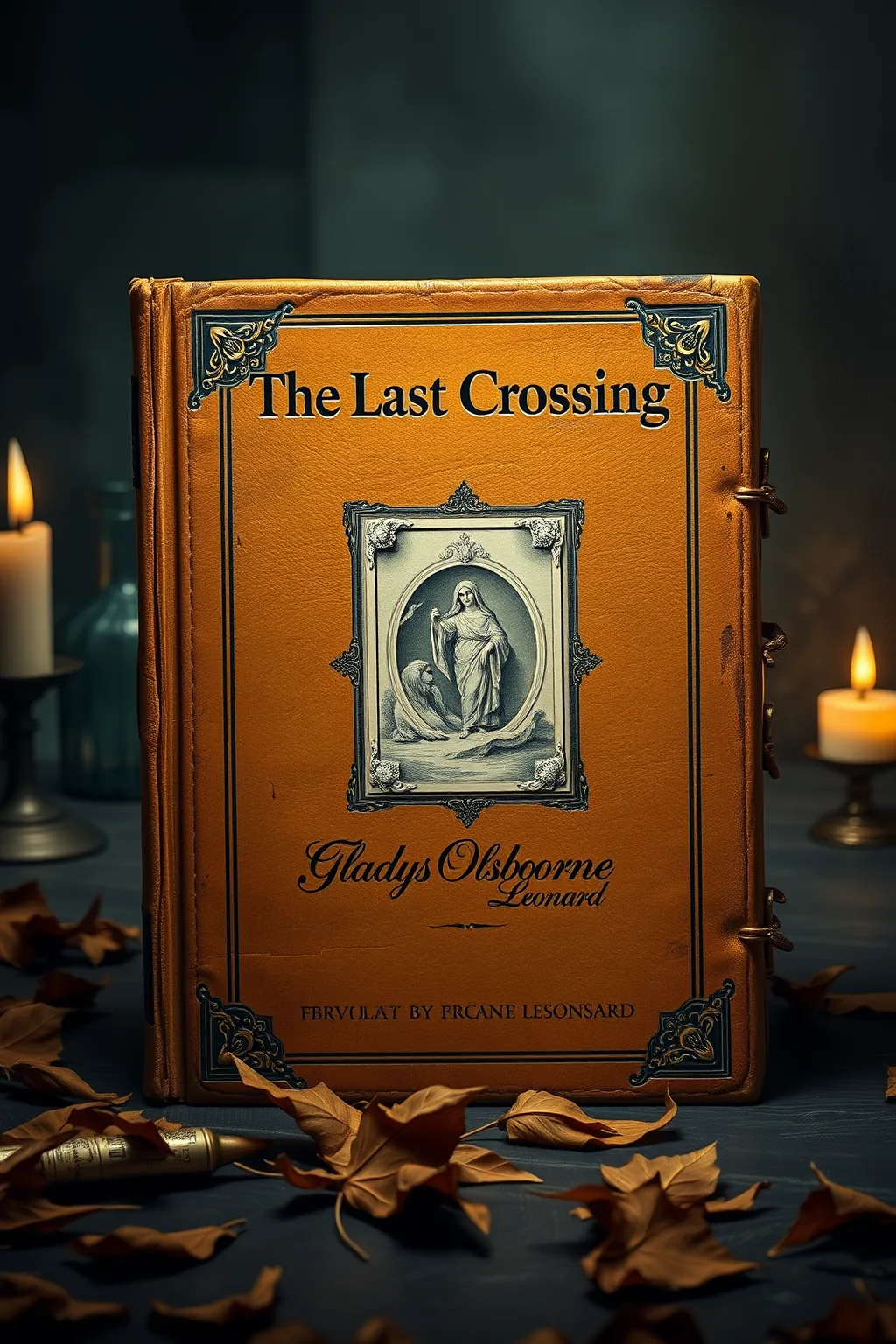
The Last Crossing
 72
72

The Last Crossing



Silas Hawthorne, Hermetic Studies Editor: Gladys Osborne Leonard's "The Last Crossing" remains a cornerstone of spiritualist literature, offering unparalleled insights into the mechanics of death and the immediate post-mortem experience. Leonard's decades of mediumistic practice lend an authority and authenticity rarely found. She masterfully blends empirical observation with profound spiritual understanding, demystifying the transition and presenting the afterlife as a coherent, albeit subtle, continuation of existence. This work is essential for serious students of consciousness, mediumship, and the perennial quest for understanding life's ultimate journey. A truly illuminating exploration.
📝 Description
72
Published in 1933, Gladys Osborne Leonard's 'The Last Crossing' details her experiences with spirit communication.
Gladys Osborne Leonard, known for her work as a trance medium, wrote 'The Last Crossing' in 1933. The book details her direct experiences with spirit communication and the transitional period between life and what she described as the afterlife. Leonard presents these phenomena not as abstract theories but as observed realities. She uses records from séances and her own observations to analyze the subtle shifts and changes individuals undergo at the point of death. The work aims to offer insights into what happens after passing, based on decades of her mediumistic practice. It is intended for readers interested in empirical accounts of consciousness beyond physical death.
Leonard's account focuses on the mechanics and experiences of what she termed the 'last crossing.' She sought to provide concrete examples and observations from her extensive work with alleged spirit communicators. The book documents specific instances and conversations, aiming to demystify the process of dying and the subsequent existence. It is a record of her personal findings and interpretations drawn from a long career of spiritualist investigation.
This book is part of the spiritualist movement that gained prominence in the mid-19th century. Spiritualism posits that the living can communicate with the spirits of the dead, often through mediums. 'The Last Crossing' fits within this tradition by documenting a medium's direct accounts and observations of the afterlife. It shares common ground with other spiritualist literature that seeks to provide evidence for survival of consciousness after bodily death and describes the nature of post-mortem existence.
✍️ Author
Gladys Osborne Leonard
Lydia Winterhalter Allison (September 14, 1880 – March 25, 1959), best known as Lydia W. Allison, was an American parapsychologist and writer.
💡 Why Read This Book?
Embark on a profound exploration of mortality and transcendence. "The Last Crossing" offers direct accounts of the afterlife from a pioneering medium, demystifying death and revealing the continuity of consciousness. Ideal for spiritual seekers, students of consciousness, and anyone yearning for deeper understanding of life's ultimate mystery.
⭐ Reader Reviews
Honest opinions from readers who have explored this book.
❓ Frequently Asked Questions
What is 'The Last Crossing' about?
It details the moment of dying and the immediate transition into the afterlife, as experienced and described by renowned trance medium Gladys Osborne Leonard through decades of spirit communication.
Who was Gladys Osborne Leonard?
A highly respected and influential trance medium of the early 20th century, known for her ability to channel spirits and provide detailed accounts of the spiritual realm.
Is this book religious?
While it touches on spiritual and metaphysical themes, it is primarily a factual account based on mediumistic experiences rather than adherence to any specific religious doctrine.
What kind of evidence does the book provide?
The book presents evidence through detailed séance transcripts, case examples of spirit communication, and Leonard's interpretive observations of the afterlife process.
Can this book help someone grieving?
Yes, by offering a comforting perspective on the continuity of life and the nature of the afterlife, it can provide solace and a sense of peace to those experiencing loss.
🔮 Key Themes & Symbolism
The Transition of Death
This theme studies the critical moment of passing, exploring the physiological and spiritual shifts that occur. Leonard's detailed descriptions, gleaned from direct observation via mediumship, offer a nuanced understanding of how consciousness detaches from the physical form. It examines the initial sensations, the disorientation, and the gradual acclimatization to a non-physical state, providing a profound redefinition of death as a transition rather than an ending.
The Lived Reality of the Afterlife
Contrary to ethereal notions, Leonard presents the afterlife as a vibrant, structured existence. This theme focuses on the tangible aspects of the spiritual realm, including its environments, the presence of spirit guides, and the continuation of personal identity and relationships. Through vivid accounts, the book illustrates that life in the spirit world is active and purposeful, offering a comforting counterpoint to the fear of oblivion and emphasizing the enduring nature of the soul.
Spirit Communication and Mediumship
At the heart of 'The Last Crossing' lies the practice and wide implications of spirit communication. This theme explores the mechanics and ethics of mediumship, the challenges and triumphs of bridging the veil between worlds, and the nature of messages conveyed. Leonard's own experiences as a celebrated medium provide a unique window into the intricate dialogue between the living and the departed, highlighting the potential for guidance, healing, and spiritual growth through such connections.
💬 Memorable Quotes
Direct passages from the work, attributed to the author.
“The spirit body is a vestige of the physical, yet infinitely more subtle.”
— Leonard describes the form taken in the afterlife, suggesting a continuity but also an evolution of the self beyond material limitations.
“We are never truly alone; the veil is thin for those who know how to perceive.”
— This highlights the constant presence of the spiritual realm and the potential for connection, emphasizing awareness and openness.
“Love is the eternal currency of the spirit realms.”
— A profound statement on the nature of spiritual existence, suggesting that love is the fundamental force and value in the afterlife.
💡 Key Ideas
Editorial paraphrase of the work's core concepts — not direct quotes.
Death is not an ending, but a doorway.
This quote expresses the book's core message, reframing death as a transition into a new phase of existence, rather than a cessation of being.
The greatest journey begins when the physical journey ends.
This quote emphasizes the transformative and expansive nature of the post-mortem experience, positioning it as a significant and ongoing adventure.
🌙 Esoteric Significance
Tradition
While deeply rooted in the Spiritualist tradition, "The Last Crossing" intersects with broader esoteric currents such as Theosophy and Neoplatonism by exploring the nature of consciousness, reincarnation (implicitly), and the layered realities of existence beyond the material plane. It offers a practical, experiential dimension to metaphysical inquiries, grounded in direct psychic phenomena.
Symbolism
The 'crossing' itself is a potent symbol of transition, akin to the river Styx or a spiritual initiation. The descriptions of spirit guides and the organization of the afterlife employ archetypal imagery, reflecting humanity's enduring need to make sense of the unknown through familiar patterns. The book implicitly uses the symbolism of light and shadow to depict spiritual awareness and ignorance.
Modern Relevance
In an age increasingly focused on scientific materialism, "The Last Crossing" offers a vital counter-narrative, reminding us of the enduring mysteries of consciousness and the potential for realities beyond our current empirical grasp. Its insights into the continuity of self and the nature of spiritual existence remain relevant for contemporary discussions on consciousness studies, near-death experiences, and the philosophical implications of life after death.
👥 Who Should Read This Book
This work is useful for spiritual seekers yearning for concrete understanding of the afterlife. Scholars of parapsychology and consciousness will find Leonard's empirical approach foundational. Practitioners of spiritual disciplines and those interested in mediumship will gain clear insights into the mechanics and ethics of spirit communication. For anyone grappling with the existential questions surrounding death, 'The Last Crossing' offers a comforting, evidence-based perspective, useful the path beyond mortal existence.
📜 Historical Context
Published in 1939, "The Last Crossing" emerged during a period of intense interest in Spiritualism and the afterlife, fueled by the aftermath of World War I and a widespread desire for communion with lost loved ones. The era saw a flourishing of séances, psychical research societies, and prolific writings on spirit phenomena. Gladys Osborne Leonard was a prominent figure within this movement, her decades of mediumistic work lending significant weight to the discourse. This book, therefore, is not just a personal account but a significant artifact of a cultural moment grappling with mortality and seeking solace and understanding through the exploration of the unseen realms.
📔 Journal Prompts
Reflect on your personal beliefs about the moment of death. How does Leonard's description align or contrast with your own imaginings?
Consider the concept of a 'spirit body.' What qualities do you imagine it possessing, and how might it differ from our physical form?
Write about a time you felt a strong connection to someone who has passed. What did that experience feel like, and how does it relate to Leonard's descriptions of spirit communication?
Explore the idea of the afterlife as a 'lived reality.' What aspects of your current life would you hope to continue or transform in a spiritual existence?
What fears or hopes does the concept of 'The Last Crossing' evoke in you? Journal your immediate emotional and intellectual responses.
🗂️ Glossary
Trance Medium
An individual who enters a dissociated state, allowing a spirit entity to communicate through them, often characterized by altered voice, mannerisms, and knowledge beyond the medium's normal awareness.
Spirit Communication
The process by which individuals believe they can interact with the consciousness of deceased persons, typically facilitated by a medium.
Liminal Space
A transitional phase or state, particularly the threshold between life and death, or between the physical and spiritual realms.
Séance
A meeting where people attempt to make contact with the spirits of the dead, often involving a medium and specific rituals.
Continuity of Consciousness
The philosophical and spiritual concept that consciousness persists beyond the death of the physical body, suggesting an enduring self.
This book appears in 2 collections
🔮 Readers Also Liked
Browse all →
From the “Spiritualism” Collection
View all →






More Free Spiritualism & Afterlife Books
View all →