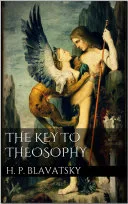
The Key to Theosophy
 79
79

The Key to Theosophy
Blavatsky's 'The Key to Theosophy' succeeds admirably in its stated goal of acting as an introductory primer. The chapter "What is Karma?" offers a refreshingly direct explanation of a concept often obscured by New Age interpretations. However, the work's earnest attempt at clarity sometimes falters under the weight of its own esoteric subject matter, occasionally resorting to jargon that, while defined, can still be dense for a complete novice. The structure, a series of questions and answers, proves effective for addressing specific doubts. While it doesn't claim exhaustive coverage, it provides a solid, if challenging, initial map for those venturing into Theosophical thought. It remains a foundational text for understanding Blavatsky's unique synthesis of Eastern and Western mysticism.
📝 Description
79
Helena Blavatsky published The Key to Theosophy in 1889 to explain the core ideas of the Theosophical Society.
The Key to Theosophy is Helena Blavatsky's 1889 introductory text designed to clarify the fundamental principles of Theosophy for a Western audience. Blavatsky sought to make the complex doctrines of the "Wisdom Religion" understandable to those unfamiliar with Eastern metaphysics or spiritual concepts. The book addresses common objections and questions, aiming for clarity and accessibility. It was written during a time of growing Western interest in spiritualism and Eastern thought, serving as Blavatsky's effort to articulate the Theosophical Society's teachings. The work presents an alternative to both materialistic science and established religious doctrines of the era.
Blavatsky's intention was not to create an exhaustive treatise, but rather a guide for newcomers. She discusses concepts such as karma, reincarnation, the nature of spirit, and the idea of ancient esoteric traditions. The book also touches upon the concept of a universal spiritual hierarchy and the potential for human spiritual advancement through understanding these principles. It acts as a primer on the foundational elements of her philosophical system.
Published in 1889, The Key to Theosophy emerged from the Theosophical Society, a movement that sought to synthesize Western occultism with Eastern philosophies like Hinduism and Buddhism. Blavatsky herself was a central figure in this syncretic trend, aiming to revive ancient wisdom traditions and present them in a form accessible to the modern West. The book positions itself against the prevailing materialism of the late 19th century, advocating for a spiritual understanding of the cosmos and humanity's place within it. It draws upon concepts found in Neoplatonism, Hermeticism, and various Eastern mystical systems.
💡 Why Read This Book?
• Understand the core principles of karma and reincarnation as presented by H.P. Blavatsky, moving beyond popular interpretations to grasp their role in spiritual evolution, as explored in "What is Karma?" • Gain clarity on the nature of the human spiritual constitution and the concept of the "Higher Self," crucial elements for deciphering Blavatsky's esoteric framework. • Explore the foundational ideas of the Theosophical Society, established in 1875, and how Blavatsky sought to present an alternative spiritual philosophy to the Western world.
⭐ Reader Reviews
Honest opinions from readers who have explored this book.
❓ Frequently Asked Questions
What is the main purpose of H.P. Blavatsky's 'The Key to Theosophy'?
The book serves as an accessible introduction to the fundamental concepts of Theosophy, aiming to clarify its principles for Western readers and address common questions and objections, rather than offering a complete textbook.
When was 'The Key to Theosophy' first published?
'The Key to Theosophy' was first published in 1889, a period when Blavatsky was actively disseminating Theosophical ideas.
Does 'The Key to Theosophy' explain complex esoteric terms?
Yes, the book is structured as a Q&A to define and explain key Theosophical terms and concepts, such as karma, reincarnation, and the different planes of existence, in a relatively simplified manner.
Who is the intended audience for 'The Key to Theosophy'?
The book is primarily intended for individuals in the West who are curious about spiritual and metaphysical subjects but may find traditional Theosophical teachings complex or unfamiliar.
What is the 'Wisdom Religion' mentioned in the book?
The 'Wisdom Religion' refers to the ancient, universal spiritual tradition that Blavatsky believed underpinned all world religions, and which Theosophy sought to revive and explain.
Is 'The Key to Theosophy' a good starting point for beginners?
Yes, it is widely considered a foundational text for beginners seeking to understand the basic philosophy and aims of the Theosophical movement as articulated by H.P. Blavatsky.
🔮 Key Themes & Symbolism
The Wisdom Religion
Blavatsky posits the existence of a singular, ancient 'Wisdom Religion' from which all other faiths derive their essential truths. This primordial knowledge, she argues, was once universally understood but has become obscured over millennia. 'The Key to Theosophy' endeavors to unveil these core principles, presenting Theosophy not as a new religion, but as the underlying spiritual science connecting humanity, nature, and the cosmos. It emphasizes universal brotherhood and the perennial truths found across diverse spiritual traditions.
Karma and Reincarnation
Central to Blavatsky's teachings are the concepts of Karma and reincarnation, presented as immutable laws governing existence. Karma is depicted as the law of cause and effect, where every action generates consequences that shape an individual's present and future lives. Reincarnation is the mechanism through which souls experience these consequences, evolving through successive lifetimes. The book clarifies these principles as fundamental to understanding spiritual progression and the interconnectedness of all beings.
The Nature of Man
Blavatsky explores the complex constitution of the human being, often described as a composite of several principles or bodies, ranging from the physical to the purely spiritual. She differentiates between the personal, lower self and the immortal, divine Higher Self. Understanding this multi-faceted nature is presented as crucial for spiritual development, enabling individuals to transcend earthly limitations and realize their inherent divinity through the process of evolution.
Objections and Clarifications
A significant portion of 'The Key to Theosophy' is dedicated to addressing common Western objections and misunderstandings regarding Theosophical ideas. Blavatsky directly confronts skepticism about concepts like reincarnation, the existence of spiritual hierarchies, and the possibility of esoteric knowledge. This Q&A format aims to explain the teachings, making them more palatable and comprehensible to a skeptical audience by providing reasoned explanations and philosophical arguments.
💬 Memorable Quotes
Direct passages from the work, attributed to the author.
“Theosophy is a synthesis of science, philosophy, and religion.”
— This statement expresses Blavatsky's ambition to present Theosophy as a comprehensive system that harmonizes the findings of empirical science, the logical structures of philosophy, and the spiritual aspirations of religion.
“Karma is not a system of reward and punishment, but the impersonal law of cause and effect.”
— This clarifies that karmic consequences are not divine judgments but natural outcomes of one's actions, emphasizing a mechanistic and ethical understanding of universal justice.
“Man is a spiritual being, temporarily clothed in a physical body.”
— This highlights the essential spiritual nature of humanity, suggesting that the physical form is transient and secondary to the eternal, evolving soul.
“The Masters are not mythical beings but advanced human adepts.”
— This addresses the concept of spiritual teachers within Theosophy, asserting their tangible existence as individuals who have achieved a high degree of spiritual evolution.
“Reincarnation provides the framework for spiritual evolution across lifetimes.”
— This explains reincarnation not merely as rebirth, but as a necessary process for the soul's gradual development and purification through multiple terrestrial experiences.
🌙 Esoteric Significance
Tradition
Theosophy, as presented in this work, draws heavily from Neoplatonism, Hermeticism, Kabbalah, and Eastern Dharmic religions (Hinduism and Buddhism). Blavatsky framed it as a revival of the ancient 'Wisdom Religion,' a perennial philosophy she believed underpinned all world faiths. 'The Key to Theosophy' serves as a foundational text for this modern esoteric tradition, attempting to reconcile spiritual teachings with scientific inquiry, a departure from more purely mystical or religious approaches.
Symbolism
The book implicitly references universal archetypes rather than focusing on specific, codified symbols. Concepts like the 'chain of being' (representing cosmic hierarchy and evolution), the duality of the lower personality versus the divine Higher Self, and the cyclical nature of existence (karma and reincarnation) function as symbolic frameworks for understanding spiritual realities and the human condition.
Modern Relevance
Blavatsky's synthesis continues to influence contemporary esoteric thought. Modern New Age movements, various forms of Western Esotericism, and even some philosophical discussions on consciousness and cosmology often trace their lineage or conceptual frameworks back to Theosophical ideas introduced in works like this. Thinkers exploring perennial philosophy and comparative spirituality frequently cite Blavatsky's foundational role.
👥 Who Should Read This Book
• Students of comparative religion and philosophy seeking to understand the origins and core tenets of the Theosophical movement and its influence on Western esotericism. • Inquirers interested in Eastern concepts like karma and reincarnation, who desire a foundational explanation grounded in Blavatsky's specific interpretations and philosophical arguments. • Those exploring alternative spiritual frameworks who wish to engage with a historically significant text that attempted to bridge Eastern and Western metaphysical thought in the late 19th century.
📜 Historical Context
Published in 1889, 'The Key to Theosophy' emerged during a fertile period for occult and spiritual exploration in the West. Theosophy, co-founded by Helena Blavatsky and Henry Steel Olcott in 1875, sought to synthesize Eastern philosophies (particularly Hinduism and Buddhism) with Western esoteric traditions, challenging the materialist worldview prevalent in Victorian science. Blavatsky's work coincided with the rise of spiritualism and theosophical societies across Europe and America. It engaged with intellectual currents influenced by figures like Arthur Schopenhauer and the burgeoning interest in comparative religion. While lauded by adherents, Theosophy also faced significant criticism and skepticism, notably from scientific circles and established religious institutions, with figures like theologian and critic J.D. Bucke engaging with its claims.
📔 Journal Prompts
The concept of the "Wisdom Religion" as an ancient, universal source of truth.
The impersonal nature of Karma as a law of cause and effect.
The seven principles of Man and their relationship to spiritual evolution.
The role of the "Higher Self" in guiding personal spiritual development.
Theosophy's approach to reconciling science, philosophy, and religion.
🗂️ Glossary
Theosophy
A philosophical and religious movement founded in the 19th century, seeking to understand the divine nature of reality and the place of humanity within it, often through the study of ancient wisdom traditions.
Karma
The Sanskrit term for the universal principle of cause and effect, where every action has a consequence that influences an individual's present and future experiences, often across multiple lifetimes.
Reincarnation
The process by which a soul or spiritual essence passes into a new physical body after biological death, continuing its evolutionary journey through successive lives.
Adepts
Individuals who have attained a high level of spiritual development and mastery over their lower nature, often referred to as Masters in Theosophical literature.
Manvantara
In Theosophical cosmology, a period of existence or a 'world-period,' representing a vast cycle of creation and dissolution, much longer than a human lifetime.
Dhyan Chohans
Cosmic intelligences or celestial beings described in Theosophy as guiding the processes of evolution and maintaining cosmic order.
Higher Self
The divine, immortal aspect of the human being, often contrasted with the lower, personal self, representing the ultimate spiritual potential and true nature.