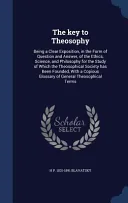
The Key to Theosophy
 71
71

The Key to Theosophy
Helena Blavatsky's 'The Key to Theosophy' presents a formidable challenge, not for its prose, which is often direct and explanatory, but for the sheer density of its metaphysical architecture. The book functions as a catechism for the nascent Theosophical movement, meticulously outlining its cosmology and ethics. Blavatsky’s strength lies in her ability to articulate complex ideas, such as the seven principles of man, with a structured, almost scientific, approach that aimed to lend gravitas to her esoteric system. However, the work occasionally suffers from a polemical tone, particularly when addressing established religions or scientific materialism of her era, which can feel dated to a contemporary reader. A particularly illuminating section details the concept of Karma, explaining it not as fatalistic punishment but as an impersonal, unerring law of cause and effect governing spiritual evolution. While the book demands significant intellectual engagement, its attempt to synthesize Eastern spiritual wisdom with Western philosophical inquiry remains a notable historical contribution. It is an essential, if demanding, text for understanding the roots of modern esoteric thought.
📝 Description
71
Helena Blavatsky published 'The Key to Theosophy' in 1889 to explain the core tenets of her movement.
Published in 1889, Helena Blavatsky's 'The Key to Theosophy' is a systematic explanation of the Theosophical Society's principles. It was written to clarify complex metaphysical and ethical doctrines for a Western audience then encountering new spiritual and scientific ideas. The book addresses fundamental questions about reality, humanity's place in the universe, and spiritual development, drawing on Eastern philosophies and esoteric traditions.
This work is aimed at serious students of comparative religion, esoteric philosophy, and Western occultism. It is particularly useful for understanding the origins and foundational beliefs of Theosophy, a movement that later influenced New Age and spiritualist thought. Readers interested in the intersection of science, religion, and mysticism in the late 19th century will find substantial material. The exposition is detailed, though it can be dense.
Emerging in the late 1800s, Theosophy sought to synthesize science, religion, and philosophy, presenting itself as a revival of ancient wisdom. Blavatsky and her co-founders aimed to address a perceived spiritual void in Western society. The movement engaged with figures like Annie Besant and faced criticism from established religious and scientific circles. Its publication coincided with a growing European and American interest in Eastern religions and spiritualism.
💡 Why Read This Book?
• Understand the Seven Principles of Man as detailed in the text, which provides a framework for human consciousness beyond the physical body, offering a unique model of psycho-spiritual anatomy. • Grasp the Theosophical interpretation of Karma and Reincarnation, moving beyond simplistic notions to see them as the engine of cosmic evolution and personal development, as explained in Chapter V. • Explore the concept of the 'Great White Brotherhood' as presented by Blavatsky, learning about the role attributed to spiritual Masters in guiding humanity's progress, a core tenet shaping esoteric movements.
⭐ Reader Reviews
Honest opinions from readers who have explored this book.
❓ Frequently Asked Questions
What is the primary goal of Theosophy as explained in 'The Key to Theosophy'?
The book states the primary goals are to form a nucleus of Universal Brotherhood, encourage the study of comparative religion, and investigate unexplained laws of nature and psychic powers latent in humanity.
When was 'The Key to Theosophy' first published, and by whom?
'The Key to Theosophy' was first published in 1889 by Helena Petrovna Blavatsky, a pivotal figure in the Theosophical movement.
Does the book discuss reincarnation and karma?
Yes, the book dedicates significant attention to explaining reincarnation and karma as fundamental laws governing the cycle of existence and the evolution of consciousness.
Is 'The Key to Theosophy' considered a primary source for Theosophical teachings?
Absolutely. It is considered one of Blavatsky's most direct expositions of Theosophical philosophy, intended to clarify its core doctrines for a wider audience.
What is the 'Great White Brotherhood' mentioned in the book?
The book describes the Great White Brotherhood as a group of highly evolved spiritual teachers or Masters who guide humanity's spiritual evolution from behind the scenes.
Is this book available in the public domain?
Yes, 'The Key to Theosophy' is in the public domain in the United States, allowing for its wide dissemination and study.
🔮 Key Themes & Symbolism
The Seven Principles of Man
Blavatsky meticulously outlines the human constitution as comprising seven distinct principles, extending far beyond the physical body. These range from the physical form (Sthula Sharira) to the higher spiritual aspects (Atma, Buddhi). This layered understanding is crucial for grasping Theosophical concepts of reincarnation and spiritual evolution, suggesting that human existence is a complex interplay of material and immaterial elements, each playing a role in the soul's journey through various lifetimes and states of consciousness.
Karma and Reincarnation
This work presents Karma not as arbitrary fate, but as the immutable law of ethical causation. Every action, thought, and intention creates ripples that determine future experiences, both in this life and subsequent incarnations. Reincarnation is the vehicle through which this law operates, providing opportunities for the spiritual self to learn, evolve, and ultimately achieve liberation from the cycle of birth and death. The book emphasizes personal responsibility within this cosmic framework.
Universal Brotherhood
A central tenet of Theosophy, the concept of Universal Brotherhood is presented as the practical application of understanding humanity's interconnectedness. The book argues that beneath superficial differences of race, creed, or sex lies a fundamental spiritual unity. Fostering this brotherhood is seen as essential for the elevation of consciousness and the harmonious progress of all beings, forming the primary objective of the Theosophical Society.
The Nature of Deity and Masters
Blavatsky discusses a formless, unmanifest Absolute Principle (often referred to as Parabrahman) as the ultimate source of all existence, moving away from anthropomorphic deities. Simultaneously, the text introduces the concept of the Great White Brotherhood—a hierarchy of enlightened beings, or Masters, who have attained spiritual perfection and work to guide humanity's evolution. These Masters are presented as tangible, albeit hidden, guides accessible through dedicated spiritual practice.
💬 Memorable Quotes
Direct passages from the work, attributed to the author.
“The Theosophical Society has three fundamental objects.”
— This statement introduces the core mission of the society, highlighting its structured approach to promoting spiritual and intellectual advancement across humanity.
“Karma is the unerring, unerring law which binds all beings.”
— This emphasizes the impersonal and universal nature of karmic law, framing it as a fundamental principle governing existence rather than a form of divine judgment.
“Man is not one, but seven.”
— This concise statement points to the complex, multi-layered nature of human constitution as understood in Theosophy, comprising physical, vital, astral, mental, and spiritual elements.
“The Masters are men who have passed through the cycle of evolution.”
— This clarifies the nature of the spiritual guides within Theosophy, presenting them as perfected human beings rather than supernatural entities, accessible through spiritual attainment.
“We are all brothers and sisters of the human family.”
— This expresses the foundational ideal of Universal Brotherhood, underscoring the inherent unity and interconnectedness of all people regardless of external distinctions.
🌙 Esoteric Significance
Tradition
Theosophy, as presented by Blavatsky, draws heavily from esoteric interpretations of Eastern religions (Hinduism, Buddhism) and Western Hermeticism, Kabbalah, and Neoplatonism. 'The Key to Theosophy' functions as a foundational text for the Theosophical tradition itself, attempting to synthesize these diverse streams into a coherent modern esoteric philosophy. It departs from purely Western traditions by its explicit incorporation of concepts like Karma and Reincarnation as central organizing principles.
Symbolism
Key symbols include the 'Circle and Swastika' (or 'Circle and Interlocking Triangles'), representing the eternal cycle of existence and the interplay of divine and human principles. The concept of the 'Seven Principles of Man' itself acts as a symbolic map of consciousness, detailing the different planes of being. The 'Lotus' is also a recurring motif, symbolizing spiritual unfoldment and the emergence of higher consciousness from the material world.
Modern Relevance
Theosophy's emphasis on Universal Brotherhood, reincarnation, and the interconnectedness of all life has profoundly influenced the New Age movement and contemporary spiritual thought. Modern practitioners of comparative religion, alternative spirituality, and consciousness studies often reference Blavatsky's work. Concepts like subtle bodies, karma, and the idea of Masters continue to be explored in various esoteric circles and personal development philosophies.
👥 Who Should Read This Book
['• Students of esoteric philosophy: Those seeking a comprehensive overview of the foundational principles of Theosophy, including its cosmology and ethics, directly from one of its principal founders.', '• Researchers of comparative religion: Individuals interested in how Eastern spiritual concepts (like Karma and Reincarnation) were adapted and presented to a Western audience in the late 19th century.', '• Inquirers into spiritual movements: Readers curious about the origins and core doctrines of Theosophy, which significantly shaped later spiritual and New Age thought in the 20th century.']
📜 Historical Context
Published in 1889, 'The Key to Theosophy' emerged during a period of intense spiritual and intellectual upheaval in the West. The late 19th century witnessed both the ascendancy of scientific materialism, exemplified by Darwinian evolution, and a concurrent surge of interest in spiritualism, mesmerism, and Eastern religions. Helena Blavatsky, along with Henry Steel Olcott, founded the Theosophical Society in 1875 to offer a 'synthesis of science, religion, and philosophy,' aiming to provide a spiritual alternative. The movement engaged with and often challenged established Christian theology and Western scientific dogma. Contemporary figures like Annie Besant would later become prominent leaders within the society. Theosophy's claims regarding ancient wisdom and hidden spiritual hierarchies drew both fervent adherents and significant skepticism, with critics often questioning the authenticity of Blavatsky's claimed sources and experiences.
📔 Journal Prompts
The concept of the Seven Principles of Man: How might these principles inform your understanding of your own experiences?
Reflect on the law of Karma as presented in Chapter V. What are its implications for personal responsibility?
Consider the ideal of Universal Brotherhood. How can this ideal be practically applied in contemporary society?
The book discusses the 'Great White Brotherhood.' What does this concept suggest about spiritual guidance and evolution?
Analyze the Theosophical view of Deity. How does it differ from traditional Western religious concepts?
🗂️ Glossary
Theosophy
A system of esoteric philosophy and speculative theology aiming to reconcile science, religion, and philosophy, often drawing upon Eastern wisdom traditions.
Karma
The universal principle of cause and effect, ethical causation, and the law of consequences that governs the cycle of rebirth and spiritual evolution.
Reincarnation
The process by which a soul or consciousness is reborn into a new physical body after death, serving as a mechanism for karmic progression and spiritual development.
Manvantara
A period of cosmic manifestation or a 'day of Brahma,' representing a cycle of existence within the larger cosmic scheme, followed by a Pralaya.
Pralaya
A period of cosmic dissolution or rest, occurring between Manvantaras, during which the universe is withdrawn before a new cycle of manifestation begins.
Atma
The highest spiritual principle in the human constitution, often translated as the 'Self' or the divine spark, identical with the Universal Spirit.
Sthula Sharira
The physical body, considered the lowest and most material of the seven principles of man in Theosophical doctrine.