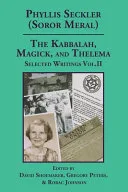
The Kabbalah, Magick, and Thelema. Selected Writings Volume II
 71
71

The Kabbalah, Magick, and Thelema. Selected Writings Volume II
Phyllis Seckler’s ‘The Kabbalah, Magick, and Thelema: Selected Writings Volume II’ offers a rigorous, if at times dense, comparative study. Seckler’s strength lies in her meticulous charting of conceptual overlaps between Kabbalistic cosmology and Thelemic philosophy, particularly evident in her discussion of the Sephiroth and their corresponding magickal correspondences. She navigates these complex systems with a scholar's precision. However, the collection occasionally feels fragmented, with the transitions between essayistic sections not always seamless, leaving the reader to bridge some conceptual gaps independently. A particularly illuminating passage details the correspondences between specific Hebrew letters and stages of magickal attainment, highlighting Seckler's unique ability to synthesize diverse symbolic languages. The work serves as a valuable, albeit challenging, resource for advanced students of Western esotericism.
📝 Description
71
Phyllis Seckler's 'The Kabbalah, Magick, and Thelema: Selected Writings Volume II' gathers her essays on mysticism from 2020.
This volume collects Phyllis Seckler's essays, published initially in 2020, that examine the connections and differences between Kabbalistic thought, ceremonial magick, and Aleister Crowley's Thelema. Seckler's work assumes a reader already familiar with basic Kabbalah and magickal theory. It aims to illuminate the theoretical structures and practical uses of these traditions, as understood from a contemporary viewpoint.
For those interested in comparing mystical systems or tracking the development of occult ideas, this book offers significant material for reflection. Seckler's writings come from a time when occultism experienced renewed interest, both academically and popularly, in the late 20th and early 21st centuries. Her contributions lie in how she brings together these related yet distinct systems of thought.
Seckler's writings engage with the legacy of figures like Aleister Crowley and the philosophical systems that shaped him. This collection sits within the study of Western esotericism, a field that gained more scholarly attention following Gershom Scholem's work on Kabbalah. Seckler's approach is notable for its synthesis of these interconnected systems.
💡 Why Read This Book?
• Gain a nuanced understanding of how Kabbalistic concepts, such as the Sephiroth, are reinterpreted and applied within the magickal framework of Thelema, as explored in Seckler's detailed analyses. • Discover specific correspondences between Kabbalistic pathways on the Tree of Life and ceremonial magickal practices, offering concrete examples of esoteric synthesis. • Appreciate a scholarly perspective on the evolution of occult thought, contextualizing Seckler's work within the lineage of figures like Aleister Crowley and early 20th-century esoteric movements.
⭐ Reader Reviews
Honest opinions from readers who have explored this book.
❓ Frequently Asked Questions
What is the primary focus of Phyllis Seckler's 'The Kabbalah, Magick, and Thelema: Selected Writings Volume II'?
This volume primarily focuses on the intersections and divergences between Kabbalistic mysticism, ceremonial magick, and the philosophy of Thelema, as established by Aleister Crowley.
When was Phyllis Seckler's 'The Kabbalah, Magick, and Thelema: Selected Writings Volume II' first published?
The book was first published in November 2020, consolidating Seckler's selected writings on these esoteric subjects.
Who are the key figures or traditions discussed in relation to Seckler's work?
The book engages significantly with Kabbalah, ceremonial magick, and the Thelemic system, often referencing Aleister Crowley and the broader Hermetic tradition.
Is this book suitable for beginners in esoteric studies?
While informative, the book assumes a foundational understanding of Kabbalah and magickal theory, making it more suitable for intermediate to advanced students.
What makes Seckler's approach unique compared to other works on these topics?
Seckler's approach is noted for its detailed comparative analysis, mapping specific Kabbalistic concepts onto magickal practices and Thelemic philosophy with scholarly rigor.
Does the book offer practical magickal instruction?
The book focuses more on the theoretical and philosophical underpinnings, exploring concepts and correspondences rather than providing step-by-step practical instructions for rituals.
🔮 Key Themes & Symbolism
Kabbalah and Thelemic Synthesis
This theme examines how Seckler bridges the ancient Kabbalistic Tree of Life with the modern system of Thelema. She explores the Sephiroth and Paths not just as symbolic maps but as active principles within magickal practice. The work highlights how concepts like Kether and Malkuth find resonance and reinterpretation within Crowley's philosophy, offering a unique perspective on the continuity and evolution of Western esoteric thought. It's an analysis of how foundational mystical structures inform later occult developments.
Ceremonial Magick Correspondences
Seckler meticulously details the correspondences between elements of ceremonial magick and Kabbalistic structures. This includes mapping planetary, elemental, and astrological correspondences to specific Sephiroth and Paths on the Tree of Life. The book looks at how these correspondences function not merely as mnemonic devices but as integral components of magickal operations, enabling practitioners to direct subtle energies by aligning their work with cosmic patterns.
Thelema as Esoteric Framework
This section focuses on the philosophical and ethical tenets of Thelema as presented by Seckler, often in dialogue with Kabbalistic ideas. It discusses the Law of Thelema ('Do what thou wilt shall be the whole of the Law') and its relation to concepts of divine will and individual destiny found in Kabbalistic literature. Seckler analyzes how Thelemic cosmology offers a distinct yet related path to understanding the universe and humanity's place within it.
Comparative Esotericism
The overarching theme involves comparing and contrasting various esoteric traditions to reveal underlying unities and specific divergences. Seckler's work serves as a case study in comparative mysticism, demonstrating how different symbolic languages and philosophical systems can address similar existential and spiritual questions. This comparative approach encourages a deeper appreciation for the rich diversity and interconnectedness within the broader field of occult studies.
💬 Memorable Quotes
Direct passages from the work, attributed to the author.
“The Tree of Life is not merely a diagram of cosmic structure but a dynamic map for the soul's ascent.”
— This interpretation emphasizes the active, experiential nature of the Kabbalistic Tree of Life, suggesting it's a practical guide for spiritual development rather than just a theoretical model.
“Thelemic Will requires a rigorous understanding of one's true nature, akin to Kabbalistic self-knowledge.”
— This highlights the necessity for self-awareness and inner discipline in fulfilling one's True Will, drawing a parallel to the Kabbalistic emphasis on understanding one's place in the divine order.
“Magickal correspondences serve as keys, unlocking specific energetic potentials within the practitioner and the cosmos.”
— This suggests that the detailed mapping of correspondences in ceremonial magick is not arbitrary but a functional system for accessing and manipulating occult forces.
“Exploring the links between Kabbalah and Thelema reveals a continuous thread in Western esoteric tradition.”
— This points to the idea that seemingly distinct esoteric systems may share common origins or influences, forming a cohesive, evolving lineage of mystical thought.
“The adept must integrate both the analytical framework of Kabbalah and the volitional impulse of Thelema.”
— This emphasizes the need for both intellectual understanding and active application of will in advanced magical and spiritual practice.
🌙 Esoteric Significance
Tradition
This work is firmly rooted in the Western Esoteric Tradition, specifically engaging with Hermeticism, Kabbalah, and ceremonial magick. It represents a modern attempt to synthesize and clarify the relationships between these distinct yet interconnected lineages. Seckler's approach departs from purely academic interpretations by infusing her scholarship with an understanding of the practical implications and experiential aspects of these systems, positioning it as a bridge between intellectual study and adept practice.
Symbolism
Central to the book is the Kabbalistic Tree of Life, presented not just as a symbolic map but as a framework for understanding magickal operations and Thelemic principles. Seckler also explores the symbolism of Hebrew letters and their correspondence to the Paths on the Tree, as well as the significance of the divine names and angelic hierarchies within both Kabbalistic and magickal contexts. These symbols are treated as functional keys to unlocking specific states of consciousness and cosmic forces.
Modern Relevance
Seckler's work remains highly relevant for contemporary practitioners and scholars of Western esotericism. Modern occult organizations and independent practitioners engaged with Hermeticism, Kabbalah, and Thelema frequently draw upon detailed comparative analyses like hers. Her synthesis provides a valuable resource for those seeking to deepen their understanding of these traditions beyond superficial engagement, informing current discussions on magickal theory and comparative mysticism.
👥 Who Should Read This Book
• Students of comparative mysticism seeking to understand the structural and philosophical links between Kabbalah and Thelema. • Practitioners of ceremonial magick interested in deepening their knowledge of Kabbalistic correspondences and their application in ritual. • Scholars of Western Esotericism looking for rigorous analysis that bridges theoretical frameworks with practical occult systems.
📜 Historical Context
Phyllis Seckler's 'Selected Writings Volume II' emerges from a fertile period of esoteric scholarship and practice, particularly following the resurgence of interest in figures like Aleister Crowley and the Hermetic Order of the Golden Dawn. Her work, published in 2020, engages with intellectual currents that gained momentum in the late 20th century, building upon foundational analyses of Kabbalah by scholars like Gershom Scholem, who published his seminal 'Major Trends in Jewish Mysticism' in 1941. Seckler's synthesis of Kabbalah, magick, and Thelema situates her within a lineage of thinkers who sought to integrate these disparate yet related systems. This period also saw a greater academic acceptance of studying occultism, moving beyond purely historical accounts to explore the philosophical and practical dimensions. Seckler's contribution lies in her detailed mapping of conceptual overlaps, offering a perspective that acknowledges both the historical roots and the living practice of these traditions, distinct from purely academic or purely devotional approaches.
📔 Journal Prompts
The dynamic nature of the Tree of Life as a map for the soul's ascent.
The integration of Kabbalistic self-knowledge with Thelemic volitional impulse.
Specific magickal correspondences and their role as energetic keys.
The concept of 'True Will' in Thelema and its Kabbalistic parallels.
The evolution of esoteric thought from Kabbalah through ceremonial magick to Thelema.
🗂️ Glossary
Kabbalah
A body of Jewish mystical teachings and esoteric traditions that examine the nature of God, the creation of the universe, and the relationship between the divine and the human.
Thelema
A religious philosophy based on the 1904 "Book of the Law" by Aleister Crowley, emphasizing the concept of 'True Will' and individual spiritual attainment.
Tree of Life
A central symbolic diagram in Kabbalah, representing the structure of the universe and the path of spiritual evolution, consisting of ten Sephiroth and 22 Paths.
Sephiroth
The ten divine emanations or attributes of God described in Kabbalistic cosmology, forming the structure of the Tree of Life.
Ceremonial Magick
A system of ritualistic magic that often employs symbolic actions, invocations, and correspondences with various spiritual or cosmic forces.
True Will
A core concept in Thelema, representing an individual's unique divine purpose or destiny, distinct from superficial desires.
Correspondences
In esoteric traditions, the symbolic relationships or affinities between different elements, such as planets, colors, letters, and spiritual concepts.