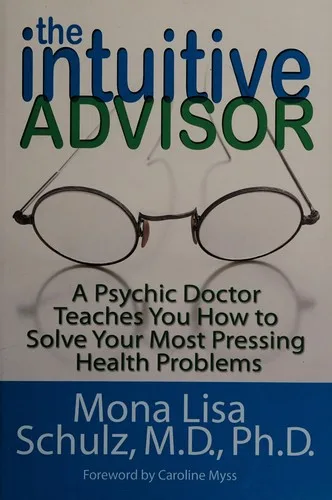
The intuitive advisor
 79
79

The intuitive advisor
Mona Lisa Schulz’s 'The Intuitive Advisor' attempts to bridge the gap between the subjective experience of intuition and observable phenomena, a commendable goal. The book’s strength lies in its effort to present intuition as a trainable skill, rather than an innate, unexplainable talent. Schulz’s discussion of how physical and emotional states can affect one’s intuitive clarity, particularly her analogy of a "noisy channel" obscuring subtle signals, offers a tangible framework. However, the work sometimes struggles to maintain a consistent level of rigor. While aiming for a blend of psychology and esoteric thought, the exposition can occasionally drift into speculative territory without sufficient empirical backing. The concept of "intuitive zones" in the brain, while intriguing, could benefit from more explicit grounding in established neuroscientific models. Despite these limitations, the book provides a practical starting point for those wishing to cultivate their inner guidance, offering exercises that encourage self-awareness and attentiveness to subtle bodily and energetic cues. It serves as a useful primer for the aspiring intuitive, even if it doesn't fully satisfy the skeptical scientific mind.
📝 Description
79
Mona Lisa Schulz published "The Intuitive Advisor" in 2009, proposing intuition is a sophisticated cognitive process.
Published in 2009, Mona Lisa Schulz's "The Intuitive Advisor" presents intuition not as mere guesswork but as a complex cognitive and energetic function. The book details how this inner knowing can be cultivated and applied to everyday life. Schulz connects intuition to fields such as psychology and neuroscience, moving it away from purely mystical interpretations.
This guide is for anyone wanting to make better decisions, improve relationships, or connect more deeply with their inner voice. It will also interest those already involved in personal or spiritual growth who seek to better use their intuitive abilities. Readers will find practical methods for trusting their gut feelings and understanding subtle energetic signals.
Schulz's work arrived in the early 21st century, a time when interest in the mind-body connection and consciousness was growing. While figures like Carl Jung had long discussed the unconscious and New Age thought had popularized intuition, Schulz aimed for a more unified view. Her approach coincided with neuroscience research that began to explore subconscious information processing, giving a potential scientific basis to intuitive experiences.
💡 Why Read This Book?
• Learn to distinguish between true intuitive signals and emotional noise, a skill crucial for making grounded decisions, by understanding Schulz's concept of the "noisy channel" of intuition. • Discover practical techniques to enhance your intuitive perception, such as the "body scan" exercises, enabling you to interpret subtle energetic cues more reliably than generic mindfulness practices. • Gain a framework for integrating intuition into daily life, moving beyond vague spiritual notions to a more grounded understanding, as exemplified by Schulz's discussion of intuition's role in decision-making, a concept first explored in her 2009 publication.
⭐ Reader Reviews
Honest opinions from readers who have explored this book.
❓ Frequently Asked Questions
What is the core difference between intuition and logical reasoning according to 'The Intuitive Advisor'?
Schulz posits intuition as a rapid, subconscious pattern-recognition process that draws on vast amounts of data, often bypassing conscious deliberation. Logical reasoning, conversely, is a slower, conscious analytical process. The book emphasizes that intuition is not a replacement for logic but a complementary faculty.
How does 'The Intuitive Advisor' suggest physical health impacts intuition?
The book argues that physical and emotional well-being are crucial for clear intuitive reception. Schulz explains that stress, fatigue, or unresolved emotional issues can create "noise" or interference, akin to a "noisy channel," obscuring the subtle signals of intuition.
Can intuition be developed or learned according to Mona Lisa Schulz?
Yes, a central thesis of 'The Intuitive Advisor' is that intuition is a skill that can be cultivated. Schulz provides exercises and techniques aimed at honing this ability, encouraging readers to become more attuned to their inner guidance and subtle perceptions.
What are 'intuitive zones' as described in the book?
While not always strictly defined by neuroscience, 'intuitive zones' in Schulz's work refer to areas or states of awareness where intuitive perception is heightened. The book suggests these can be accessed through specific practices that quiet the analytical mind and increase sensitivity to subtle information.
Does 'The Intuitive Advisor' require prior knowledge of esoteric subjects?
No, the book is written for a general audience and aims to demystify intuition. While it touches upon concepts that can be found in esoteric traditions, it grounds them in psychological and practical terms, making it accessible to beginners.
When was 'The Intuitive Advisor' first published?
Mona Lisa Schulz's 'The Intuitive Advisor' was first published in 2009, positioning it within the early 21st-century discourse on consciousness, intuition, and the mind-body connection.
🔮 Key Themes & Symbolism
Intuition as Pattern Recognition
Schulz frames intuition not as a mystical gift but as a sophisticated cognitive function of the subconscious mind. This perspective aligns with emerging ideas in cognitive science that highlight the brain's capacity for rapid, non-conscious information processing. The work argues that intuition arises from the subconscious mind's ability to quickly identify patterns based on past experiences and subtle environmental cues, far exceeding the speed of conscious logical deduction. This makes intuition a powerful tool for understanding complex situations where explicit data is insufficient.
The "Noisy Channel" Phenomenon
A central metaphor in 'The Intuitive Advisor' is the concept of the "noisy channel." Schulz explains that emotional distress, physical fatigue, or unresolved psychological issues can create interference, akin to static on a radio transmission, obscuring clear intuitive signals. This concept provides a practical, relatable explanation for why intuition might feel unreliable at times. By identifying and addressing these "noise" factors, readers are guided towards creating a clearer, more receptive state for their inner guidance to manifest effectively.
Integrating Intuition with Well-being
The book strongly links the cultivation of intuition to overall physical and emotional health. Schulz suggests that practices promoting balance, such as mindfulness, adequate rest, and emotional processing, are essential for maintaining a "clean" intuitive channel. This perspective moves beyond purely intellectual or spiritual approaches to intuition, grounding it in the holistic well-being of the individual. It implies that tending to one's physical and mental state is a prerequisite for accessing and trusting one's intuitive insights reliably.
Energetic Perception
Schulz explores intuition as a form of subtle energetic perception, suggesting that individuals can sense underlying energetic patterns and information in their environment and in others. This concept draws parallels with various esoteric traditions that speak of subtle bodies and energy fields. The book guides readers to develop sensitivity to these energetic cues, framing them as valuable data points for understanding situations and people more deeply, thereby enhancing both personal and interpersonal awareness.
💬 Memorable Quotes
Direct passages from the work, attributed to the author.
“Intuition is not a random flash of insight, but a highly sophisticated form of subconscious pattern recognition.”
— This statement reframes intuition from a mystical phenomenon to a cognitive process. It suggests that our subconscious mind is constantly processing information and identifying patterns, which then surface as intuitive guidance, making it a trainable and understandable faculty.
“Your body is an intuitive instrument; learn to read its subtle signals.”
— Schulz emphasizes the somatic aspect of intuition, positing that physical sensations are direct indicators of our intuitive knowing. This encourages readers to pay close attention to bodily responses as a primary source of guidance, rather than dismissing them as mere physical reactions.
“Emotional turmoil acts like static on the line, making it difficult to hear your inner voice.”
— This interpretation of the 'noisy channel' concept highlights how psychological states can interfere with intuitive perception. It suggests that emotional regulation and inner peace are crucial for accessing clear intuitive information, making self-awareness a key component of intuitive development.
“The subconscious mind gathers data far faster than the conscious mind can process.”
— This highlights the efficiency of subconscious processing, which is fundamental to Schulz's explanation of intuition. It implies that our intuitive hits are based on a vast, rapid assessment of subtle cues that our conscious awareness might miss.
💡 Key Ideas
Editorial paraphrase of the work's core concepts — not direct quotes.
Trusting your intuition requires practice and a willingness to act on what you perceive.
This quote underscores that developing intuition is an active process. It's not enough to simply receive intuitive signals; one must also cultivate the courage and discipline to heed them, even when they contradict logical reasoning or external advice.
🌙 Esoteric Significance
Tradition
While not strictly adhering to a single esoteric lineage, 'The Intuitive Advisor' draws implicitly from traditions that emphasize inner knowing and subtle perception, such as Hermeticism's focus on the correspondence between the inner and outer worlds, and Gnostic ideas of inner illumination. Schulz's work can be seen as an attempt to translate these often esoteric concepts into a more accessible, psychologically-grounded language suitable for a modern audience seeking practical spiritual tools.
Symbolism
The book frequently uses the metaphor of a "noisy channel" to symbolize the interference that hinders intuitive perception. This channel, when clear, allows subtle information to flow. Another implicit symbol is the "body" itself, presented not just as a biological organism but as a sensitive instrument for receiving intuitive data, echoing alchemical ideas of the human body as a vessel for divine or subtle energies.
Modern Relevance
Schulz's work remains relevant for contemporary practitioners of mindfulness, energy healing, and somatic psychology who seek to understand the mechanisms behind subtle perception. Her emphasis on the mind-body connection and the practical development of intuition speaks to current trends in holistic health and integrated wellness approaches, influencing coaches and therapists who incorporate intuitive development into their practices.
👥 Who Should Read This Book
• Individuals seeking to enhance their decision-making skills by learning to trust and interpret their inner guidance, moving beyond purely logical analysis. • Aspiring practitioners of holistic health and wellness who wish to understand the energetic and psychological components of intuition as a diagnostic and guiding tool. • Those interested in the scientific and psychological underpinnings of intuition, looking for a practical guide that bridges esoteric concepts with cognitive and somatic awareness.
📜 Historical Context
Mona Lisa Schulz’s 'The Intuitive Advisor,' published in 2009, emerged during a period of burgeoning interest in the intersection of consciousness studies, neuroscience, and personal development. While Carl Jung’s work on the collective unconscious and archetypes had laid significant groundwork decades prior, and the New Age movement had widely popularized concepts of intuition, Schulz’s approach sought a more integrated, practical framework. Her work arrived as neuroscientists were increasingly exploring the brain's capacity for non-conscious processing, providing a potential scientific counterpoint to more purely metaphysical explanations of intuition. This era saw a proliferation of books on mindfulness, emotional intelligence, and body-mind connection, such as those by Daniel Goleman, positioning Schulz's contribution within a broader cultural conversation about harnessing inner resources. The reception was generally positive among self-help and esoteric circles, though it likely faced skepticism from mainstream scientific and psychological communities that adhered strictly to empirical verification.
📔 Journal Prompts
Reflection on a time when your "noisy channel" of intuition was particularly strong.
Identify three subtle bodily sensations that reliably signal discomfort or alignment for you.
How does your current emotional state influence your perception of intuitive signals?
Consider a recent decision where intuition played a role, however small.
What practices could you implement to "cleanse" your intuitive channel?
🗂️ Glossary
Intuitive Advisor
A person or inner faculty that provides guidance based on subtle perception and subconscious pattern recognition, rather than solely on logical deduction or external information.
Noisy Channel
A metaphor used by Schulz to describe the interference (from stress, emotions, fatigue) that obscures clear intuitive signals, making it difficult to receive or trust inner guidance.
Subconscious Mind
The part of the mind operating below conscious awareness, responsible for rapid pattern recognition, memory storage, and processing vast amounts of information that inform intuitive insights.
Energetic Perception
The ability to sense subtle energy fields, emotional states, or underlying patterns in people and situations, which contributes to intuitive understanding.
Body Scan
An exercise or technique involving bringing focused attention to different parts of the body to notice sensations, which can serve as indicators of intuitive information or emotional states.
Intuitive Zones
Areas or states of awareness conducive to heightened intuitive perception, often achieved by quieting the analytical mind and increasing sensitivity to subtle cues.
Pattern Recognition
The subconscious cognitive process of identifying recurring regularities or structures in data, which forms the basis of intuitive insights.
🔮 Readers Also Liked
Browse all →









More by Mona Lisa Schulz
All books →
More Free Spiritual Development Books
View all →