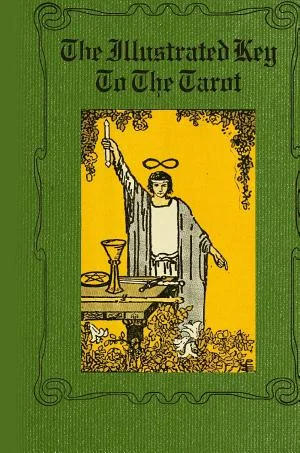
The Illustrated Key To The Tarot
 81
81

The Illustrated Key To The Tarot
Lauron William De Laurence's "The Illustrated Key To The Tarot" offers a dense, if somewhat dated, compendium of early 20th-century Tarot interpretation. Its strength lies in its systematic approach, breaking down the deck into categories like 'the veil and its symbols' and 'the greater keys,' providing a structured learning path for the dedicated student. The preservation of the 78 color drawings, even in a facsimile reprint, is a significant asset, allowing direct engagement with the original visual lexicon. However, the prose can be dense and occasionally repetitive, reflecting the style of its original era. A notable limitation is the reliance on a specific, somewhat dogmatic, esoteric framework that may not align with all modern interpretations. The section on the 'outer method of the oracles' feels particularly direct, offering a stark contrast to more nuanced modern approaches. Ultimately, this reprint serves as a valuable historical artifact for understanding the evolution of Tarot scholarship.
📝 Description
81
This 1918 edition of "The Illustrated Key To The Tarot" preserves original color illustrations in black-and-white.
This is a facsimile reprint of Lauron William De Laurence's 1918 work, "The Illustrated Key To The Tarot." Though presented in black-and-white, it retains the original 78 color illustrations, each paired with explanatory text. The book serves as a guide to the Tarot's symbolic language and its divinatory uses. It aims to explain the deeper meanings of the cards, moving past simple fortune-telling to discuss esoteric principles.
This text is for serious students of Tarot and symbolism, particularly those interested in historical interpretations. It will appeal to readers who appreciate early 20th-century occult literature and seek a text grounding Tarot practice in a wider metaphysical framework. Those interested in the historical development of Tarot as a spiritual tool, rather than just a modern divinatory system, will find value here.
The original publication appeared during a time of heightened interest in Western occultism and esoteric studies. Theosophy, Hermeticism, and various mystical traditions were influencing the interpretation of ancient symbols. De Laurence, a notable publisher of occult literature around the turn of the 20th century, contributed to this growing field. His writings often combined different occult traditions, making them available to an audience seeking spiritual knowledge beyond conventional religious or scientific views.
💡 Why Read This Book?
• Gain insight into the 'secret tradition under the veil of divination,' understanding how early 20th-century occultists viewed Tarot as a repository of hidden wisdom. • Study the 'art of tarot divination' as presented by De Laurence, offering a historical perspective on divinatory techniques distinct from contemporary methods. • Analyze the 'inner symbolism' of the Tarot, exploring how the cards were interpreted as keys to metaphysical principles during a period of widespread occult revival.
⭐ Reader Reviews
Honest opinions from readers who have explored this book.
❓ Frequently Asked Questions
What is the historical significance of Lauron William De Laurence's 'The Illustrated Key To The Tarot'?
Published originally around 1918, this book is a product of the early 20th-century occult revival, a period of intense interest in esoteric traditions and symbolism across the Western world.
Does this reprint of 'The Illustrated Key To The Tarot' include the original color illustrations?
Yes, this black-and-white facsimile reprint specifically preserves the original 78 color drawings of the Tarot cards, which are crucial for understanding De Laurence's commentary.
What specific topics does 'The Illustrated Key To The Tarot' cover?
The book covers 'the veil and its symbols,' 'secret tradition under the veil of divination,' 'art of tarot divination,' 'outer method of the oracles,' 'the tarot in history,' 'inner symbolism,' and 'the greater keys.'
Is this book suitable for beginners in Tarot?
While it covers foundational concepts, its dense prose and historical esoteric context may be more challenging for absolute beginners. It is best suited for those with some prior interest in occult symbolism.
What is the original publication date of Lauron William De Laurence's Tarot work?
The original edition of 'The Illustrated Key To The Tarot' that this reprint is based on was first published around 1918.
What is the relationship between the 2021 reprint and the 1918 edition?
The 2021 edition is a black-and-white facsimile reprint of the 1918 edition, carefully reproducing its content and illustrations, including the 78 original color drawings.
🔮 Key Themes & Symbolism
The Veil and Hidden Knowledge
De Laurence frames the Tarot as a system containing 'the veil and its symbols,' representing a layer of hidden esoteric knowledge accessible through diligent study. This concept suggests that the cards are not merely for fortune-telling but act as a symbolic language guarding deeper metaphysical truths. The 'secret tradition under the veil of divination' posits that these symbols carry wisdom passed down through esoteric lineages, requiring interpretation beyond the superficial. Understanding this veil is presented as the first step towards unlocking the Tarot's true potential as a key to spiritual understanding.
The Art of Tarot Divination
This theme addresses the practical application of the Tarot as an oracle. De Laurence outlines an 'outer method of the oracles,' detailing how to approach the cards for divinatory purposes. This involves not just interpreting individual cards but understanding their interplay within a spread and how they reflect external circumstances or future potentials. The work emphasizes a systematic approach, suggesting that effective divination requires a disciplined mind and a grasp of the underlying symbolic logic, connecting the 'art' of reading to the deeper 'science' of the cards.
Inner Symbolism and Greater Keys
Beyond historical context and divinatory methods, De Laurence examines the 'inner symbolism' of the Tarot. This refers to the profound, often Kabbalistic or Hermetic, meanings embedded within each card and their relationships. The 'greater keys' are the overarching principles and useful insights derived from this inner symbolism, suggesting that the Tarot is a complete system for understanding universal laws. The book aims to equip the reader with the tools to decode this complex layer, moving from the visible structure of the deck to its invisible, metaphysical architecture.
Tarot in History and Tradition
De Laurence situates the Tarot within a historical and traditional framework, exploring its perceived origins and evolution. This section suggests that the cards are not a modern invention but carry elements of ancient wisdom traditions. By examining 'the tarot in history,' the book aims to legitimize its esoteric significance, linking it to broader currents of mystical thought. This historical perspective reinforces the idea of a continuous esoteric lineage, for which the Tarot serves as a vital, albeit often misunderstood, artifact.
💬 Memorable Quotes
Direct passages from the work, attributed to the author.
“The secret tradition under the veil of divination suggests an ancient, preserved knowledge within the cards.”
— This idea emphasizes the author's belief that the Tarot is part of a hidden spiritual lineage, holding wisdom passed down through generations of occult practitioners.
“The art of tarot divination involves both an outer method and an inner understanding of symbolism.”
— This points to De Laurence's dual approach to the Tarot: practical techniques for reading the cards ('outer method') combined with a deeper, symbolic interpretation ('inner symbolism').
“The greater keys of the Tarot unlock profound metaphysical principles when its inner symbolism is understood.”
— This suggests that mastering the Tarot's deeper layers of meaning provides access to fundamental universal laws and spiritual insights.
“Examining the tarot in history reveals its connection to ancient esoteric traditions.”
— This indicates the book's intent to ground the Tarot's significance in historical continuity, linking it to older systems of mystical thought and practice.
💡 Key Ideas
Editorial paraphrase of the work's core concepts — not direct quotes.
The veil and its symbols are fundamental to understanding the Tarot's hidden meanings.
This paraphrased concept highlights De Laurence's view of the Tarot as a symbolic language concealing deeper esoteric truths, accessible through dedicated study of its visual elements.
🌙 Esoteric Significance
Tradition
De Laurence's work aligns broadly with the Hermetic and Kabbalistic traditions prevalent in early 20th-century occultism. It draws upon the concept of a 'secret tradition,' suggesting the Tarot functions as a cipher for mystical doctrines. While not strictly adhering to one specific school, it synthesizes elements found in various European esoteric lineages, presenting the Tarot as a key to understanding universal spiritual laws, akin to how Qabalistic texts were used.
Symbolism
The book emphasizes 'the veil and its symbols,' treating each card as a potent emblem. Key symbols explored include the archetypal figures (Emperor, High Priestess), the elemental suits (Wands, Cups, Swords, Pentacles), and the Major Arcana's journey, which De Laurence interprets through a lens of spiritual progression and hidden cosmic principles. The number and arrangement of symbols within each card are presented as integral to its divinatory and metaphysical meaning.
Modern Relevance
Contemporary occultists and Tarot scholars often reference early 20th-century works like De Laurence's for historical context and foundational interpretive frameworks. While modern practices may diverge, the book remains a point of reference for understanding how the Tarot was codified and taught during a crucial period of its Western esoteric development, influencing subsequent generations of practitioners and theorists.
👥 Who Should Read This Book
• Students of early 20th-century occultism seeking to understand De Laurence's specific contributions and publishing style. • Tarot enthusiasts interested in historical interpretations and the development of esoteric Tarot symbolism beyond modern approaches. • Researchers of Western Esotericism interested in the popularization and dissemination of occult knowledge during the early 1900s.
📜 Historical Context
The original publication of Lauron William De Laurence's "The Illustrated Key To The Tarot" circa 1918 places it squarely within the fertile ground of the early 20th-century Western esoteric revival. This era saw a surge of interest in Hermeticism, Kabbalah, Theosophy, and spiritualism, fueled by figures like Helena Blavatsky and Arthur Edward Waite. De Laurence himself was a prolific publisher of occult texts, often synthesizing diverse traditions for a burgeoning audience. His work emerged in dialogue with, and sometimes in competition with, other prominent occult publishers and authors of the time. The intellectual climate was ripe for reinterpreting ancient symbols through a lens of occult philosophy, and the Tarot, with its rich visual language, became a prime subject. While specific reception events for De Laurence's work are less documented than, say, Aleister Crowley's, his consistent output indicates a significant readership seeking accessible occult knowledge.
📔 Journal Prompts
The concept of 'the veil and its symbols' as presented by De Laurence.
De Laurence's 'outer method of the oracles' and its practical application.
The 'inner symbolism' of the Major Arcana's progression.
Interpreting the 'secret tradition' through specific card imagery.
Connecting the 'Tarot in history' to contemporary esoteric beliefs.
🗂️ Glossary
The Veil
In De Laurence's context, 'the veil' represents the hidden, esoteric knowledge concealed within the Tarot's symbols, separating the uninitiated from deeper spiritual truths.
Secret Tradition
Refers to a body of esoteric knowledge or mystical teachings believed to be passed down through select groups or lineages, often considered hidden from mainstream understanding.
Art of Tarot Divination
The practice and skill of using the Tarot cards for the purpose of divination, interpreted by De Laurence as a structured system involving symbolic understanding and specific methods.
Outer Method of the Oracles
De Laurence's term for the practical, external techniques and procedures used in reading the Tarot for divinatory purposes, as opposed to purely internal or intuitive approaches.
Inner Symbolism
The deeper, metaphysical, and often Kabbalistic or Hermetic meanings embedded within the Tarot cards, which are considered essential for true understanding beyond superficial interpretation.
Greater Keys
The fundamental principles and advanced esoteric insights derived from a comprehensive study of the Tarot's symbolism and structure, representing a mastery of its spiritual teachings.
Facsimile Reprint
A reproduction that closely mimics the original document's appearance, including layout and illustrations, as opposed to a modern reinterpretation or summary.