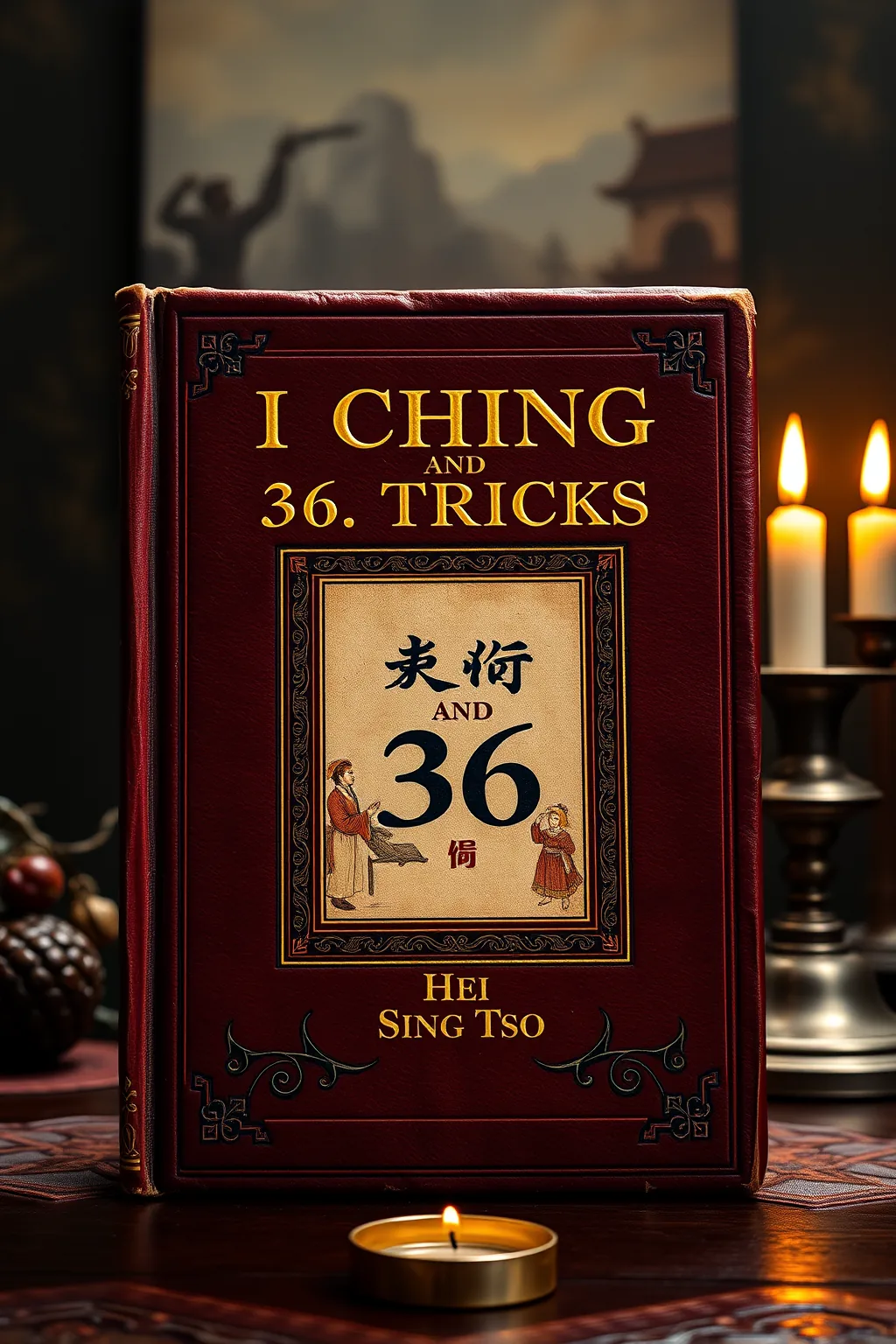
I Ching and 36 Tricks
 61
61

I Ching and 36 Tricks



Isolde Whitaker, Sacred Texts Editor: Hei Sing Tso's 'I Ching and 36 Tricks' is an exceptional synthesis, bridging the venerable oracular tradition of the I Ching with the practical, often Machiavellian, insights of the 36 Stratagems. This text offers a rare and potent perspective for practitioners seeking not just foresight but also the strategic acumen to manifest desired outcomes. Tso's elucidation of how universal principles manifest in both divination and worldly tactics is particularly insightful. Highly recommended for students of Eastern philosophy, divination arts, and those interested in the subtle interplay of destiny and free will.
📝 Description
61
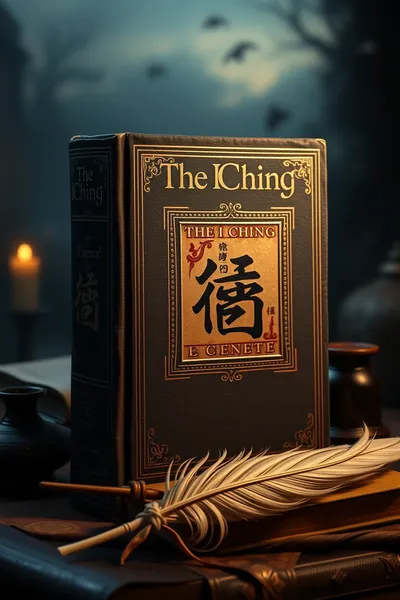
Hei Sing Tso's 'I Ching and 36 Tricks' connects the ancient Chinese divination text with military strategy.
Published by Hei Sing Tso, 'I Ching and 36 Tricks' draws a parallel between the cyclical patterns of the I Ching and the strategic principles found in the 36 Stratagems. The author argues that the hexagrams of the I Ching reflect universal rules governing human action and comprehension. This work aims to show readers how to recognize underlying structures in events and use this knowledge for better decision-making.
The book guides readers to identify recurring motifs in life and understand the symbolic language of destiny. It suggests that by grasping these concepts, individuals can improve their ability to anticipate outcomes and manage complex situations. The text combines the practices of divination with strategic thinking, presenting a method for personal growth and effective self-management. It discusses themes of equilibrium, change, and adapting to circumstances.
This book sits within traditions that seek to understand cosmic order and human agency through symbolic systems. It links the I Ching, a foundational text in Chinese philosophy and divination, with the practical, often covert, methods of the 36 Stratagems, historically used in warfare and politics. The work suggests a correspondence between the patterns of natural change described in the I Ching and the dynamics of human conflict and maneuvering. It proposes that by studying these correspondences, one can gain insight into the underlying forces that shape events, thereby improving one's capacity for wise action.
💡 Why Read This Book?
Unlock profound insights into cosmic cycles and strategic living. 'I Ching and 36 Tricks' offers a unique synthesis of ancient divination and practical wisdom, empowering seekers and practitioners to navigate life with greater clarity and efficacy. Discover how to align your actions with universal forces, enhance your foresight, and master the art of subtle influence. Ideal for those drawn to esoteric studies, strategic thinking, and the pursuit of enlightened self-development.
⭐ Reader Reviews
Honest opinions from readers who have explored this book.
❓ Frequently Asked Questions
What is the core philosophy of the book?
The book's core philosophy lies in the harmonious integration of cosmic order (I Ching) and human strategy (36 Tricks), illustrating how understanding universal patterns can inform effective action and personal transformation.
Is this book suitable for beginners in divination?
Yes, while offering deep insights for advanced practitioners, the book's clear explanations and evocative prose make its foundational concepts accessible to those new to the I Ching and esoteric studies.
How does the I Ching relate to the 36 Tricks?
The book posits that the hexagrams of the I Ching embody fundamental principles and archetypes that are mirrored in the strategic maneuvers of the 36 Tricks, offering a dual lens for understanding life's challenges and opportunities.
What kind of esoteric knowledge can one expect to find?
Expect revelations on the cyclical nature of reality, the interplay of Yin and Yang, symbolic meanings of hexagrams, and the psychological and practical applications of ancient strategic thought.
Can this book be used for practical application in daily life?
Absolutely. It provides a framework for making informed decisions, understanding interpersonal dynamics, and developing a more resilient and adaptable approach to personal and professional endeavors.
🔮 Key Themes & Symbolism
The Interplay of Destiny and Strategy
This theme explores the profound connection between the seemingly immutable currents of destiny, as represented by the I Ching's hexagrams, and the dynamic, proactive application of human strategy, embodied by the 36 Tricks. It looks at how an understanding of cosmic cycles and archetypal patterns can empower individuals to make more informed choices, adapt to changing circumstances, and ultimately, influence the unfolding of their own paths. The book argues that true mastery lies not in passively accepting fate, but in skillfully navigating its currents with awareness and deliberate action.
Symbolism and Archetypal Resonance
Hei Sing Tso meticulously unpacks the rich symbolic language of the I Ching, revealing how each hexagram and its constituent trigrams act as potent archetypes that resonate with universal human experiences and natural phenomena. This theme examines how these ancient symbols provide a profound framework for understanding the dynamics of change, conflict, harmony, and transformation. The book posits that by deciphering this symbolic lexicon, readers can gain deeper insights into their own inner landscapes and the external forces shaping their lives, fostering a more intuitive and enlightened approach to existence.
The Esoteric Art of Action
This central theme focuses on the practical application of esoteric knowledge, demonstrating how the wisdom gleaned from the I Ching and the strategic principles of the 36 Tricks can be integrated into a potent methodology for effective action. It moves beyond mere theoretical understanding to explore the 'how-to' of navigating complex situations, achieving objectives, and fostering personal growth through mindful engagement with the world. The book champions a balanced approach, where inner wisdom guides outer action, leading to more purposeful and impactful endeavors.
💬 Memorable Quotes
Direct passages from the work, attributed to the author.
“To know the pattern is to wield the unseen.”
— This highlights the power of understanding underlying principles, suggesting that foresight and strategic insight grant a form of subtle control over circumstances.
“Flow with the river, yet guide its course.”
— A metaphor for balancing adaptability with agency, emphasizing the skill of working with natural forces rather than resisting them.
“The truest victory is in understanding the enemy within.”
— This points to the introspective aspect of the 36 Tricks, suggesting that self-awareness is the ultimate strategic advantage.
“When the cosmic wheel turns, so must the wheel of the mind.”
— This emphasizes the necessity of mental and spiritual alignment with external changes, promoting conscious adaptation.
💡 Key Ideas
Editorial paraphrase of the work's core concepts — not direct quotes.
The hexagrams are whispers of the cosmos, the stratagems are the elements of enlightened will.
This quote captures the book's central thesis: the I Ching provides a divine blueprint, while the 36 Tricks offer the human capacity to act wisely within that framework.
🌙 Esoteric Significance
Tradition
This work is deeply rooted in the Taoist and Confucian traditions of ancient China, particularly its emphasis on natural law, balance, and cyclical change. It draws heavily from the cosmological framework of the I Ching, which views the universe as a dynamic interplay of opposing yet complementary forces. The integration with the 36 Stratagems introduces a layer of practical, almost alchemical, application of these principles, suggesting that mastery of life's challenges is achieved through understanding and harmonizing with these fundamental cosmic energies.
Symbolism
Key symbols abound, with the 64 hexagrams of the I Ching serving as primary archetypes representing diverse situations and transformations. The Yin and Yang duality is foundational, illustrating the constant flux and interdependence of opposing forces. The 36 Stratagems themselves function as symbolic representations of specific psychological and tactical approaches, such as 'Deceive the heavens to cross the sea' or 'Attack where the enemy is unprepared.' The entire work is a collection of symbolic meaning, inviting readers to decode the hidden language of reality and their own inner lives.
Modern Relevance
In our rapidly evolving and often chaotic world, the principles outlined in 'I Ching and 36 Tricks' offer a profound anchor. The I Ching's insights into cyclical change and adaptability provide a framework for navigating uncertainty with equanimity, while the 36 Stratagems offer timeless strategies for problem-solving, negotiation, and personal empowerment. The book's emphasis on understanding underlying patterns and acting with informed intention is remarkably relevant for anyone seeking clarity, resilience, and a more strategic approach to personal and professional challenges in the 21st century.
👥 Who Should Read This Book
This book is an invaluable resource for a diverse range of readers. **Beginners** in esoteric studies will find a clear and engaging introduction to the foundational concepts of the I Ching and strategic thinking. **Scholars** of Eastern philosophy and history will appreciate the nuanced synthesis and historical context provided. **Seekers** of self-knowledge and spiritual growth will discover clear insights into the nature of reality and their place within it. **Practitioners** of divination, martial arts, business strategy, or any field requiring keen observation and decisive action will benefit from the practical applications and enlightened perspectives offered by Hei Sing Tso's masterful work.
📜 Historical Context
Emerging from a rich tradition of Eastern philosophical and strategic thought, 'I Ching and 36 Tricks' draws upon the ancient Chinese 'Book of Changes' (I Ching), a divination text dating back to the Zhou Dynasty (c. 1046–256 BCE), and the legendary 'Thirty-Six Stratagems,' a compilation of tactical maneuvers believed to have been compiled during the Southern and Northern Dynasties period (420–589 CE) or later. The era in which Hei Sing Tso synthesized these two powerful streams of wisdom was likely one that valued the integration of spiritual insight with practical application. Such periods often saw a confluence of intellectual curiosity, a desire for practical guidance in turbulent times, and a deep respect for the accumulated knowledge of sages and strategists. The book stands as a evidence of the enduring relevance of these ancient systems, offering a bridge between timeless wisdom and the ever-present challenges of human existence.
📔 Journal Prompts
Reflect on a recent challenge: Which I Ching hexagram might represent its essence, and how could one of the 36 Stratagems be applied to navigate it?
Consider a personal goal. What universal principles (as revealed by the I Ching) are at play, and what strategic approach (from the 36 Tricks) would best serve its attainment?
Explore the concept of 'deception' not as malice, but as strategic misdirection. How can this principle be applied ethically in everyday interactions?
Analyze a current situation where you feel 'stuck.' What is the underlying pattern (I Ching) of this stagnation, and what is the 'escape' strategy (36 Tricks) you might employ?
How does the balance of Yin and Yang manifest in your daily life, and how can understanding this balance inform your strategic decisions?
🗂️ Glossary
I Ching
The 'Book of Changes,' an ancient Chinese divination text and classic of Chinese philosophy, used to understand the world and make decisions through a system of hexagrams.
Hexagram
A figure composed of six stacked horizontal lines, where each line is either Yang (unbroken) or Yin (broken), representing a fundamental state or situation in the I Ching.
Yin and Yang
Two complementary and interdependent forces or principles in ancient Chinese philosophy, representing darkness and light, feminine and masculine, passive and active, etc.
36 Stratagems
A collection of classical Chinese stratagems or tactics, often used in warfare, business, and politics, designed to achieve victory through clever maneuvering and psychological insight.
Trigram
A figure composed of three stacked lines, each either Yin or Yang. The combination of two trigrams forms a hexagram in the I Ching.
This book appears in 2 collections
🔮 Readers Also Liked
Browse all →









From the “I Ching” Collection
View all →





More Free Divination & Tarot Books
View all →