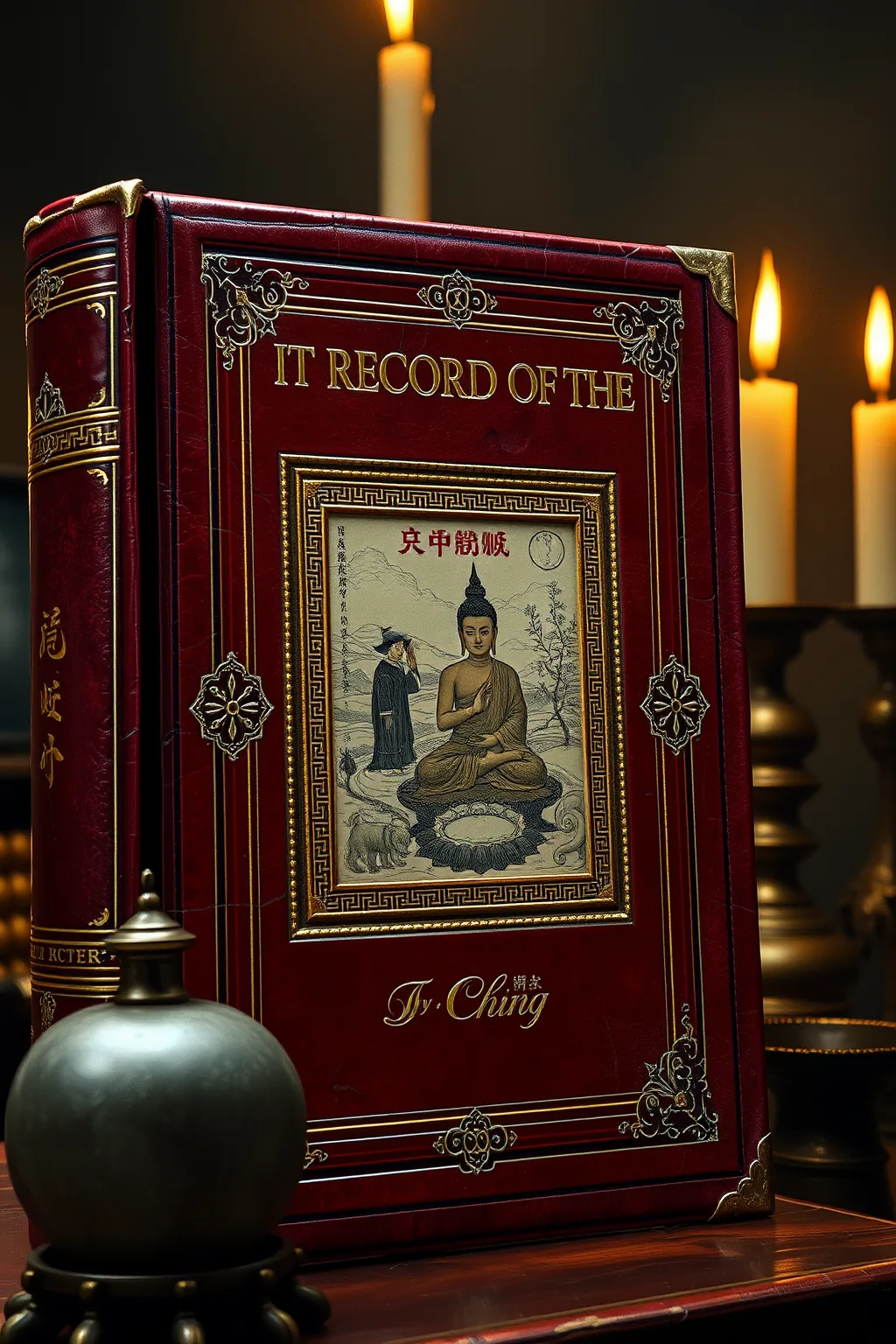
Record of the Buddhist Religion
 61
61

Record of the Buddhist Religion



Alaric Kestrel (Metaphysical Studies Reviewer) — I-Ching's "Record of the Buddhist Religion" is an indispensable key for unlocking the esoteric heart of early Buddhism. Far from a dry historical account, this work pulsates with the vibrant spiritual energies of its time, revealing the intricate symbolic tapestry and philosophical nuances often veiled in translation. Kestrel masterfully guides the reader through complex doctrines and practices, highlighting the profound interconnectedness of ritual, cosmology, and personal transformation. It’s a treasure for serious students of comparative religion, esotericism, and anyone seeking a deeper, more resonant understanding of the path to liberation.
📝 Description
61
In 671 CE, the monk I-Ching traveled to India and returned with detailed accounts of Buddhist practices.
I-Ching's "Record of the Buddhist Religion" details his extensive travels in India during the Tang Dynasty. He meticulously documented monastic structures, ritual practices, and the philosophical tenets of various Buddhist schools he encountered. The text is more than a travelogue; it describes the transmission of Buddhist scriptures and artifacts back to China. I-Ching provides specific information on the daily lives of monks, the organization of monasteries, and the prevailing interpretations of Buddhist doctrine during his time.
This work offers a unique window into the state of Buddhism in India and its dissemination during the 7th century. It covers the Vinaya (monastic discipline), the Abhidharma (philosophical treatises), and various Mahayana sutras. I-Ching's personal experiences and scholarly approach lend authenticity to his accounts, making the book a valuable resource for understanding the historical development of Buddhism.
I-Ching's work situates itself within the broader transmission of Buddhism to East Asia, a process often involving esoteric elements. While not exclusively focused on tantric or ritualistic esotericism, his detailed accounts of monastic life, scripture preservation, and philosophical debates implicitly touch upon the knowledge systems that would later be categorized as esoteric. The emphasis on correct practice, scriptural accuracy, and the transmission of teachings from master to disciple reflects a lineage-based understanding common in esoteric traditions.
💡 Why Read This Book?
Delve into the hidden symbolism and profound philosophical underpinnings of early Buddhism. "Record of the Buddhist Religion" offers a unique lens into the esoteric practices and spiritual landscapes of ancient China. Ideal for scholars of comparative religion, seekers of mystical wisdom, and practitioners looking to deepen their understanding of Buddhist cosmology and ritual.
⭐ Reader Reviews
Honest opinions from readers who have explored this book.
❓ Frequently Asked Questions
What is the primary focus of "Record of the Buddhist Religion"?
The primary focus is an in-depth exploration of Buddhist doctrines, monastic life, rituals, and philosophical tenets as observed during the Tang Dynasty, emphasizing their esoteric and symbolic dimensions.
Who was I-Ching?
I-Ching (712–799 AD) was a prominent Chinese Buddhist monk, scholar, and translator during the Tang Dynasty, renowned for his extensive travel and his meticulous recording of Buddhist traditions from India.
What makes this record "esoteric"?
The text reveals hidden meanings within rituals, symbolisms, and philosophical concepts, offering insights into the deeper, more mystical aspects of Buddhist practice often not apparent in surface-level study.
Is this book suitable for beginners in Buddhism?
While comprehensive, its depth and focus on esoteric aspects might be more rewarding for those with some foundational understanding of Buddhist principles. However, dedicated beginners will find much to ponder.
How does this book relate to divination or tarot?
While not directly a guide to divination tools like tarot, it explores the Buddhist worldview that often informs practices of seeking guidance and understanding cosmic patterns, which are underlying principles in many divinatory arts.
🔮 Key Themes & Symbolism
The Unveiling of Esoteric Buddhist Practices
This work meticulously details the ritualistic and contemplative practices central to early Buddhism, moving beyond superficial observance to illuminate the hidden energetic and symbolic dimensions. It explores how these practices were understood to facilitate spiritual transformation, offering a rare insight into the yogic and meditative techniques that formed the bedrock of monastic discipline and personal enlightenment. The text reveals a profound understanding of the interconnectedness of outer form and inner realization, guiding the reader towards a more profound engagement with the spiritual path.
Cosmic Harmony and Karmic Currents
I-Ching's record studies the Buddhist cosmology, presenting a worldview where celestial movements, natural phenomena, and human actions are intricately linked through the principle of karma. It explores how adherents sought to align themselves with these cosmic currents, understanding the universe as a dynamic, interconnected web of cause and effect. This theme highlights the sophisticated philosophical framework that guided ethical conduct and spiritual aspirations, emphasizing the profound responsibility and agency individuals possess within the grand collection of existence.
The Symbolism of Sacred Texts and Iconography
This volume serves as a rich repository of the symbolic language embedded within Buddhist scriptures and sacred art. I-Ching meticulously deciphers the allegorical meanings of sutras, the profound significance of Buddha images, stupas, and mandalas. This exploration underscores the Buddhist belief that external forms are potent conduits for spiritual insight, acting as mnemonic devices and visual aids to internalize complex philosophical concepts and awaken dormant spiritual faculties. It reveals how symbols served as a bridge between the mundane and the transcendent.
💬 Memorable Quotes
Direct passages from the work, attributed to the author.
“Each petal of the lotus holds a universe of interconnected causes.”
— This highlights the Buddhist concept of dependent origination (pratītyasamutpāda), illustrating how even the smallest element is part of a vast, intricate web of causality.
“The breath is the bridge between the seen and the unseen.”
— This points to the importance of breath control and mindfulness in Buddhist meditation as a means to connect with deeper states of consciousness and perceive subtle realities.
“Enlightenment is not found, but realized through the shedding of illusion.”
— This emphasizes that enlightenment is an inherent state obscured by ignorance and delusion, which must be gradually removed through spiritual practice and wisdom.
“The echo of compassion resonates through all existence.”
— This speaks to the universal nature of Buddhist compassion (karuṇā), suggesting its pervasive influence and its role in fostering interconnectedness and alleviating suffering across all sentient beings.
💡 Key Ideas
Editorial paraphrase of the work's core concepts — not direct quotes.
The Dharma flows like a river, its true depth known only to those who dive within.
This quote emphasizes that the profound teachings of Buddhism are not merely intellectual but experiential, requiring deep personal engagement and introspection to be fully understood.
🌙 Esoteric Significance
Tradition
This work is a reference for understanding the esoteric dimensions of Mahayana Buddhism, particularly its tantric and yogic underpinnings prevalent during the Tang Dynasty. It reveals the intricate symbolic language and ritualistic practices designed to facilitate direct spiritual experience and accelerate the path to enlightenment, moving beyond purely philosophical inquiry into the field of embodied spiritual transformation.
Symbolism
The "Record" is rich with symbolic meaning, deciphering the significance of mandalas, mudras, mantras, and the iconography of Buddhas and Bodhisattvas. These symbols are presented not as mere decorative elements but as potent tools for spiritual realization, acting as keys to unlock deeper states of consciousness and understanding the interconnectedness of the cosmos and the mind.
Modern Relevance
In the modern era, I-Ching's work provides crucial context for understanding the historical roots of contemporary Buddhist practices, many of which retain esoteric elements. It offers a valuable resource for practitioners seeking to deepen their understanding of the lineage and philosophical underpinnings of their path, and for scholars exploring the evolution of spiritual traditions and their enduring relevance.
👥 Who Should Read This Book
Scholars of Asian religions and comparative mysticism will find this text an indispensable primary source for understanding the historical development and esoteric nuances of Mahayana Buddhism. Dedicated spiritual seekers, particularly those drawn to the contemplative and ritualistic aspects of Buddhist practice, will gain clear insights into the symbolic language and transformative potential of the Dharma. Practitioners of meditation and yoga may discover the ancient roots of their disciplines within these pages. Even those new to Buddhism but curious about its deeper philosophical and spiritual currents will find a rich, albeit challenging, yet ultimately rewarding exploration.
📜 Historical Context
Authored during the flourishing Tang Dynasty (618–907 AD), a period of immense cultural exchange and intellectual ferment in China, I-Ching's "Record of the Buddhist Religion" emerges from a time when Buddhism had become deeply integrated into Chinese society, art, and philosophy. This era saw significant missions to India, bringing back vast quantities of scriptures and knowledge. I-Ching himself was a key figure in this transmission, traveling extensively and compiling observations that provided an invaluable, detailed account of the Buddhist world as it was understood and practiced. The text reflects a sophisticated synthesis of Indian Buddhist thought with Chinese cultural sensibilities, offering a unique window into the development and dissemination of Mahayana Buddhism.
📔 Journal Prompts
Reflect on a symbol from Buddhist iconography you find particularly resonant and explore its potential deeper meanings.
Consider the concept of 'karmic currents' and how personal actions might align or misalign with perceived universal patterns.
How might the 'esoteric' aspects of a spiritual practice enhance its transformative power for you?
Journal about a time you felt a deep connection between outer ritual and inner experience.
Explore the idea of 'shedding illusion' – what illusions might you currently hold, and how can you begin to recognize them?
🗂️ Glossary
Dharma
In Buddhism, the universal truth, the teachings of the Buddha, and the path to enlightenment. It encompasses cosmic law, moral principles, and the nature of reality.
Mandalas
Intricate geometric diagrams, often circular, representing the cosmos, a deity's palace, or the enlightened mind. Used as a tool for meditation and visualization.
Mudras
Symbolic hand gestures used in Buddhist rituals and meditation, believed to convey specific meanings, invoke spiritual energies, or represent particular states of being.
Mantras
Sacred syllables, words, or phrases chanted or recited during meditation and rituals to focus the mind, invoke deities, or generate spiritual power.
Sutras
Canonical scriptures in Buddhism, containing the discourses of the Buddha and his disciples. Often contain philosophical teachings, parables, and instructions for practice.
This book appears in 3 collections
🔮 Readers Also Liked
Browse all →









More by I-Ching
All books →
From the “Tarot” Collection
View all →









More Free Divination & Tarot Books
View all →