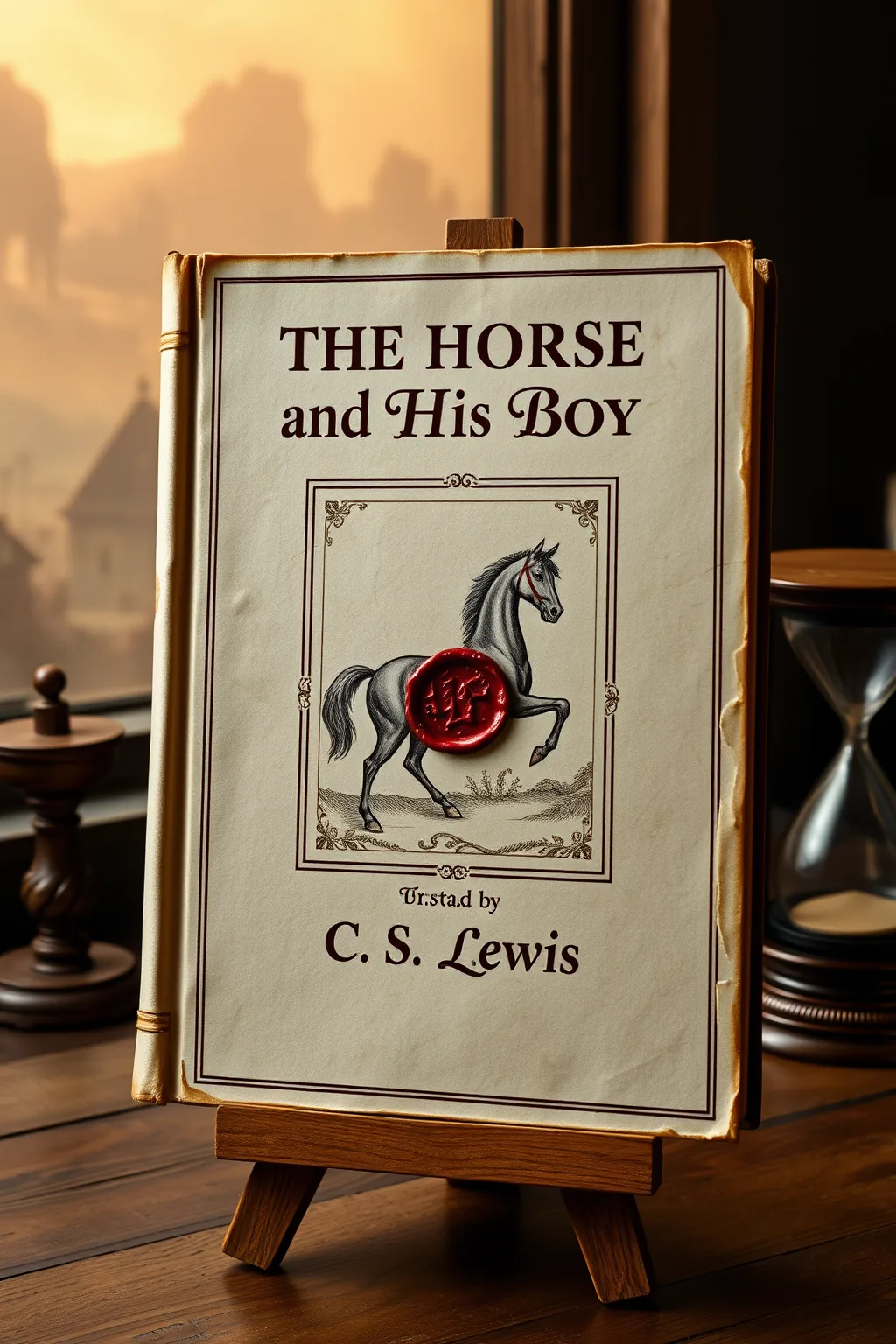
The Horse and His Boy
 71
71

The Horse and His Boy
Lewis's capacity for creating compelling narratives with underlying spiritual currents is evident in *The Horse and His Boy*. The dynamic between Shasta and Bree, a Narnian talking horse, provides much of the story's charm and philosophical heft, as they navigate disparate worldviews and shared peril. The novel excels in its portrayal of courage found in unlikely places and the constant, subtle presence of a benevolent guiding force. However, the depiction of Calormen and its inhabitants, particularly the vizier and his degenerate son, can strike modern readers as somewhat starkly drawn, bordering on caricature, which detracts from the nuanced exploration of good and evil seen in other Narnian chronicles. Despite this, the climax at Anvard and the subsequent revelations about Shasta's heritage remain powerfully executed. The book is a solid entry in the Narnian saga, offering a unique perspective on faith and destiny.
📝 Description
71
C.S. Lewis published The Horse and His Boy in 1954, a Narnian story set before The Lion, the Witch and the Wardrobe.
This novel follows Shasta, a young boy who believes he is the son of a fisherman in Calormen. He discovers his true parentage is unknown and flees his homeland with Bree, a talking horse. Their flight north to the free cities of Narnia becomes a dangerous quest. Shasta and Bree encounter other travelers, including Aravis and her horse Hwin, who are also seeking freedom from Calormen. Together, they face perils and make difficult choices as they move toward an uncertain future.
The narrative examines Shasta's struggle with his identity and his place in the world. It contrasts the rigid, oppressive society of Calormen with the independent spirit found in Narnia and its allies. The characters often find themselves in seemingly chance encounters that guide their path, suggesting a larger, unseen force at work. The story blends adventure with reflections on freedom, destiny, and the nature of true belonging.
Published in 1954, The Horse and His Boy emerged as Lewis wrote within a tradition that valued myth and allegory, influenced by contemporaries like J.R.R. Tolkien. This era saw a renewed interest in ancient mythologies and a questioning of purely rationalist worldviews. Lewis, a member of the Inklings, used the fantasy setting of Narnia to explore complex spiritual and ethical ideas, drawing on Christian tradition and classical literature. The novel engages with concepts of hidden providence and the individual's role within a divinely ordered universe, presented through a story of adventure and self-discovery.
💡 Why Read This Book?
• Understand the concept of Aslan's subtle providence by examining Shasta's unexpected encounters and near-misses during his journey from Calormen, a key element Lewis uses to illustrate divine care. • Experience a literary exploration of identity and freedom through Shasta's quest to discover his true heritage and escape servitude, contrasting the oppressive Calormene society with Narnian liberty. • Appreciate Lewis's technique of embedding Christian allegory within a classic adventure narrative, exemplified by the parallels between Shasta's trials and the biblical Exodus story.
⭐ Reader Reviews
Honest opinions from readers who have explored this book.
❓ Frequently Asked Questions
When was C.S. Lewis's *The Horse and His Boy* first published?
C.S. Lewis's *The Horse and His Boy* was first published in 1954, making it the fifth book published in The Chronicles of Narnia series.
What is the main setting for *The Horse and His Boy*?
The primary setting is the fictional land of Narnia and its surrounding regions, particularly the desert kingdom of Calormen, from which the protagonist, Shasta, escapes.
Who are the main protagonists of *The Horse and His Boy*?
The main protagonists are Shasta, a young boy who believes he is a fisherman's son, and Bree, a talking Narnian horse who was once a war-horse in Narnia.
What esoteric or philosophical themes are present in *The Horse and His Boy*?
The book explores themes of identity, destiny, freedom versus oppression, and divine providence, often interpreted through a Christian allegorical lens.
How does *The Horse and His Boy* connect to other Narnia books?
While published fifth, its events chronologically precede *The Lion, the Witch and the Wardrobe*, and it features the lion Aslan and the country of Narnia.
What is the significance of the talking horses in the book?
Talking horses like Bree represent freedom, intelligence, and a connection to the magical world of Narnia, contrasting with the non-magical, enslaved horses of Calormen.
🔮 Key Themes & Symbolism
Identity and Origin
Shasta's journey is fundamentally one of self-discovery. He begins believing he is the son of a poor fisherman in Calormen, but his flight north reveals hints of a nobler heritage. This theme mirrors spiritual journeys where one's true identity is often hidden or misunderstood, requiring a quest to uncover it. Lewis uses Shasta's evolving understanding of himself to explore the idea that one's birth or upbringing does not define their ultimate worth or destiny, a concept resonant within theological frameworks of adopted sonship and divine purpose.
Freedom and Oppression
The stark contrast between Calormen and Narnia highlights the theme of freedom versus subjugation. Calormen is depicted as a hierarchical, authoritarian society where individual liberty is limited, and even horses are treated as mere property. Narnia, conversely, represents a area of freedom, where talking beasts and humans coexist with a sense of inherent dignity. This dichotomy serves as an allegory for spiritual freedom found in alignment with divine will, versus the bondage of sin or tyrannical earthly powers.
Providence and Guidance
Throughout the narrative, characters frequently encounter seemingly chance occurrences that avert disaster or lead them toward their goals. This is particularly evident in Shasta's numerous near-misses and fortuitous meetings, orchestrated by the lion Aslan, though often unrecognized by the characters themselves. Lewis presents a world where a benevolent, guiding hand subtly intervenes, shaping events to fulfill a higher purpose. This concept of divine providence is central to the book's spiritual message, suggesting that even in peril, individuals are not truly alone.
Courage and Faith
Characters like Shasta, Bree, Aravis, and Hwin demonstrate courage not in the absence of fear, but in acting despite it. Shasta's initial fear of his adoptive father gives way to the courage needed for his escape, and later, to face the dangers of the desert and the Tarkaan. Bree, despite his initial pride and fear of recapture, finds bravery in protecting Shasta. This theme underscores the idea that true courage is often intertwined with faith – trusting in a higher power or a righteous cause even when the outcome is uncertain.
💬 Memorable Quotes
Direct passages from the work, attributed to the author.
“He is not a tame lion.”
— This famous line, spoken by Mrs. Beaver in *The Lion, the Witch and the Wardrobe* but highly relevant to Aslan's presence throughout the series including this book, emphasizes Aslan's wild, powerful, and untamable nature. It suggests a divine force that is not subservient to human will or understanding, commanding awe and respect.
“The horses did not like to be ridden by people who were afraid of them.”
— This observation from Bree points to a subtle truth about relationships: fear creates barriers. Bree, a sentient being, responds poorly to Shasta's initial fear. It suggests that trust and mutual respect are crucial for harmonious interaction, even between different species or beings.
“We are only the horse and his boy.”
— This phrase, used by the characters themselves, reflects a moment of humility and self-awareness. They acknowledge their perceived low status in the eyes of the world, yet their actions prove their significance, suggesting that true worth is not determined by external titles or societal roles.
💡 Key Ideas
Editorial paraphrase of the work's core concepts — not direct quotes.
If you do not behave, I shall call the guards and have you put in the stocks.
Spoken by Shasta's adoptive father, this quote exemplifies the oppressive and fearful atmosphere of Calormen. It highlights the use of threats and punishment to maintain control, contrasting sharply with the principles of freedom and justice valued in Narnia.
It is a dangerous thing to ask yourself how much you love your neighbour before you know whether you love God.
This quote, attributed to Aslan, touches upon the hierarchy of love and devotion. It suggests that true, selfless love for others stems from, or is best understood in the context of, a prior or foundational love for the divine.
🌙 Esoteric Significance
Tradition
While C.S. Lewis explicitly framed his work within Christian theology, *The Horse and His Boy* draws upon archetypal narratives found in various esoteric traditions, including Gnosticism and Hermeticism, particularly in its exploration of hidden origins and the search for true selfhood. The concept of a divine spark within, obscured by worldly circumstances (Calormen), and the journey towards liberation and recognition of that spark aligns with Gnostic ideas of gnosis. The overarching theme of a guiding, benevolent force (Aslan) operating unseen also echoes Hermetic principles of divine order and immanent divinity.
Symbolism
The 'talking horse' is a potent symbol. In many mythologies, horses represent freedom, swiftness, and the connection between the earthly and the spiritual realms. Bree, as a Narnian talking horse, embodies this elevated status – possessing intelligence, will, and a connection to Aslan's magic, contrasting with the subjugated, mute beasts of Calormen. The desert journey itself symbolizes spiritual trial and purification, a common motif in initiatory narratives across traditions, where hardship strips away the non-essential to reveal true character and destiny.
Modern Relevance
Contemporary spiritual seekers and writers exploring the intersection of faith and narrative continue to find value in Lewis's work. Aspects of *The Horse and His Boy*, such as the theme of hidden identity and the subtle workings of providence, resonate with modern psychological approaches to self-discovery and the concept of synchronicity. Thinkers in the Jungian analytical psychology tradition, for instance, might see Shasta's journey as an exploration of the Self, archetypally guided. The book's enduring appeal lies in its ability to speak to universal quests for meaning and belonging.
👥 Who Should Read This Book
• Individuals interested in Christian allegory and its literary applications, seeking to understand how theological concepts can be embedded in engaging narratives. • Young adult and adult readers who appreciate adventure stories with underlying themes of identity, destiny, and moral development, particularly those drawn to mythical or fantastical settings. • Students of comparative literature and mythology who wish to examine Lewis's synthesis of classical, biblical, and invented lore within the context of 20th-century British literature.
📜 Historical Context
Published in 1954, *The Horse and His Boy* emerged from the fertile intellectual ground of post-war Britain, a period marked by a desire for moral clarity and a renewed appreciation for myth. C.S. Lewis, a key member of the literary circle known as the Inklings alongside J.R.R. Tolkien, was deeply engaged with classical literature, theology, and mythology. This era saw a cultural undercurrent that questioned purely materialistic worldviews, making allegorical narratives that explored spiritual truths highly resonant. Lewis's work, while distinctly Christian, engaged with broader European literary traditions that valued symbolic storytelling. Contemporary authors like Tolkien were also exploring mythopoeia, though Tolkien’s approach, as seen in *The Lord of the Rings* (published 1954-1955), often focused on creating a deep, internally consistent mythology, whereas Lewis prioritized the allegorical conveyance of Christian doctrine within familiar adventure structures. Lewis’s reception was generally positive among his audience, though critics sometimes debated the overtness of his allegorical methods.
📔 Journal Prompts
Shasta's mistaken identity and eventual discovery of his lineage.
Bree's pride and subsequent lessons in humility during the journey.
The role of Aslan's subtle interventions in guiding the characters.
Aravis's internal conflict between her Calormene upbringing and her evolving conscience.
The contrast between the societal structures of Calormen and Narnia.
🗂️ Glossary
Calormen
A powerful, despotic empire in Lewis's Narnian world, characterized by a rigid social hierarchy, elaborate rituals, and a culture often contrasted with the freedom and natural magic of Narnia.
Narnia
The primary magical land in C.S. Lewis's series, ruled by Aslan and characterized by talking animals, mythical creatures, and a benevolent, albeit often challenged, order.
Tarkaan
A high-ranking nobleman or lord in Calormen, possessing significant power and authority over lesser individuals and slaves.
Stocks
A medieval punishment device consisting of a wooden frame with holes for the feet and sometimes the hands, used for public humiliation and restraint.
Tash
The chief god of Calormen, depicted as a monstrous, avian deity, representing a dark, oppressive, and arguably false divinity in contrast to Aslan.
Anvard
The capital city of Archenland, a neighboring kingdom to Narnia, which serves as a key location in the story's climax.
Archenland
A kingdom south of Narnia and east of Calormen, inhabited by humans, known for its loyalty and its alliance with Narnia.
🔮 Readers Also Liked
Browse all →









More by C. S. Lewis
All books →




More Free Occult Philosophy Books
View all →