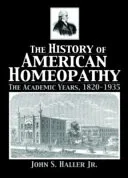
The History of American Homeopathy
 82
82

The History of American Homeopathy
John Haller’s "The History of American Homeopathy" provides a sober, academic account of a medical tradition that once held substantial sway in the United States. Haller excels at situating homeopathy within the broader context of 19th-century American medical thought, demonstrating its appeal and the systematic ways it was integrated into healthcare, particularly through institutions like Hahnemann Medical College in Philadelphia. A notable strength is the detailed examination of the professionalization of homeopathy, showing it as more than just a set of remedies but a developed practice with its own institutions and arguments. However, the book’s exhaustive detail, while academically rigorous, can sometimes make the narrative feel dense, occasionally obscuring the more compelling social and cultural dynamics at play. The discussion of the eventual decline, while factually presented, lacks a certain narrative urgency. Nevertheless, Haller’s work stands as a thorough, if unvarnished, record of a significant chapter in American medical history.
📝 Description
82
John Haller's 2005 history traces American homeopathy from 1820 to 1935.
John Haller's 2005 book chronicles the trajectory of homeopathic practice in the United States from 1820 to 1935. The study details how homeopathic approaches developed, experienced periods of widespread public and professional acceptance, and eventually diminished in mainstream medicine. Haller examines the intellectual climate that supported homeopathy's rise and subsequent decline.
This work will interest historians of medicine, especially those focused on alternative therapies. It also provides insights for scholars of American social history, illuminating public health views and practices during the 19th and early 20th centuries. Students of medical epistemology can use it to understand changes in accepted medical paradigms.
Haller revisits a time of significant change in American medicine, a period marked by the emergence of new scientific methods. Homeopathy, supported by figures such as Constantine Hering, gained prominence in the mid-19th century, challenging established medical practices. Debates were vigorous, with critics like Oliver Wendell Holmes Sr. questioning homeopathic principles, fueling discussions on medical legitimacy and effectiveness.
While not explicitly esoteric in its medical application, homeopathy arose from a period when vitalistic and energetic theories of disease were common, predating purely mechanistic views of biology. Its principle of 'like cures like' and the concept of potentization through serial dilution and succussion suggested forces beyond conventional chemical or physical explanations available at the time. This book examines how these ideas interacted with and were eventually superseded by the more materialist and evidence-based approaches that came to define modern Western medicine, placing homeopathy in a lineage of healing traditions that posited subtle or energetic principles.
💡 Why Read This Book?
• Understand the specific mechanisms and principles of homeopathic therapy, such as potentization, as detailed in Haller's examination of its development between 1820 and 1935. • Gain insight into the social and institutional factors that fueled homeopathy's widespread growth and eventual fall from favor in American medicine. • Analyze the intellectual battles between competing medical philosophies by examining critiques from figures like Oliver Wendell Holmes Sr. and the homeopaths' responses.
⭐ Reader Reviews
Honest opinions from readers who have explored this book.
❓ Frequently Asked Questions
When did homeopathy first gain significant traction in America?
Homeopathy began to gain significant traction in America during the early to mid-19th century, with its roots tracing back to the work of Samuel Hahnemann in Europe.
What were the main reasons for homeopathy's decline in popularity?
Homeopathy's decline was influenced by advancements in scientific medicine, stricter regulation of medical practice, and a lack of robust empirical evidence supporting its efficacy in large-scale studies.
Did homeopathy have its own medical institutions?
Yes, American homeopathy had its own institutions, including numerous colleges and hospitals, such as the Hahnemann Medical College in Philadelphia, which Haller discusses.
Who were some key figures in American homeopathy?
Key figures included Constantine Hering, often considered the 'father of American homeopathy,' and others who established colleges and promoted its practice.
What period does John Haller's "The History of American Homeopathy" primarily cover?
The book primarily covers the period from the academic years 1820 to 1935, detailing the development, acceptance, and eventual decline of homeopathic practice in the United States.
How did homeopathy interact with conventional medicine during its peak?
Homeopathy often coexisted and competed with conventional (allopathic) medicine, with ongoing debates and sometimes outright conflict over medical theories and practices.
🔮 Key Themes & Symbolism
The Law of Similars
This central tenet of homeopathy, 'like cures like,' posits that a substance causing symptoms in a healthy person can, in highly diluted form, treat similar symptoms in a sick person. Haller explores how this principle was applied and debated within American practice from its introduction in the 1820s, contrasting it with prevailing allopathic theories and examining the rationale behind its perceived efficacy by adherents.
Potentization and Dilution
The process of potentization, involving serial dilution and succussion (vigorous shaking), is a hallmark of homeopathic remedy preparation. The book details how these methods, often reaching extreme dilutions far beyond what conventional science could detect, were central to homeopathic practice and a major point of contention with allopathic medicine, which increasingly relied on measurable dosages.
Institutionalization of Homeopathy
Haller documents the significant efforts by homeopaths to establish their system within American society through dedicated medical colleges, hospitals, and professional societies. This institutionalization, particularly evident in the late 19th and early 20th centuries, highlights homeopathy's ambition to be recognized as a legitimate and distinct medical tradition, not merely a fringe practice.
The Fall from Favor
The work examines the complex factors leading to homeopathy's decline, including the rise of scientific medicine, the Flexner Report's influence on medical education standards, and the increasing demand for evidence-based treatments. Haller analyzes how these shifts gradually marginalized homeopathic practice within the mainstream medical landscape by the early 20th century.
💬 Memorable Quotes
Direct passages from the work, attributed to the author.
“The development of homeopathy’s unorthodox therapies”
— This phrase highlights the unique and often counter-intuitive nature of homeopathic treatments, setting them apart from the more established, and often invasive, medical practices of the era.
“Its burgeoning acceptance”
— This points to a specific historical phase where homeopathy transitioned from a niche concept to a widely recognized and utilized form of medical care in America.
“Its subsequent fall from favor”
— This indicates a dramatic shift in its societal and professional standing, marking a decline from popularity and acceptance to marginalization.
“Medicine’s introspective age of doubt”
— This suggests a period where medical science itself was questioning its own foundations and efficacy, creating an environment where alternative systems like homeopathy could gain ground.
“The emergence of new medical paradigms”
— This refers to the scientific and medical revolutions that eventually led to the dominance of evidence-based, scientifically validated treatments, eclipsing older or less verifiable systems.
🌙 Esoteric Significance
Tradition
While not explicitly aligned with a single esoteric lineage, homeopathy shares conceptual ground with vitalistic philosophies and early modern alchemy, particularly in its emphasis on subtle energies and transformative processes. Its principle of 'like cures like' and the extreme dilutions employed echo alchemical ideas of sympathetic magic and the extraction of essences, positioning it as a bridge between empirical observation and more metaphysical understandings of healing.
Symbolism
The core symbolism revolves around dilution as a form of refinement, transforming a potent substance into a healing force through a process akin to spiritual purification. The 'vital force' or 'life principle' central to homeopathic theory can be seen as a manifestation of the universal animating spirit found in many esoteric traditions, suggesting an underlying energetic connection between the remedy, the patient, and the cosmos.
Modern Relevance
Contemporary alternative and complementary medicine practitioners, particularly those in holistic health and energy healing modalities, often draw upon the philosophical underpinnings of homeopathy. Thinkers exploring consciousness, subtle energies, and the placebo effect continue to engage with its concepts, viewing it as a precursor to or parallel development with modern mind-body medicine and quantum healing theories.
👥 Who Should Read This Book
• Students of medical history and the evolution of therapeutic practices, seeking to understand a significant non-allopathic tradition. • Researchers in social and cultural history interested in belief systems, public health, and the development of professional identities in 19th-century America. • Practitioners and theorists of alternative medicine looking for historical context and the philosophical underpinnings of various healing modalities.
📜 Historical Context
John Haller's study is situated within the tumultuous field of 19th and early 20th-century American medicine, an era marked by rapid scientific advancement alongside persistent medical uncertainty. Homeopathy, introduced to the US in the 1820s, rapidly gained adherents, establishing its own colleges and hospitals, such as the Hahnemann Medical College in Philadelphia. This period saw intense intellectual friction; while figures like Constantine Hering championed its principles, prominent critics like Oliver Wendell Holmes Sr. publicly decried it as quackery. The work details how homeopathy navigated this environment, offering an alternative to the often harsh and ineffective treatments of so-called heroic medicine. Its eventual decline was precipitated by the professionalization of medicine, the rise of germ theory, and the standardization movements exemplified by the Flexner Report in 1910, which favored scientifically verifiable treatments and stricter educational standards.
📔 Journal Prompts
The principle of 'like cures like' in homeopathic practice.
Hahnemann's concept of the 'vital force' as presented in historical medical debates.
The institutional rivalries between homeopathic and allopathic medical colleges.
The impact of the Flexner Report on medical education and alternative therapies.
The societal acceptance and eventual decline of homeopathy between 1820 and 1935.
🗂️ Glossary
Allopathic Medicine
The term used by homeopaths to refer to conventional Western medicine, characterized by treatments that produce effects different from or opposite to those of the disease.
Law of Similars
The fundamental principle of homeopathy, stating that a substance which causes symptoms in a healthy person can cure similar symptoms in a sick person.
Potentization
The process of preparing homeopathic remedies through serial dilution and succussion (vigorous shaking), believed to increase the remedy's energetic power.
Succussion
The vigorous shaking or striking of a diluted solution during the preparation of homeopathic remedies, considered essential for activating the remedy's properties.
Vital Force
A concept in homeopathy and other vitalistic philosophies referring to an animating, non-physical energy that sustains life and maintains health.
Heroic Medicine
A term for the aggressive medical practices of the 18th and 19th centuries, including bloodletting, purging, and blistering, which homeopathy often sought to replace.
Flexner Report
A landmark report published in 1910 that assessed medical education in the United States and Canada, leading to significant reforms and the closure of many substandard medical schools.