The hidden wisdom in the Holy Bible
 84
84

The hidden wisdom in the Holy Bible
Hodson's attempt to unseal the esoteric strata of the Bible is ambitious, presenting a coherent, albeit Theosophically-inflected, reading of familiar passages. His exposition on the symbolic representation of spiritual evolution, particularly how the Exodus narrative can be seen as an allegory for the soul's journey, is a notable strength. However, the work occasionally falters under the weight of its own allegorical framework, sometimes stretching interpretations to fit a pre-determined esoteric schema. For instance, his reading of certain genealogies as maps of spiritual development requires significant interpretive leaps for the uninitiated. The book is most compelling when it grounds its symbolism in recognizable biblical themes, offering a fresh perspective on the Garden of Eden or the Parables. This is a serious scholarly effort for those already steeped in esoteric traditions seeking to connect them with Christian scripture.
📝 Description
84
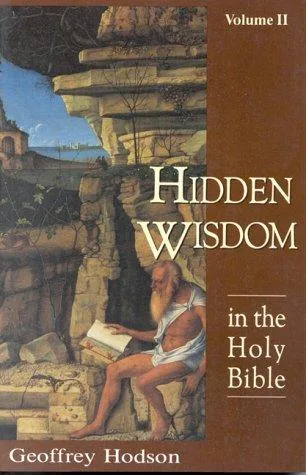
Geoffrey Hodson published The Hidden Wisdom in the Holy Bible in 1986.
This 1986 examination by Geoffrey Hodson looks beyond the literal meaning of the Christian scriptures. Hodson suggests the Bible contains a hidden spiritual blueprint, accessible through its symbolic language. He argues that biblical narratives and teachings are rich with mystical allegories and symbolic meanings.
The book is for readers who see the Bible as more than just a historical or theological text. It will appeal to students of comparative religion, occult philosophy, and spiritual traditions seeking a non-conventional understanding of biblical texts. Those interested in theosophy and Hermeticism will find particular relevance here.
Hodson's work continues a long tradition of esoteric biblical interpretation. This lineage includes figures like Helena Blavatsky and Annie Besant, who sought to uncover universal spiritual truths within sacred texts. The book reflects the Theosophical movement's effort to synthesize Eastern and Western mystical traditions, viewing the Bible as a repository of such synthesized wisdom.
💡 Why Read This Book?
• Gain an esoteric perspective on biblical narratives, learning to identify symbolic representations of spiritual evolution beyond literal interpretations, as explored in chapters discussing the allegorical nature of the Exodus. • Understand the Theosophical interpretation of key biblical figures and events, providing a comparative framework to standard theological readings, particularly concerning the concept of the 'Christ within' as a universal principle. • Discover the hidden spiritual blueprint Hodson suggests is encoded within scripture, offering a method for decoding its deeper meanings through the lens of ancient wisdom traditions, as exemplified by his analysis of the Garden of Eden symbolism.
⭐ Reader Reviews
Honest opinions from readers who have explored this book.
❓ Frequently Asked Questions
What is the primary esoteric tradition influencing 'The Hidden Wisdom in the Holy Bible'?
The primary esoteric tradition influencing Geoffrey Hodson's work is Theosophy, a spiritual movement that emerged in the late 19th century. This influence is evident in his allegorical interpretations of biblical texts and his focus on universal spiritual laws and the evolution of consciousness.
When was 'The Hidden Wisdom in the Holy Bible' first published?
Geoffrey Hodson's 'The Hidden Wisdom in the Holy Bible' was first published in 1986, continuing a long tradition of esoteric exegesis of sacred texts.
Does the book offer a literal interpretation of the Bible?
No, the book deliberately moves beyond literal interpretations. It focuses on uncovering symbolic, allegorical, and mystical meanings within the Holy Bible, viewing biblical stories as vehicles for conveying profound spiritual truths and cosmic principles.
Who is Geoffrey Hodson, the author?
Geoffrey Hodson (1886-1983) was a prominent figure in the Theosophical Society, known for his extensive writings on spiritual subjects, meditation, and clairvoyance. He was a prolific author and lecturer dedicated to exploring the inner dimensions of life.
What are the main themes explored in the book regarding biblical symbolism?
The book explores themes such as the Bible as a symbolic representation of spiritual evolution, the Christ principle as an inner divine reality, and the hidden meanings within parables and narratives like the Garden of Eden story and the Exodus.
Is this book suitable for beginners in esoteric studies?
While accessible to those with a serious interest, the book's depth of esoteric interpretation may be best suited for readers already familiar with spiritual symbolism or Theosophical concepts. Beginners might benefit from a foundational understanding of esoteric principles.
🔮 Key Themes & Symbolism
Biblical Allegory as Spiritual Map
Hodson posits that the Bible functions as an elaborate allegory, a map for the soul's journey toward divine consciousness. He reinterprets narratives like the Creation and the Fall not as historical events but as symbolic representations of cosmic principles and stages of human spiritual development. The Genesis account, for instance, is presented as a symbolic depiction of the descent of spirit into matter and the subsequent evolutionary path back to spiritual awareness. This approach frames the scriptures as a guide for inner transformation.
The Christ Principle Within
The book emphasizes the concept of the 'Christ within' as a universal divine principle residing in every human being, rather than solely identifying it with the historical Jesus. Hodson interprets biblical references to Christ as symbolic of this indwelling divinity and the potential for spiritual awakening. This perspective aligns with mystical traditions that seek the divine spark within the individual, offering a path to realizing one's own divine nature through spiritual discipline and understanding.
Symbolism of the Exodus
The liberation of the Israelites from Egypt in the Book of Exodus is analyzed as a profound allegory for the soul's liberation from the bondage of materialism and ignorance. Hodson suggests that the journey through the wilderness represents the challenges and purification processes encountered on the path of spiritual evolution. The Promised Land symbolizes the attainment of higher consciousness or spiritual realization, making the narrative a guide for overcoming inner obstacles and achieving spiritual freedom.
The 'Great Architect' and Cosmic Law
Hodson frames the biblical creation narratives and divine pronouncements through the lens of a universal, intelligent force – often referred to as the 'Great Architect' or Divine Mind. This concept suggests an ordered, law-governed universe where spiritual laws operate with precision. The book implies that understanding these underlying cosmic laws, as revealed through biblical symbolism, is essential for aligning oneself with the divine plan and facilitating spiritual growth.
💬 Memorable Quotes
Direct passages from the work, attributed to the author.
“The Bible is not a book of dogma, but a book of life; not a record of history, but a revelation of spiritual law.”
— This statement expresses Hodson's core thesis, contrasting his esoteric approach with literal, historical, or dogmatic readings. It frames the Bible as a dynamic source of living wisdom and universal principles applicable to spiritual development.
“The Garden of Eden represents not a physical place, but a state of consciousness.”
— This interpretation is central to Hodson's allegorical method. It redefines biblical settings as symbolic landscapes of the inner world, suggesting that spiritual truths are found within the human psyche rather than in external historical events.
💡 Key Ideas
Editorial paraphrase of the work's core concepts — not direct quotes.
Every character, every event, every command in scripture has its spiritual significance.
This paraphrase highlights Hodson's belief in the pervasive symbolism within the Bible. It suggests that no element is without a deeper, hidden meaning, inviting readers to look beyond the surface narrative for profound spiritual lessons.
The exodus from Egypt is the soul's journey out of the wilderness of ignorance.
This paraphrase illustrates the allegorical treatment of biblical narratives. It frames the Exodus story as a metaphor for the individual's spiritual quest, moving from a state of darkness and limitation towards enlightenment and freedom.
The Christ is the indwelling light, the potential for divinity within every human being.
This quote presents a mystical understanding of the Christ figure, emphasizing an inner, universal spiritual principle rather than a solely external historical or theological one. It points towards self-realization as the path to divine connection.
🌙 Esoteric Significance
Tradition
This work is firmly rooted in the Theosophical tradition, which seeks to synthesize Eastern and Western esoteric philosophies. Hodson applies Theosophical principles—such as reincarnation, karma, and the evolution of consciousness—to his interpretation of the Bible. He views the scriptures as a coded expression of universal spiritual laws and an inner path of development, a common theme in Theosophical exegesis that sought to demonstrate the underlying unity of all religions.
Symbolism
Key symbols explored include the Garden of Eden, which Hodson interprets as a state of consciousness rather than a physical location, representing innocence before the descent into material awareness. The Serpent symbolizes the awakening of intellect and the duality of knowledge. The Exodus narrative is treated as an allegory for the soul's liberation from ignorance and materialism, with the wilderness representing the trials of spiritual purification and the Promised Land signifying spiritual attainment.
Modern Relevance
Hodson's work continues to influence contemporary esoteric scholars and practitioners interested in comparative religion and mystical interpretations of scripture. It informs discussions within Theosophical circles, Anthroposophy, and various New Age spiritualities that seek to find universal truths within traditional religious texts. Readers today engage with his interpretations for a non-dogmatic, psychologically oriented understanding of biblical narratives, seeking personal spiritual growth through symbolic reading.
👥 Who Should Read This Book
• Students of Theosophy and comparative religion seeking to understand the esoteric interpretations of biblical texts within a 19th/20th-century framework. • Spiritual seekers interested in allegorical readings of scripture who wish to explore the Bible as a guide to inner transformation rather than historical record. • Esoteric practitioners looking for symbolic keys to unlock deeper meanings in biblical stories, parables, and characters for personal spiritual development.
📜 Historical Context
Geoffrey Hodson's 'The Hidden Wisdom in the Holy Bible' (1986) emerged within the continuing stream of esoteric interpretation that gained significant traction in the late 19th and early 20th centuries, heavily influenced by the Theosophical Society. Figures like Helena Blavatsky and Annie Besant had already laid groundwork by suggesting that world scriptures, including the Bible, contained coded spiritual truths accessible through symbolic analysis. Hodson, a prominent Theosophist himself, worked within this intellectual current, aiming to synthesize biblical narratives with universal spiritual principles. His work can be seen as a response to, and continuation of, the Theosophical project of revealing the 'Ancient Wisdom' underlying all religions. While not directly engaging with contemporary biblical scholarship of the 1980s, which often focused on historical-critical methods, Hodson's book offered a distinct alternative, appealing to those seeking spiritual meaning rather than historical fact. His approach was part of a broader esoteric milieu that included movements like the Hermetic Order of the Golden Dawn and later New Age thought, all exploring hidden dimensions within established religious frameworks.
📔 Journal Prompts
The symbolic meaning of the Serpent in the Garden of Eden as presented by Hodson.
How does the concept of the 'Christ within' compare to other traditions' immanent divine principles?
Reflect on the Exodus narrative as an allegory for personal spiritual liberation.
Consider the biblical genealogies as maps of spiritual development, as suggested in the work.
Analyze a chosen parable through the lens of Hodson's esoteric interpretation.
🗂️ Glossary
Theosophy
A spiritual philosophy founded in the late 19th century, seeking to synthesize Eastern and Western religions, philosophies, and sciences, positing a universal divine wisdom underlying all existence and emphasizing spiritual evolution.
Allegory
A story, poem, or picture that can be interpreted to reveal a hidden meaning, typically a moral or political one. In this context, biblical narratives are viewed as symbolic vehicles for spiritual truths.
Esoteric
Intended for or likely to be understood by only a small number of people with a specialized knowledge or interest. Refers to inner, hidden teachings often contrasted with exoteric, outward teachings.
Spiritual Evolution
The Theosophical concept of gradual development of consciousness and spiritual awareness through various lifetimes and stages of existence, leading towards divine perfection.
Inner Christ
The concept of the divine spark or Christ principle residing within each individual, representing the potential for spiritual realization and union with the divine.
Cosmic Law
Universal principles governing the operation of the cosmos, believed by esotericists to be precise and immutable, influencing all levels of existence and consciousness.
Spiritual Blueprint
An underlying divine pattern or plan for spiritual development and cosmic order, believed to be encoded within sacred texts and observable in nature.
🔮 Readers Also Liked
Browse all →








More by Geoffrey Hodson
All books →





More Free Theosophy & Anthroposophy Books
View all →