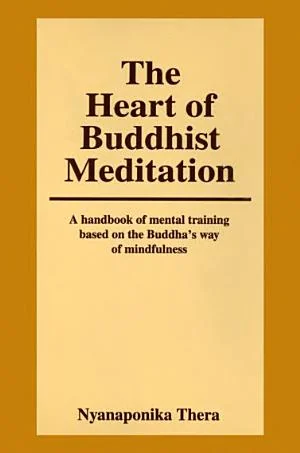
The Heart of Buddhist Meditation
 76
76

The Heart of Buddhist Meditation
Nyanaponika Thera’s "The Heart of Buddhist Meditation" offers a rigorously structured approach to Vipassanā that distinguishes it from more generalized mindfulness literature. The author’s strength lies in his ability to translate complex Pali suttas into accessible, actionable instructions, particularly evident in his detailed exposition of the Four Foundations of Mindfulness. One limitation, however, is the text's inherent focus on the Theravada tradition, which may feel less inclusive to those exploring broader Buddhist or cross-traditional meditative paths. The section dissecting the concentration states, while informative, can become quite technical, demanding sustained reader attention. Yet, the clarity with which Thera elucidates the path from initial awareness to profound insight makes this a significant contribution to understanding Buddhist contemplative practice, especially the crucial link between concentration and wisdom.
📝 Description
76
Nyanaponika Thera's 2005 book is a direct guide to Buddhist insight meditation.
Nyanaponika Thera's "The Heart of Buddhist Meditation" offers a systematic breakdown of Vipassanā, or insight meditation, as taught in the Buddhist tradition. Published first in 2005, it has become a standard text for those interested in the practice and study of mindfulness.
The book details the Four Foundations of Mindfulness: body, feelings, mind, and mental objects. It explains how concentration, known as samatha, supports the development of insight, or vipassanā. Thera also discusses challenges practitioners might face and the ethical guidelines that underpin meditative work.
This text is suitable for anyone looking for a structured approach to meditation rooted in the Buddha's original teachings. It is especially useful for individuals who wish to apply mindfulness in practical ways, moving beyond simple relaxation.
Emerging in the mid-20th century, this work appeared as Western interest in Eastern spiritual paths grew. Nyanaponika Thera's book provided a clear exposition of Theravada Buddhist meditation, focusing on the Satipaṭṭhāna Sutta. Its accessibility helped establish Buddhist meditation as a subject for serious study and practice outside of its Asian origins.
💡 Why Read This Book?
• Gain a systematic understanding of the Four Foundations of Mindfulness, as detailed in the Satipaṭṭhāna Sutta, to develop a structured approach to contemplative practice. • Learn the relationship between concentration (samatha) and insight (vipassanā) meditation, a core distinction within Buddhist practice first articulated in ancient India. • Understand the role of ethical conduct (sila) in supporting meditative development, as outlined by Nyanaponika Thera, for a holistic approach to spiritual growth.
⭐ Reader Reviews
Honest opinions from readers who have explored this book.
❓ Frequently Asked Questions
What is Vipassanā meditation as described in 'The Heart of Buddhist Meditation'?
Vipassanā, or insight meditation, is presented as the core practice for developing wisdom. It involves direct observation of reality—impermanence, suffering, and non-self—through focused attention on the body, feelings, mind, and mental phenomena, as detailed by Nyanaponika Thera.
Is 'The Heart of Buddhist Meditation' suitable for beginners?
Yes, while it delves deeply into Buddhist philosophy, the book is structured to guide both beginners and experienced practitioners. Nyanaponika Thera’s exposition of basic mindfulness techniques makes it accessible for those new to meditation.
What is the significance of the Satipaṭṭhāna Sutta in this book?
The Satipaṭṭhāna Sutta is central, forming the framework for the book's exploration of the Four Foundations of Mindfulness. Nyanaponika Thera uses this ancient text, composed in Pali, as the primary source for his detailed instructions on meditation practice.
Does the book cover different types of Buddhist meditation?
Primarily, it focuses on Vipassanā (insight) and its preparatory stage, Samatha (concentration) meditation, as taught within the Theravada tradition. It provides a comprehensive guide to these specific practices.
When was 'The Heart of Buddhist Meditation' first published?
The book was first published on December 1, 2005, though its teachings are rooted in much older Buddhist traditions and texts. Its enduring popularity speaks to the timeless relevance of its content.
What does 'mindfulness' mean in the context of this book?
Mindfulness, or 'sati' in Pali, refers to a state of alert attention and clear comprehension. In the book, it is cultivated through systematic observation of one's physical and mental experiences, as outlined by the Buddha.
🔮 Key Themes & Symbolism
Four Foundations of Mindfulness
The book meticulously elaborates on the Four Foundations of Mindfulness: mindfulness of the body, feelings, mind, and mental objects. Nyanaponika Thera presents these as direct fields for investigative practice, moving beyond theoretical understanding to lived experience. This systematic approach, rooted in the Satipaṭṭhāna Sutta, forms the backbone of the book, guiding the reader to observe phenomena as they arise and pass away, fostering clear comprehension and equanimity.
Concentration and Insight
A central theme is the interdependence of concentration (samatha) and insight (vipassanā). Thera explains how developing focused attention through samatha creates a stable platform from which to observe the true nature of reality—impermanence, unsatisfactoriness, and non-self. This distinction is crucial for understanding the progressive stages of Buddhist meditation, moving from calming the mind to penetrating its deepest workings.
The Path to Liberation
Ultimately, 'The Heart of Buddhist Meditation' frames these practices within the broader context of the Buddhist path to liberation from suffering. Nyanaponika Thera emphasizes that mindfulness is not merely a psychological tool but a profound spiritual discipline aimed at awakening. Ethical conduct (sila) and wisdom (prajna) are presented as integral components supporting this ultimate goal.
Practical Application
The work prioritizes practical application over abstract philosophy. Thera provides detailed instructions on how to cultivate mindfulness in daily life and during formal meditation sessions. He addresses common hindrances and offers methods for overcoming them, making the ancient teachings of the Buddha accessible and relevant for contemporary practitioners.
💬 Memorable Quotes
Direct passages from the work, attributed to the author.
“Concentration is the foundation upon which insight is built.”
— This concise statement captures the essential relationship between samatha and vipassanā, underscoring the necessity of mental stability for developing wisdom.
“The practice of insight meditation leads to the understanding of impermanence, suffering, and non-self.”
— This captures the ultimate aim of Vipassanā as presented in the book: the direct realization of the Three Marks of Existence, leading to liberation.
“Ethical conduct is not separate from meditation but an integral part of the path.”
— This reflects the book's holistic view, where right action (sila) supports mental development and wisdom, as expounded by Nyanaponika Thera.
“The Great Discourse on Mindfulness provides the complete map for the contemplative journey.”
— This interpretation points to the foundational importance of the Satipaṭṭhāna Sutta, which the book systematically unpacks for the practitioner.
💡 Key Ideas
Editorial paraphrase of the work's core concepts — not direct quotes.
Mindfulness is the awareness that arises from the constant observation of one's own body, feelings, mind, and mental objects.
This paraphrase highlights the book's emphasis on direct, moment-to-moment observation as the core of mindfulness practice, grounding it in the Four Foundations.
🌙 Esoteric Significance
Tradition
While rooted in the Theravada Buddhist tradition, Nyanaponika Thera’s work functions as an esoteric text for Western practitioners by making the subtle, internal path of Vipassanā accessible. It offers a systematic, almost alchemical process for transforming consciousness, focusing on the purification of mind through disciplined observation, a common thread in many esoteric lineages seeking inner transformation.
Symbolism
The Four Foundations of Mindfulness (body, feelings, mind, mental objects) can be seen as symbolic microcosms of the practitioner's entire existence. The body represents the material, the feelings the affective, the mind the cognitive, and mental objects the conceptual or spiritual realm. The practice symbolizes the alchemical process of observing and refining each aspect to achieve a unified, liberated consciousness.
Modern Relevance
Contemporary mindfulness-based interventions (MBIs) like MBSR and MBCT owe a significant debt to the foundational work laid by texts like this. Thinkers and practitioners in secularized mindfulness, as well as those in Western Buddhist and contemplative science circles, continue to draw on Thera’s precise distinctions between concentration and insight for developing advanced meditative skills.
👥 Who Should Read This Book
• Dedicated students of Buddhism seeking a deep, textual understanding of Vipassanā meditation, moving beyond introductory concepts. • Contemplative practitioners interested in the specific techniques and philosophical underpinnings of the Theravada tradition as presented in its original form. • Scholars of comparative religion and psychology interested in the structure and practice of mindfulness as taught by the Buddha.
📜 Historical Context
Published in 2005, "The Heart of Buddhist Meditation" arrived in a Western landscape increasingly receptive to Eastern spiritual practices, yet often seeking accessible, systematic guides. While figures like Alan Watts popularized Zen and Swami Vivekananda introduced Vedanta, Nyanaponika Thera’s work offered a rigorous, step-by-step exposition of Theravada Buddhist meditation, specifically drawing from the Pali Canon. Its meticulous translation and commentary on the Satipaṭṭhāna Sutta filled a void for practitioners seeking authentic instruction beyond generalized mindfulness. The book emerged during a period when Buddhist scholarship was gaining academic traction, with scholars like Edward Conze also translating and analyzing similar texts. Unlike more syncretic or Westernized interpretations of meditation appearing at the time, Thera’s approach remained firmly rooted in the original Buddhist teachings, making it a crucial reference point for dedicated students.
📔 Journal Prompts
The Four Foundations of Mindfulness as fields of investigation.
Cultivating concentration (samatha) to support insight (vipassanā).
Observing impermanence in daily feelings.
The role of clear comprehension in mental object awareness.
Ethical conduct (sila) as a support for meditation.
🗂️ Glossary
Vipassanā
Insight meditation, a core practice in Buddhism aimed at developing wisdom by directly observing the nature of reality (impermanence, suffering, non-self).
Samatha
Calm-abiding or concentration meditation, practiced to develop mental stability and focus, often serving as a preparation for Vipassanā.
Satipaṭṭhāna Sutta
A significant discourse of the Buddha, found in the Pali Canon, which forms the basis for the Four Foundations of Mindfulness and is central to this book.
Sila
Ethical conduct or morality, considered a fundamental aspect of the Buddhist path that supports mental development and wisdom.
Anicca
Impermanence; the doctrine that all conditioned phenomena are in a constant state of flux.
Dukkha
Suffering or unsatisfactoriness; the inherent stress and pain in conditioned existence.
Anattā
Non-self; the doctrine that there is no permanent, unchanging self or soul in phenomena.
This book appears in 2 collections
🔮 Readers Also Liked
Browse all →









From the “Meditation” Collection
View all →







More Free Occult Philosophy Books
View all →