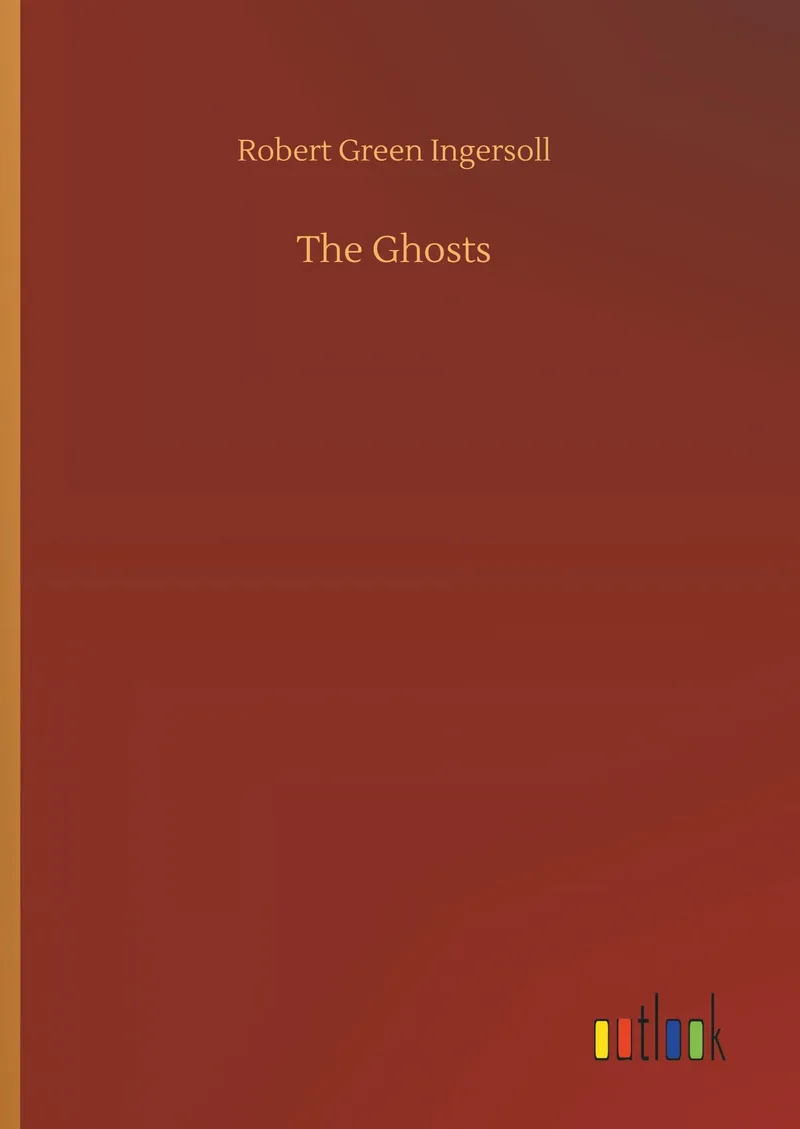
The Ghosts
 77
77

The Ghosts
Ingersoll's "The Ghosts" offers a sharp, if somewhat dated, dissection of spiritualist claims. His relentless application of rationalism to phenomena like hauntings is the work's primary strength, providing a clear articulation of skeptical inquiry from the late 19th century. He masterfully exposes the logical fallacies and psychological biases that underpin many supernatural beliefs. However, the text's limitation lies in its occasional condescension towards believers and its reliance on scientific understanding of the time, which has since evolved. The passage where Ingersoll dissects the supposed spectral sounds as mere auditory illusions, attributing them to "the wind, the creaking of timbers, or the scurrying of rats," is particularly illustrative of his approach.
Ultimately, "The Ghosts" is a valuable historical document for understanding the freethought movement, rather than a contemporary guide to the paranormal.
📝 Description
77
Robert Green Ingersoll published "The Ghosts" in 1879, a rationalist critique of spiritualist claims.
Published in 1879, Robert Green Ingersoll's "The Ghosts" offers a sharp rationalist examination of spiritualist phenomena. Ingersoll, a prominent freethinker of the late 19th century, dissects accounts of hauntings and spectral visitations not to endorse the supernatural, but to analyze the beliefs and psychological factors that foster such convictions. He approaches these claims through the lens of scientific skepticism and psychological explanation, seeking to demystify occurrences often attributed to the ethereal.
This work is intended for readers interested in the history of skepticism, psychical research, and the philosophical discussions surrounding belief in the afterlife. It appeals to those who value rigorous argumentation against superstition and wish to grasp the historical context of rationalist thought. The book scrutinizes the psychological underpinnings of ghost sightings, proposing that fear, suggestion, and misinterpretation of natural events are principal drivers. Ingersoll deconstructs the testimonies of those claiming supernatural encounters, providing alternative explanations rooted in sensory illusions, hysteria, and the desire for comfort.
Ingersoll's "The Ghosts" stands as a significant text within the broader tradition of freethought and skepticism that challenged prevailing spiritualist movements of the late 19th century. While spiritualism itself explored what it perceived as direct communication with the afterlife, Ingersoll's work exemplifies a countercurrent dedicated to empirical evidence and rational explanation. His approach contrasts with those who sought validation for the unseen, instead focusing on human perception, societal anxieties, and the potential for deception or self-deception in reported encounters with spirits. This book engages with the era's fascination with the supernatural by offering a distinctly materialist perspective.
💡 Why Read This Book?
• Understand the historical roots of rationalist critiques of the supernatural, specifically Ingersoll's 1879 arguments against ghost beliefs, providing context for modern skepticism. • Examine how 19th-century scientific understanding was applied to debunk spiritualist claims, learning from Ingersoll's methodical deconstruction of anecdotal evidence. • Gain insight into the psychological factors Ingersoll identified, such as fear and suggestion, as explanations for alleged hauntings, enhancing your critical thinking skills.
⭐ Reader Reviews
Honest opinions from readers who have explored this book.
❓ Frequently Asked Questions
When was Robert Green Ingersoll's "The Ghosts" first published?
Robert Green Ingersoll's "The Ghosts" was first published in 1879, reflecting the intellectual climate and debates surrounding spiritualism during the late 19th century.
What is the main argument of "The Ghosts"?
The primary argument of "The Ghosts" is that reported supernatural phenomena, such as hauntings, can be explained through rational, naturalistic causes like psychological suggestion, misinterpretation of natural events, and fear, rather than actual ghosts.
What historical movement does "The Ghosts" engage with?
The book directly engages with the spiritualism movement, which gained significant traction in the mid-to-late 19th century, offering a skeptical counterpoint to widespread belief in mediums and spectral communication.
Who was Robert Green Ingersoll?
Robert Green Ingersoll (1833-1899) was a prominent American orator, writer, and lecturer known for his advocacy of atheism and agnosticism. He was a leading figure in the freethought movement, challenging religious dogma and superstition.
Does "The Ghosts" offer scientific evidence for its claims?
Ingersoll's work relies on logical reasoning and appeals to empirical observation and common sense, characteristic of the scientific skepticism of his era, rather than presenting novel scientific experiments.
Is "The Ghosts" a primary source for studying spiritualism?
Yes, "The Ghosts" serves as a primary source for understanding the skeptical response to spiritualism in the late 19th century, offering insight into the arguments used to counter its influence.
🔮 Key Themes & Symbolism
Rationalist Explanation of Phenomena
Ingersoll systematically dismantles claims of spectral visitations by offering rational explanations grounded in psychology and observation. He argues that phenomena attributed to ghosts are more likely products of fear, misinterpretation of natural sounds and sights, or even deliberate deception. The work emphasizes empirical evidence and logical deduction as superior tools for understanding the world compared to anecdotal accounts or supernatural beliefs. This theme is central to his 1879 critique, aiming to clarify the unseen and promote a scientific worldview.
Critique of Spiritualism
As a direct response to the burgeoning spiritualism movement of the 19th century, "The Ghosts" serves as a significant critique. Ingersoll challenges the credibility of mediums and the validity of messages from the deceased, highlighting the societal and psychological factors that fueled belief in such practices. He posits that the comfort derived from perceived contact with departed loved ones often overrides critical judgment, making individuals susceptible to fraud or self-deception. This theme positions the book within the broader intellectual conflict of its time.
The Role of Psychology in Belief
A core tenet of Ingersoll's argument is the power of the human mind to create or perceive phenomena that do not objectively exist. He explores how fear, anticipation, and suggestion can profoundly influence perception, leading individuals to interpret ambiguous stimuli as supernatural. This focus on the psychological underpinnings of belief anticipates later studies in cognitive biases and the sociology of belief, offering a precursor to modern understandings of why people accept extraordinary claims without sufficient evidence.
Skepticism as an Intellectual Stance
Ingersoll embodies the spirit of late 19th-century skepticism, advocating for critical inquiry and a rejection of dogma. "The Ghosts" is not merely an attack on spiritualism but a broader statement on the importance of intellectual honesty and the courage to question widely accepted beliefs. His work champions reason and evidence, urging readers to adopt a stance of healthy doubt towards claims that lack verifiable support. This theme underscores his role as a prominent freethinker.
💬 Memorable Quotes
Direct passages from the work, attributed to the author.
“The fear of the supernatural is often the parent of the belief in it.”
— This expresses Ingersoll's view that emotional states, particularly fear, can drive individuals to accept supernatural explanations for events, rather than seeking rational causes.
“What is called a ghost is often a shadow mistaken for a substance.”
— This metaphor highlights Ingersoll's core argument: perceived supernatural entities are frequently misinterpretations of natural phenomena or psychological projections.
“Credulity is the companion of ignorance.”
— Ingersoll links the tendency to believe without evidence to a lack of knowledge or critical thinking skills, suggesting education is a bulwark against superstition.
“The evidence for ghosts is about as substantial as the ghosts themselves.”
— A sharp, concise statement underscoring his assessment of the lack of credible evidence supporting the existence of ghosts.
“The human mind, when willing to believe, can find reasons in the wind.”
— This emphasizes the active role of the individual's desire to believe, suggesting that confirmation bias can lead people to perceive evidence for their desired conclusions, even where none exists.
🌙 Esoteric Significance
Tradition
While Ingersoll himself was a staunch rationalist and atheist, his work is significant in the context of esoteric studies as a critical counterpoint. It engages with the broader cultural milieu in which many esoteric traditions, including spiritualism, flourished. By dissecting the mechanisms of belief and illusion, Ingersoll inadvertently provides a framework for understanding the psychological and societal conditions that make esoteric claims appealing, even as he rejects their supernatural basis.
Symbolism
The central 'symbol' in "The Ghosts" is not a traditional esoteric motif but the very concept of the 'ghost' itself. Ingersoll deconstructs this symbol, stripping it of its supernatural connotations and reinterpreting it as a manifestation of psychological states like fear and grief, or as a product of misinterpretation. He also implicitly engages with the symbolism of light and darkness, where rationality (light) is pitted against the perceived mysteries of the unseen (darkness).
Modern Relevance
Ingersoll's arguments remain relevant for contemporary skeptics and critical thinkers examining phenomena such as ghost hunting shows, parapsychological claims, and the psychology of belief. His meticulous approach to deconstructing anecdotal evidence and highlighting psychological biases informs modern critical thinking practices and the study of cognitive illusions within psychology and philosophy.
👥 Who Should Read This Book
• Students of 19th-century American intellectual history and the freethought movement, seeking primary source material on the debates surrounding spiritualism. • Aspiring skeptics and critical thinkers interested in learning historical methods of debunking supernatural claims through rational and psychological analysis. • Researchers in the history of science and psychology, examining the evolution of explanations for unexplained phenomena and the societal impact of belief systems.
📜 Historical Context
Robert Green Ingersoll's "The Ghosts," first published in 1879, emerged during a period of intense public fascination with spiritualism. Following the American Civil War, mediums, séances, and alleged communications with the dead became widespread phenomena, influencing social circles from the common person to intellectuals. Ingersoll, a prominent orator and leading figure of the American freethought movement, stood in stark contrast to proponents like Arthur Conan Doyle, who embraced spiritualism. Ingersoll’s work served as a direct challenge to these beliefs, employing rationalist arguments and psychological insights to debunk supernatural claims. He engaged with the prevailing scientific discourse of the era, using logic and empirical reasoning—as understood then—to counter the wave of spiritualist fervor that swept through America and Europe, prompting widespread debate on religion, science, and the nature of reality.
📔 Journal Prompts
Ingersoll's critique of spectral phenomena: How does your personal experience align with or diverge from his rational explanations?
The concept of 'credulity' as discussed by Ingersoll: Reflect on instances where belief, rather than evidence, seemed to drive acceptance.
Analyze a common superstition: Apply Ingersoll's methods of questioning and seeking naturalistic explanations.
The role of fear in belief, as outlined by Ingersoll: Identify how fear might influence interpretations of events in your own life.
Ingersoll's emphasis on evidence: How can you more rigorously apply evidential standards to extraordinary claims you encounter today?
🗂️ Glossary
Spiritualism
A religious movement prominent in the 19th century that asserted the possibility of communicating with the spirits of the dead, often through mediums.
Freethought
A philosophical movement that advocates for opinions and beliefs based on logic, reason, and empirical evidence, rather than religious dogma or tradition.
Rationalism
A philosophical stance emphasizing reason as the primary source of knowledge and justification, often contrasted with empiricism or faith.
Medium
A person believed to be able to communicate with the spirits of the dead, acting as an intermediary between the living and the spiritual realm.
Skepticism
An attitude of doubt or a disposition to incredulity, either in general or toward a particular subject or belief.
Superstition
A belief or way of behaving that is based on fear of the unknown and of magic or luck, or on a false idea of what is known about things.
Anecdotal Evidence
Evidence based on personal accounts rather than on investigation or scientific data.