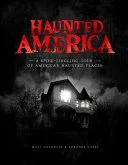
Haunted America
 75
75

Haunted America
Matt Chandler and Suzanne Garbe's Haunted America offers a sprawling, if somewhat undiscriminating, catalog of spectral sightings. Its strength lies in the sheer volume of reported phenomena, presenting a broad sweep of American ghost lore from historical accounts to more contemporary anecdotes. One striking example is the detailed recounting of the Bell Witch legend, a narrative deeply embedded in American folklore. However, the book’s limitation is its lack of critical analysis; it largely presents these accounts without much skepticism or deeper investigation into their origins or cultural impact. The work explores a wide array of alleged hauntings but rarely pauses to dissect the psychological or sociological underpinnings that might explain them. Ultimately, Haunted America serves as a comprehensive index of hauntings but offers little in the way of critical discernment.
📝 Description
75
Haunted America (2009) collects over 200 accounts of spectral phenomena across the United States.
Matt Chandler and Suzanne Garbe compiled a catalog of reported hauntings and paranormal events throughout the United States. The book draws from historical records, folklore, and personal accounts to document a wide array of alleged supernatural occurrences. It distinguishes between different types of hauntings, such as residual phenomena, where past events seem to replay, and intelligent hauntings, which suggest the presence of conscious entities.
The work examines the geographical distribution of these reported hauntings, linking specific locations like battlefields and old asylums to their associated spectral narratives. It aims to present a broad overview of documented ghostly encounters rather than a deep theoretical analysis. This approach provides a comprehensive look at the persistence of unexplained phenomena in American history and culture.
This collection engages with the long-standing human interest in ghosts and the afterlife, a tradition present in folklore across cultures. It reflects the historical development of spiritualism and paranormal inquiry in America, particularly during the 19th and early 20th centuries when such topics gained widespread attention. The book situates these accounts within a continuous cultural thread of exploring the unexplained, predating modern scientific investigation.
💡 Why Read This Book?
• Understand the geographical spread of reported hauntings across the United States, learning how specific locations like the Eastern State Penitentiary are linked to spectral narratives. • Explore the concept of 'residual energy' versus 'intelligent hauntings,' gaining insight into different theoretical frameworks used to describe paranormal activity. • Discover a wide array of documented ghost sightings, providing a foundational understanding of American folklore and its persistent engagement with the supernatural.
⭐ Reader Reviews
Honest opinions from readers who have explored this book.
❓ Frequently Asked Questions
What is the primary focus of Haunted America by Matt Chandler and Suzanne Garbe?
The book primarily focuses on documenting reported ghost sightings and hauntings across various locations in the United States, drawing from historical records and eyewitness accounts.
Does Haunted America provide explanations for the hauntings it describes?
While it describes various phenomena, the book largely presents accounts without offering definitive explanations or deep critical analysis of their causes.
Are there specific types of locations featured in Haunted America?
Yes, the book covers a wide range of locations, including historical sites, old buildings, battlefields, and private residences, all associated with reported paranormal activity.
Who would benefit most from reading Haunted America?
Individuals interested in American folklore, ghost stories, paranormal investigation, and cultural history would find this book particularly engaging.
When was Haunted America first published?
Haunted America was first published in 2014, compiling a collection of spectral accounts relevant to American geography and history.
Does the book categorize different types of hauntings?
Yes, the work explores different categories of hauntings, such as residual energy phenomena and alleged intelligent hauntings, offering a nuanced look at spectral reports.
🔮 Key Themes & Symbolism
Geography of the Paranormal
Haunted America maps the spectral field of the United States, linking specific geographical locations to reported hauntings. This includes infamous sites like the Eastern State Penitentiary in Philadelphia or the battlefields of Gettysburg, suggesting that place itself can become imbued with psychic energy. The book presents these locations not merely as backdrops but as active participants in the narrative of the paranormal, where historical events and lingering presences intertwine. It creates a kind of cartography of the uncanny, inviting readers to consider how national history and local folklore contribute to the phenomena of American hauntings.
Manifestations of Spectral Activity
The work delineates distinct forms of reported supernatural occurrences. It differentiates between 'residual hauntings,' often described as imprints of past events replaying without conscious intent, and 'intelligent hauntings,' which suggest the presence of discernible entities capable of interaction. This categorization allows for a more nuanced understanding of the varied phenomena attributed to ghosts, moving beyond a monolithic concept of spectral presence. The book explores how these different types of activity are perceived and reported, reflecting a spectrum of human experience with the unexplained.
Folklore and Eyewitness Testimony
Central to Haunted America is the reliance on folklore and eyewitness accounts as primary sources for documenting hauntings. The book draws heavily on oral traditions, historical anecdotes, and personal testimonies, presenting them as evidence of paranormal activity. This approach highlights the significant role that storytelling and collective memory play in shaping our understanding of ghosts and the supernatural. By compiling these narratives, the authors tap into a rich vein of American cultural heritage, where tales of the spectral are deeply woven into the fabric of local and national identity.
The American Ghost Narrative
Haunted America contributes to a distinct tradition of American ghost narratives, often infused with the nation's historical events, expansion, and diverse cultural influences. Unlike European ghost lore which might focus on ancient castles, American hauntings frequently occur in more contemporary settings like old homes, asylums, or sites of historical conflict such as the Civil War battlefields. The book showcases how these narratives reflect anxieties, historical traumas, and the enduring human fascination with what lies beyond the veil within the unique context of the United States.
💬 Memorable Quotes
Direct passages from the work, attributed to the author.
“Reports detail apparitions and unexplained phenomena in locations ranging from historic homes to public institutions.”
— This highlights the pervasive nature of reported hauntings across diverse American settings, suggesting that spectral activity is not confined to specific types of environments but can manifest widely.
“The Bell Witch legend persists as a significant narrative in American folklore.”
— This points to the enduring power of specific ghost stories to embed themselves within cultural memory, illustrating how certain narratives become touchstones for discussions about the paranormal.
“Accounts often differentiate between lingering energy and conscious spectral presence.”
— This distinguishes between two primary conceptualizations of hauntings: one as an echo of past events and the other as an active, perhaps intelligent, entity, reflecting theoretical approaches within paranormal studies.
“Specific locations are often cited as focal points for repeated paranormal occurrences.”
— This emphasizes the importance of place in ghost lore, suggesting that certain sites possess unique qualities that attract or retain spectral manifestations, linking geography to the supernatural.
“Eyewitness testimony forms a substantial basis for the documented hauntings.”
— This underscores the reliance on personal experience and anecdotal evidence in the study of hauntings, acknowledging the human element as a key source of paranormal accounts.
🌙 Esoteric Significance
Tradition
While not explicitly tied to a singular esoteric lineage, Haunted America appeals to the broader tradition of occultism that seeks to understand and document phenomena beyond conventional scientific explanation. It aligns with a general interest in the unseen world, a core tenet in many esoteric paths. The book's focus on spirit manifestation and the lingering presence of the departed echoes themes found in spiritualism and certain branches of mediumship, albeit presented in a more folkloric and less ritualistic manner.
Symbolism
The book implicitly uses locations as symbols. A former asylum, for instance, symbolizes past suffering and confinement, while a historic battlefield symbolizes unresolved conflict and the elements of violence. These places become symbolic vessels for the residual energies and spectral presences documented, representing tangible anchors for intangible phenomena. The spectral figures themselves, whether residual or intelligent, symbolize the persistent human concern with mortality, memory, and the possibility of an afterlife or continued consciousness.
Modern Relevance
Contemporary paranormal investigation groups and enthusiasts often draw on compendiums like Haunted America for case studies and inspiration. The book's approach to cataloging hauntings informs methodologies used in ghost hunting, emphasizing location-based research and the collection of anecdotal evidence. Thinkers exploring the cultural impact of ghost stories or the psychology of fear might also find its extensive listings useful as a resource for understanding the prevalence and evolution of spectral narratives in American culture.
👥 Who Should Read This Book
• Amateur paranormal investigators seeking a wide range of case studies and potential locations for investigation. • Students of American folklore and cultural history interested in the prevalence and evolution of ghost stories. • General readers curious about reported supernatural phenomena and their connection to American history and geography.
📜 Historical Context
Published in 2014, Haunted America emerged during a period of sustained popular interest in the paranormal, fueled by television programs and online communities dedicated to ghost hunting. This era saw a continued engagement with folkloric traditions, building upon earlier waves of spiritualism and parapsychology that gained momentum in the late 19th century. While the book itself doesn't engage deeply with academic discourse, it taps into a cultural zeitgeist that often parallels the work of folklorists like Vance Randolph, who documented Ozark folklore, or the more sensationalist paranormal literature of the 20th century. The reception of such books generally catered to a public eager for unexplained mysteries, often existing outside the purview of mainstream academic inquiry and facing skepticism from scientific circles.
📔 Journal Prompts
The concept of 'residual energy' as a haunting mechanism.
The geographical distribution of reported hauntings across different American states.
The role of eyewitness testimony in documenting spectral phenomena.
The distinction between 'residual' and 'intelligent' hauntings.
The historical context of specific haunted locations mentioned in the book.
🗂️ Glossary
Residual Haunting
A type of reported haunting characterized by the non-interactive replay of past events or emotions, believed to be imprinted on a location's environment.
Intelligent Haunting
A form of alleged haunting where a distinct spectral entity appears to be conscious and capable of interacting with the living, responding to questions or exhibiting awareness.
Apparition
The visual manifestation of a ghost or spirit, typically seen as a spectral figure or form.
Eyewitness Testimony
First-hand accounts provided by individuals who claim to have directly experienced or observed a paranormal event.
Folklore
The traditional beliefs, customs, and stories of a community, passed through generations by word of mouth, often including tales of the supernatural.
Paranormal Investigation
The systematic examination of alleged supernatural phenomena, often involving the use of specialized equipment and the collection of anecdotal evidence.
Spectral Phenomena
A broad term encompassing reported occurrences involving ghosts, spirits, or other disembodied entities.