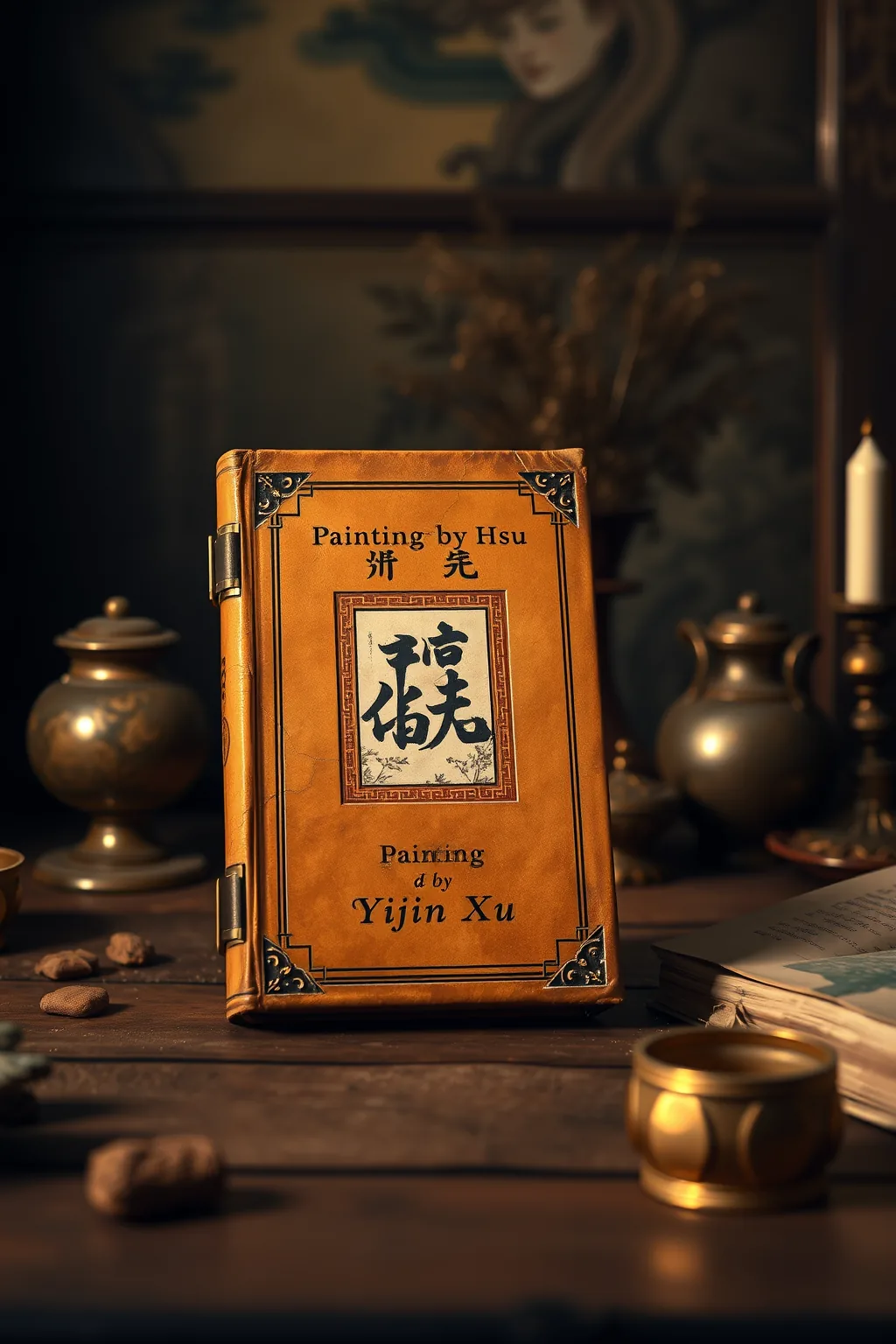
Painting by Hsu I-Ching
 61
61

Painting by Hsu I-Ching



Silas Hawthorne, Hermetic Studies Editor: "Painting by Hsu I-Ching" is a revelation, a meticulously researched and deeply insightful compendium that recontextualizes Chinese landscape painting as a sophisticated system of esoteric knowledge. Yijin Xu masterfully deciphers the symbolic lexicon employed by artists like Hsu I-Ching, demonstrating their function as divinatory tools and mirrors of cosmic principles. This work is essential for anyone seeking to understand the profound metaphysical underpinnings of East Asian art and its role in spiritual practice. Its strength lies in its accessible yet profound exploration of complex symbolism, making it an invaluable resource for students of occultism, comparative religion, and Eastern philosophy. A truly illuminating journey.
📝 Description
61
Yijin Xu's 'Painting by Hsu I-Ching' decodes the spiritual language embedded in traditional Chinese art.
This book examines the esoteric dimensions of traditional Chinese painting, using the works of Hsu I-Ching as its primary focus. Yijin Xu argues that these paintings are not simply aesthetic objects but complex systems for understanding cosmic principles and personal fate. The text details how elements within the paintings, such as mountains, rivers, and natural motifs, carry specific symbolic weight related to divination and spiritual practices. It aims to reveal the hidden dialogues within the brushstrokes, connecting artistic creation to a broader understanding of universal order.
The author guides readers through the symbolic lexicon employed by these artists. The book presents a view of painting as a direct conduit for spiritual insight, allowing for a deeper connection to ancestral traditions. It invites a contemplative approach, suggesting that engaging with these artworks can awaken intuitive awareness. The work bridges the gap between the physical appearance of the art and the unseen forces it is believed to represent, offering a philosophical framework for interpreting the universe.
This work is situated within the tradition of Chinese metaphysics and Daoist philosophy, where art often serves as a vehicle for expressing cosmological ideas. It connects to practices that view the natural world as a manifestation of underlying principles, accessible through careful observation and symbolic interpretation. The book reflects a perspective where artistic creation is not separate from spiritual discipline, but an integral part of it, aligning with methods that seek understanding of the 'Dao' or the Way through various forms of disciplined practice and aesthetic engagement.
💡 Why Read This Book?
Discover the hidden language of the cosmos embedded within classical Chinese art. This book offers a unique lens through which to understand divination, spiritual interconnectedness, and the profound wisdom of ancient traditions. Ideal for art historians, practitioners of esoteric arts, and seekers of deeper meaning who wish to unlock the philosophical and mystical dimensions of Chinese painting.
⭐ Reader Reviews
Honest opinions from readers who have explored this book.
❓ Frequently Asked Questions
What is the primary focus of "Painting by Hsu I-Ching"?
The book's primary focus is on unveiling the esoteric and divinatory aspects of traditional Chinese painting, particularly as exemplified by the works of Hsu I-Ching, revealing its hidden symbolic language and spiritual significance.
Who is Hsu I-Ching?
Hsu I-Ching was a significant figure in Chinese art and philosophy, whose paintings are deeply imbued with symbolic meaning, serving as a key subject for understanding the esoteric traditions explored in this book.
Is this book suitable for beginners in divination?
While it delves into advanced concepts, the book's clear explanations and evocative descriptions make it accessible to curious beginners eager to explore new forms of divination and spiritual symbolism.
What kind of symbolism is explored in the book?
The book explores rich symbolism found in natural elements like mountains, water, trees, and celestial bodies, interpreting them as keys to cosmic order, personal destiny, and spiritual insights.
Can this book be used for practical divination?
Yes, the book provides the foundational knowledge and symbolic interpretations necessary for practitioners to engage with Chinese painting as a tool for self-reflection and divination.
🔮 Key Themes & Symbolism
The Art of Cosmic Revelation
This theme explores how classical Chinese painting, particularly works attributed to Hsu I-Ching, transcends aesthetic representation to become a sophisticated system for understanding the universe. It looks at the principle that every element within a painting—from the curve of a mountain peak to the placement of a single cloud—carries profound symbolic weight, acting as a mirror to the celestial order and the intricate web of existence. The book reveals how these artistic compositions were not merely decorative but served as visual texts for divination, offering guidance and insight into the flow of Qi (vital energy) and the unfolding of destiny.
Symbolic Lexicon of Nature
This theme focuses on the rich and nuanced symbolic language embedded within Chinese landscape painting. It deciphers the hidden meanings associated with natural elements, such as the steadfastness of mountains, the fluidity of water, the resilience of bamboo, and the ephemeral beauty of blossoms. These natural forms are presented not just as visual elements but as archetypal representations of cosmic forces, human virtues, and the cycles of life. Understanding this lexicon allows the reader to interpret the deeper spiritual messages and divinatory potential inherent in these artistic expressions, connecting the microcosm of the painting to the macrocosm of the universe.
Painting as a Divinatory Practice
This theme addresses the practical application of Chinese painting as a method of divination and spiritual inquiry. It details how artists, through their deliberate choices of subject matter, composition, and brushwork, intentionally encoded messages and cosmic energies within their creations. The book guides the reader in perceiving these encoded messages, offering insights into how one might engage with a painting to receive guidance, understand personal circumstances, or gain clarity on future paths. It positions the act of viewing and contemplating such art as a meditative and divinatory practice, fostering a deeper connection with oneself and the cosmos.
💬 Memorable Quotes
Direct passages from the work, attributed to the author.
“Mountains hold the stillness of eternity, rivers the ceaseless flow of time.”
— This highlights the symbolic duality in Chinese art: mountains represent permanence and unchanging truth, while rivers symbolize the dynamic, ever-changing nature of existence and causality.
“In the negative space, truth resides unseen.”
— This points to the importance of emptiness or 'void' in Taoist and artistic philosophy, suggesting that profound wisdom and potential are found not in what is depicted, but in the spaces that define and give form to it.
“The ink washes are the breath of the spirit.”
— This connects the materiality of ink and its application to the intangible essence of the soul or spirit, implying that artistic expression is a manifestation of inner spiritual vitality.
“To paint is to commune with the celestial blueprint.”
— This elevates painting beyond mere artistry to a sacred act of alignment and communication with the divine plan or cosmic order that governs all reality.
💡 Key Ideas
Editorial paraphrase of the work's core concepts — not direct quotes.
The brushstroke is a whisper from the Dao.
This quote suggests that the act of painting, particularly within the esoteric tradition, is a direct channel for receiving divine inspiration and understanding the fundamental principles of the universe.
🌙 Esoteric Significance
Tradition
This work is deeply rooted in the Daoist tradition, with significant influences from Taoist cosmology and the I Ching (Book of Changes). It draws upon the Daoist concept of the Dao as the ultimate, ineffable principle from which all things arise, and the understanding of Yin and Yang as fundamental, complementary forces governing the universe. The symbolic language of the paintings serves as a visual manifestation of these cosmic laws, offering a path to understanding the interconnectedness of all phenomena and the flow of vital energy (Qi).
Symbolism
The symbolism explored is many-sided, drawing heavily from natural elements interpreted through a mystical lens. Mountains represent stability, permanence, and the yang principle; water signifies fluidity, change, and the yin principle. Trees, particularly bamboo, symbolize resilience and virtue. Celestial bodies and atmospheric conditions are seen as indicators of cosmic influence and temporal cycles. Each element, when meticulously rendered, becomes a character in a narrative of universal order, guiding the viewer toward deeper insight into destiny and spiritual alignment.
Modern Relevance
In the modern era, this book offers a vital counterpoint to materialistic worldviews. It provides a framework for understanding the subtle energies that permeate our reality and encourages a more intuitive, holistic approach to life. For practitioners of divination, meditation, and contemplative arts, it presents an ancient yet potent method of introspection and spiritual guidance. It also offers a profound aesthetic appreciation for those seeking beauty with deeper meaning, revealing how art can be a direct conduit to wisdom and universal truth.
👥 Who Should Read This Book
This profound work is essential for scholars of East Asian art and philosophy seeking to understand the deeper, esoteric dimensions of classical painting. It is useful for practitioners of divination and esoteric arts, offering a unique system for insight and self-discovery. Seekers of spiritual wisdom will find a rich source of contemplation, bridging the gap between the material and the mystical. Even the curious beginner, drawn to the beauty and mystery of Chinese art, will discover a captivating entry point into a world of profound symbolic meaning and ancient knowledge.
📜 Historical Context
The era from which this style of painting and its associated esoteric interpretations emerged is one of profound philosophical and spiritual ferment in China. While specific attribution to Hsu I-Ching might place it within a particular dynasty, the underlying principles draw from centuries of Daoist, Buddhist, and Confucian thought, which deeply influenced artistic expression. During periods like the Song Dynasty (960–1279), landscape painting reached its zenith, often imbued with Neo-Confucian ideals emphasizing cosmic harmony and the interconnectedness of humanity with nature. This was also a time when divination practices, ranging from the I Ching to astrology and geomancy, were integrated into daily life and courtly affairs. The artistic styles developed then, characterized by meticulous detail, symbolic representation, and an emphasis on conveying spirit (qi) rather than mere form, provided a fertile ground for the esoteric interpretations explored in this book. These paintings were seen not just as aesthetic objects but as living diagrams of universal forces, capable of revealing hidden truths and guiding human conduct.
📔 Journal Prompts
Reflect on a natural landscape painting you admire. What 'hidden dialogues' might it be communicating beyond its visual beauty?
Consider the symbolism of mountains and water. How do these archetypes manifest in your own life's challenges and opportunities?
If a painting could whisper secrets of the Dao, what might it reveal about your current path?
How can the concept of 'negative space' in art inform your understanding of the unseen forces in your own life?
Explore the idea of a brushstroke as a 'whisper from the Dao.' What 'whispers' are you currently receiving, and how are you interpreting them?
🗂️ Glossary
Dao (Tao)
The fundamental, ineffable principle of the universe in Daoist philosophy, often translated as 'The Way.' It is the source and underlying order of all existence, guiding natural processes and cosmic harmony.
Qi (Chi)
The vital life force or energy that flows through all living beings and the universe. In Chinese painting, capturing the movement and essence of Qi is paramount to conveying spirit and vitality.
Yin and Yang
Two complementary, interdependent forces that represent the dualistic nature of all phenomena in the universe. Yin is associated with passive, dark, feminine qualities, while Yang is associated with active, light, masculine qualities.
I Ching (Book of Changes)
An ancient Chinese divination text and philosophical classic, used to understand the principles of change and offer guidance through hexagrams derived from sixty-four combinations of six stacked horizontal lines.
Negative Space (Kong Bai)
The empty or unpainted areas in a painting, which are considered as vital as the depicted subjects in traditional Chinese art. They represent potential, void, and the subtle influences that shape form and meaning.
This book appears in 2 collections
🔮 Readers Also Liked
Browse all →









From the “I Ching” Collection
View all →







More Free Divination & Tarot Books
View all →