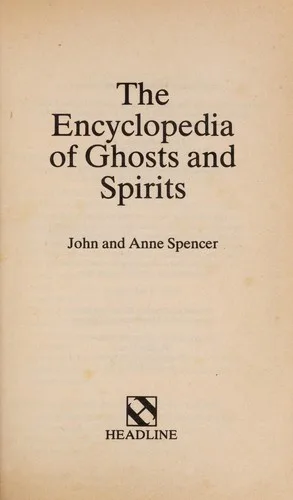
The encyclopedia of ghosts and spirits
 77
77

The encyclopedia of ghosts and spirits
John and Anne Spencer’s 1992 compilation, The Encyclopedia of Ghosts and Spirits, presents a commendable effort to categorize and document spectral entities. Its strength lies in its broad scope, encompassing a diverse range of apparitional lore from various global traditions. The structured approach, characteristic of an encyclopedia, allows for systematic research into specific types of spirits or hauntings. However, the work occasionally suffers from a lack of critical analysis, presenting anecdotal accounts with a neutrality that can sometimes blur the line between folklore and verifiable phenomena. A notable section details the distinction between residual hauntings and intelligent hauntings, a useful framework for understanding reported supernatural events. While its encyclopedic nature is its primary asset, it sometimes sacrifices narrative depth for breadth. This volume serves best as a reference catalog for those already familiar with the subject, rather than an introductory guide.
📝 Description
77
Published in 1992, The Encyclopedia of Ghosts and Spirits systematically catalogs spectral entities and apparitional phenomena.
John Spencer and Anne Spencer's 1992 work functions as a structured reference for spectral entities and apparitional phenomena from various cultures and historical periods. It details classifications, reported manifestations, and associated folklore, aiming for a comprehensive overview rather than a narrative. The book covers a broad spectrum of beliefs, from ancient legends to contemporary reported sightings, presenting information in an encyclopedic format.
This volume is intended for researchers, folklorists, occult historians, and students of paranormal studies who require detailed, organized information on spirit types and ghost lore. It is beneficial for comparative study of spiritual beliefs or as a catalog of reported entities for analytical purposes. The work is not aimed at casual readers seeking sensational accounts.
Emerging in 1992 amidst sustained popular interest in the paranormal, this encyclopedia synthesizes anecdotal evidence and mythological accounts of spirits. It builds upon earlier folklore and demonology studies, positioning itself as a significant print resource before widespread digital information. The work attempts to create a coherent reference from a vast body of belief and reported phenomena.
💡 Why Read This Book?
• Gain a structured understanding of spectral classifications, learning how phenomena like poltergeists and residual hauntings were cataloged by the Spencers in 1992. • Discover diverse folkloric traditions concerning spirits, examining the specific cultural contexts of apparitions as detailed within the book's cross-cultural survey. • Acquire analytical frameworks for paranormal investigation, understanding the methods used to differentiate between various types of spiritual manifestations presented in the text.
⭐ Reader Reviews
Honest opinions from readers who have explored this book.
❓ Frequently Asked Questions
What is the primary difference between residual hauntings and intelligent hauntings as presented in The Encyclopedia of Ghosts and Spirits?
The encyclopedia distinguishes residual hauntings as replays of past events, akin to an energetic echo, lacking consciousness. Intelligent hauntings, conversely, involve spirits exhibiting awareness and interaction with the living, a key concept explored throughout the work.
Does The Encyclopedia of Ghosts and Spirits cover apparitions from specific historical periods?
Yes, the book references accounts from various eras. For instance, it discusses early demonic lore and folklore that informed later understandings of spectral phenomena, providing a historical sweep of beliefs.
Are there any specific cultural regions focused on in the book's catalog of spirits?
The work attempts a global overview, touching upon beliefs from European folklore, ancient mythologies, and other cultural traditions, aiming for a broad comparative study of spirit lore.
Who are the authors, John Spencer and Anne Spencer, and what is their background in this field?
John Spencer and Anne Spencer are credited with the original publication in 1992. While their specific academic or professional backgrounds are not detailed in the text itself, the compilation suggests extensive research into paranormal literature and folklore.
Is this book a collection of ghost stories or a reference guide?
The Encyclopedia of Ghosts and Spirits functions primarily as a reference guide, systematically cataloging and classifying different types of spirits and phenomena rather than presenting narrative ghost stories.
What kind of entities are discussed in The Encyclopedia of Ghosts and Spirits?
The book discusses a wide array of entities, including elemental spirits, poltergeists, apparitions, and other forms of disembodied consciousness, categorizing them based on their reported characteristics and origins.
🔮 Key Themes & Symbolism
Classification of Spectral Entities
The work systematically categorizes a vast array of spiritual apparitions and phenomena. It moves beyond simple ghost stories to offer a taxonomy, distinguishing between types such as residual hauntings, intelligent spirits, and elemental entities. This structured approach aids in comparative analysis of reported supernatural events across different cultures and historical periods, reflecting an early attempt in 1992 to bring order to a complex and often anecdotal field of study.
Folklore and Mythology of Spirits
A significant portion of the encyclopedia is dedicated to tracing the origins of spirit beliefs within human folklore and mythology. It examines how cultural narratives have shaped perceptions of ghosts and spirits, from ancient animistic beliefs to more formalized religious doctrines. The Spencers present these traditions not merely as stories, but as foundational elements in understanding humanity's long-standing fascination with the afterlife and disembodied consciousness.
Manifestations and Phenomena
The book details the diverse ways in which ghosts and spirits are reported to manifest. This includes visual apparitions, auditory phenomena, physical disturbances (like those associated with poltergeists), and psychic impressions. By cataloging these specific manifestations, the authors provide a framework for researchers to analyze reported encounters and identify patterns, contributing to the broader study of paranormal phenomena as documented in the early 1990s.
Historical Parapsychology
The encyclopedia implicitly engages with the history of parapsychological investigation. It references earlier studies and the evolving methodologies used to document and understand spectral encounters. By compiling information from various historical sources, it serves as a bridge between older folkloric traditions and the nascent scientific inquiries into psychic phenomena, offering a snapshot of the research landscape around 1992.
💬 Memorable Quotes
Direct passages from the work, attributed to the author.
“Elemental spirits often exhibit characteristics tied to natural forces.”
— This interpretation points to the book's exploration of non-humanoid or nature-aligned spirits. It suggests that the encyclopedia classifies entities not just by their perceived intelligence but also by their association with elements like earth, air, fire, and water.
“Poltergeist activity often appears as physical disturbances rather than visual apparitions.”
— This interpretation focuses on a specific type of phenomenon discussed. It notes the book's observation that poltergeist activity is frequently characterized by object manipulation or environmental disruption, distinguishing it from more visual hauntings.
💡 Key Ideas
Editorial paraphrase of the work's core concepts — not direct quotes.
The distinction between residual and intelligent hauntings is crucial for analysis.
This paraphrased concept highlights a core analytical tool presented in the book. It suggests that understanding whether a haunting is a mere replay of past events or an interaction with a conscious entity is fundamental to interpreting paranormal phenomena.
Folklore provides a rich source for understanding early concepts of the afterlife.
This paraphrased idea emphasizes the book's use of mythology and traditional stories as evidence for historical beliefs about spirits and the soul's post-mortem existence. It frames folklore as a vital historical document.
Categorizing spectral phenomena aids comparative research.
This paraphrased concept underscores the encyclopedic value of the work. It suggests that by organizing different types of spirits and hauntings, the book facilitates cross-cultural and historical comparisons of belief systems and reported experiences.
🌙 Esoteric Significance
Tradition
While not strictly adhering to a single esoteric lineage, the encyclopedia draws heavily from Western occult traditions, folklore studies, and comparative religion. It synthesizes concepts found in Hermeticism and demonology with broader folkloric beliefs about nature spirits and the afterlife. Its departure lies in its encyclopedic, less ritualistic approach, focusing on cataloging rather than practical application within a specific magical system.
Symbolism
The work implicitly engages with symbolism through its classification of entities. For instance, elemental spirits symbolize the personification of natural forces, representing ancient animistic beliefs. Poltergeists can symbolize repressed psychological energy or chaotic disruption, reflecting anxieties about control. Apparitions themselves often symbolize unresolved issues, past traumas, or transitions between life and death, embodying potent archetypes.
Modern Relevance
Contemporary ghost hunting shows and paranormal investigation communities often utilize the foundational concepts of classification presented in works like this. Thinkers exploring modern folklore, digital hauntology, and the psychology of belief continue to reference the basic distinctions between different types of spectral phenomena that this encyclopedia helped to popularize in the early 1990s.
👥 Who Should Read This Book
• Researchers of folklore and comparative mythology: Gain a categorized overview of global spirit beliefs and their historical development. • Aspiring paranormal investigators: Learn established frameworks for identifying and differentiating types of hauntings and spectral manifestations. • Students of esoteric studies: Acquire a foundational reference for understanding the historical cataloging of spiritual entities within Western and global traditions.
📜 Historical Context
Published in 1992, The Encyclopedia of Ghosts and Spirits emerged at a time when paranormal interest, fueled by media and popular culture, remained strong. The work contributed to a landscape populated by various occult and esoteric texts, seeking to provide a structured, academic-style reference. It followed a lineage of demonological treatises and folklore collections, such as those by Montague Summers, but aimed for a broader, more modern categorization of phenomena. While not directly engaging with specific contemporary scholars in a polemical way, its publication implicitly responded to ongoing discussions in parapsychology and comparative religion. The reception was likely within niche circles of paranormal enthusiasts and researchers, as it was not a mainstream bestseller but rather a specialized reference tool for those interested in classifying spectral lore.
📔 Journal Prompts
The classification of spectral entities: How do the categories of residual vs. intelligent hauntings influence your perception of reported encounters?
Analysis of folkloric sources: Which mythological accounts of spirits resonate most with your understanding of human anxieties about death?
Manifestation patterns: Reflect on the described phenomena of poltergeists. What might these physical disturbances symbolize in different cultural contexts?
Historical parapsychology: Consider the challenges of documenting spectral phenomena across different eras, as evidenced by the Spencers' compilation.
Elemental spirits: Explore the symbolic meaning of nature spirits in pre-modern belief systems and their potential modern interpretations.
🗂️ Glossary
Residual Haunting
A type of haunting described as an energetic imprint or replay of past events, lacking conscious intelligence or interaction with the living. It functions like an echo of a past moment.
Intelligent Haunting
A haunting attributed to a conscious spirit or entity that exhibits awareness, can interact with its environment and living beings, and may communicate or respond.
Poltergeist
A phenomenon characterized by physical disturbances such as moving objects, loud noises, and destruction, often attributed to a disruptive spirit or psychic energy.
Elemental Spirit
Entities believed to be associated with or embody the natural elements (earth, air, fire, water), often found in folklore and occult traditions.
Apparition
The visual manifestation of a ghost or spirit, typically appearing as a human-like figure or form.
Spectral Residue
Similar to residual haunting, this term refers to lingering energetic imprints left behind by past events or intense emotions.
Disembodied Consciousness
The concept of a spirit or soul existing independently of a physical body, a central theme in the study of ghosts and afterlife beliefs.
🔮 Readers Also Liked
Browse all →









More by John Spencer, John Spencer, Anne Spencer
All books →
More Free Occult Philosophy Books
View all →