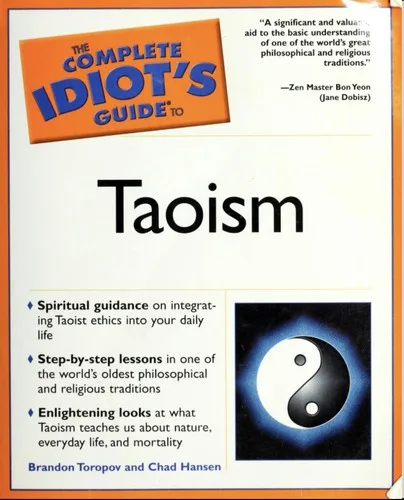
The Complete Idiot's Guide to Taoism
 77
77

The Complete Idiot's Guide to Taoism
Brandon Toropov and Chadwick Hansen's *The Complete Idiot's Guide to Taoism* offers a remarkably accessible entry point into a profound spiritual tradition. Its strength lies in demystifying concepts that can appear opaque to Western readers, drawing clear parallels to modern thought, even referencing figures like Luke Skywalker to illustrate the hero's journey archetype as influenced by Taoist thought. The work effectively explains the practical application of principles like Wu Wei. However, the 'Idiot's Guide' format, while aiding accessibility, occasionally sacrifices depth. Some nuanced philosophical discussions might feel oversimplified for those with existing familiarity with Eastern philosophies. Nonetheless, for the uninitiated, it provides a solid foundation. It serves as a competent, if not exhaustive, primer on the subject.
📝 Description
77
Brandon Toropov and Chadwick Hansen's 1998 guide introduces Taoism to the uninitiated.
This book unpacks Taoism, a philosophy and religion that began in ancient China. It goes beyond simple definitions to explain core ideas like the Tao, the balance of Yin and Yang, and the concept of Wu Wei, or effortless action. The guide is for people interested in Eastern thought who have no previous background. It shows how old Taoist ideas can help with modern issues in health, environmental concerns, and even popular culture. The book is for those who want to understand Taoism without a formal commitment.
Taoism is linked to Lao Tzu and the *Tao Te Ching*, written around the 4th century BCE. It appeared during a time in China known for political division and new ideas, when different philosophies competed for attention. Taoism presented an alternative to the strict social rules promoted by Confucianism. The Tao itself is the ineffable, central principle of the universe. The book describes how this principle appears through Yin and Yang, the opposing but connected forces that control everything. It also explains Wu Wei, acting in harmony with the Tao's natural flow by not forcing things and acting spontaneously.
Taoism, originating in ancient China, is a philosophical and religious tradition focused on living in harmony with the 'Tao' or 'Way.' This fundamental principle is seen as the source and guiding force of all existence, yet it remains ineffable and beyond simple description. The tradition emphasizes naturalness, simplicity, and effortless action (Wu Wei) as means to achieve balance and well-being. Unlike more structured or prescriptive systems, Taoism encourages a spontaneous and intuitive approach to life, often seen as a counterpoint to more rigid social or ethical frameworks.
💡 Why Read This Book?
• Learn to apply the principle of Wu Wei to reduce stress and increase effectiveness in daily tasks, drawing on the book's explanation of "effortless action" as presented in its discussions on natural flow. • Understand the foundational concept of Yin and Yang, not just as opposites, but as interdependent forces, as detailed in the book's exploration of cosmic balance. • Discover how ancient Taoist ideas, like those found in the *Tao Te Ching*, influenced modern thinkers and cultural touchstones, as illustrated by the book's references to contemporary examples.
⭐ Reader Reviews
Honest opinions from readers who have explored this book.
❓ Frequently Asked Questions
When was The Complete Idiot's Guide to Taoism first published?
The Complete Idiot's Guide to Taoism by Brandon Toropov and Chadwick Hansen was first published on March 1, 2002.
What is the central philosophy of Taoism discussed in the book?
The book centers on the Tao, the ineffable, fundamental principle of the universe, and its manifestation through concepts like Yin and Yang and the practice of Wu Wei (effortless action).
Does the book explain the Tao Te Ching?
Yes, the book explores the Tao Te Ching, the foundational text of Taoism attributed to Lao Tzu, and its key teachings regarding the Tao and living in harmony with nature.
How does the book relate Taoism to modern life?
It draws parallels between ancient Taoist principles and modern Western thought, health practices, ecological awareness, and even popular culture, making the philosophy relevant to contemporary readers.
Who are the authors of The Complete Idiot's Guide to Taoism?
The authors are Brandon Toropov and Chadwick Hansen. The book was first published in 2002.
Is this book suitable for absolute beginners to Eastern philosophy?
Yes, the 'Complete Idiot's Guide' series format is specifically designed for beginners, aiming to make complex subjects like Taoism accessible without prior knowledge.
🔮 Key Themes & Symbolism
The Tao and Its Manifestations
The book elaborates on the Tao, the ultimate reality and origin of all things, which cannot be fully described in words. It details how the Tao expresses itself through the dynamic balance of Yin and Yang, the primordial feminine and masculine forces. Understanding this interplay is presented as key to comprehending the natural order of the universe and one's place within it, moving beyond dualistic thinking towards a holistic view of existence.
Wu Wei: Effortless Action
A central theme is Wu Wei, often translated as 'non-action' or 'effortless action.' The guide explains this as acting in accordance with the natural flow of the Tao, without force or resistance. It contrasts this with striving and artificiality, illustrating how aligning with natural spontaneity can lead to greater effectiveness and peace, a concept applicable to personal conduct and governance.
Taoist Ethics and Living
The book explores the ethical implications of Taoist philosophy, emphasizing simplicity, humility, and compassion. It explores how the pursuit of the Tao influences one's interactions and perspective on life, advocating for a life free from excessive desire and societal pressures. This section highlights the practical application of Taoist wisdom for achieving inner harmony and balance.
Taoism in Popular Culture
An intriguing aspect covered is the presence of Taoist concepts in contemporary Western culture. The guide identifies traces of Taoist principles in figures like Luke Skywalker from Star Wars, the philosophy of The Beatles, and ecological movements, demonstrating the enduring and pervasive influence of this ancient tradition on modern consciousness and artistic expression.
💬 Memorable Quotes
Direct passages from the work, attributed to the author.
“The Tao that can be told is not the eternal Tao.”
— This foundational statement emphasizes the ineffable nature of the Tao. It suggests that any attempt to define or describe the ultimate reality using language is inherently limited and cannot capture its true, eternal essence.
“The highest good is like water.”
— This analogy from the Tao Te Ching highlights water's qualities: it benefits all things without contention and flows to places people disdain. It represents the ideal of yielding, adaptability, and selfless service in Taoist practice.
“Simplicity, patience, compassion. These three are your greatest treasures.”
— This captures core Taoist virtues. Simplicity frees one from material and mental clutter, patience allows for observation and natural timing, and compassion fosters connection and understanding.
“Nature does not hurry, yet everything is accomplished.”
— This highlights the principle of Wu Wei. It suggests that effective action arises not from frantic effort but from aligning with natural rhythms and processes, trusting that completion will occur in due course.
💡 Key Ideas
Editorial paraphrase of the work's core concepts — not direct quotes.
To the mind that is still, the whole universe surrenders.
This paraphrase points to the Taoist ideal of mental stillness and inner peace. Achieving a state of calm allows one to perceive and align with the natural order, leading to a sense of harmony and control over one's internal state.
🌙 Esoteric Significance
Tradition
Taoism itself is a foundational esoteric tradition, forming the bedrock for many later Chinese occult and mystical practices, including Neidan (internal alchemy). This guide fits within the broader spectrum of esoteric literature by making accessible the core principles of a major Eastern spiritual system, serving as an introduction for those drawn to non-Western paths of self-cultivation and understanding the cosmos.
Symbolism
The book likely touches upon key Taoist symbols such as the Taijitu (Yin-Yang symbol), representing the dynamic interplay and interdependence of complementary opposites. Another significant symbol is the Bagua, the eight trigrams used in the I Ching, which map cosmic forces and principles. The concept of the 'uncarved block' (Pu) also functions symbolically, representing original simplicity and potential before external conditioning.
Modern Relevance
Contemporary interest in mindfulness, natural living, ecological balance, and self-improvement practices often finds resonance with Taoist principles. Thinkers and practitioners in fields like transpersonal psychology, holistic health, and even certain branches of environmental activism draw implicitly or explicitly on Taoist concepts of harmony with nature, effortless action, and the interconnectedness of all things.
👥 Who Should Read This Book
• Beginning students of comparative religion or Eastern philosophies seeking a clear, non-academic introduction to Taoist core concepts like the Tao and Wu Wei. • Individuals interested in practical applications of ancient wisdom for reducing stress and finding balance in modern life, particularly those drawn to concepts of natural flow and simplicity. • Readers exploring themes of balance, duality, and cosmic order, who may appreciate the book's explanation of Yin and Yang and their prevalence in various cultural expressions.
📜 Historical Context
Published in 2002, *The Complete Idiot's Guide to Taoism* emerged at a time of growing Western interest in Eastern philosophies, largely driven by accessible translations and a desire for alternative spiritual frameworks beyond traditional Abrahamic religions. The early 2000s saw continued popularization efforts for concepts like Zen Buddhism and Taoism, often through self-help and comparative religion texts. This book arrived in a market already influenced by figures like Alan Watts, who had popularized Taoist ideas decades prior. While not engaging directly with academic debates, it responded to a public curiosity that paralleled the rise of New Age spirituality, offering a simplified yet informative overview of a tradition that historically competed with Confucianism for cultural dominance in China, particularly concerning governance and personal conduct.
📔 Journal Prompts
Reflect on a situation where applying Wu Wei, as described in the book, could have yielded a better outcome than forceful effort.
Consider the interplay of Yin and Yang in your daily routines and identify how these forces manifest.
Analyze a popular culture icon or story through the lens of Taoist principles discussed in the text.
Explore the concept of simplicity as a path to contentment, referencing the book's ethical discussions.
How does the idea of the Tao, as presented in the guide, challenge your current understanding of reality?
🗂️ Glossary
Tao (or Dao)
The fundamental, ineffable principle of the universe in Taoism; the natural order and source of all things. It is often described as the 'way' or 'path' of reality.
Yin and Yang
Two complementary and interdependent forces or principles that constitute the universe. Yin represents passive, dark, feminine qualities, while Yang represents active, light, masculine qualities.
Wu Wei
A core Taoist principle meaning 'effortless action' or 'non-action.' It involves acting in accordance with the natural flow of the Tao, without force or resistance.
Tao Te Ching
The foundational text of Taoism, traditionally attributed to Lao Tzu. It contains aphorisms and teachings on the Tao, virtue, and living in harmony with nature.
Lao Tzu
The philosopher traditionally credited with writing the Tao Te Ching and founding Taoism. His historical existence is debated, but he is revered as a central figure.
Ch'i (or Qi)
The vital life force or energy that flows through all things. Practices like Qigong aim to cultivate and balance Ch'i.
De (or Te)
Often translated as 'virtue' or 'power.' It refers to the manifestation of the Tao in individual beings and things; one's inherent nature or integrity.