The complete guide to nine star ki
 73
73

The complete guide to nine star ki
Bob Sachs' "The Complete Guide to Nine Star Ki" offers a rigorously structured introduction to a system often overshadowed by more widely known astrological practices. Unlike many popular Western guides, Sachs avoids vague spiritual pronouncements, instead focusing on the precise mechanics of calculating and interpreting the nine Ki numbers. His strength lies in demystifying the mathematical underpinnings, making the system feel tangible rather than purely intuitive. The section detailing the characteristics of each of the nine stars, particularly their interaction within relationships, is especially well-executed, providing concrete insights into interpersonal dynamics. However, the sheer volume of detail, while comprehensive, can sometimes feel overwhelming for a complete novice. The 1992 publication date means some of the cultural context surrounding its reception by Western esoteric circles might be less apparent to contemporary readers. Despite this, the book remains a solid, if dense, manual for anyone serious about mastering Nine Star Ki.
📝 Description
73
Bob Sachs' 1992 guide details the ancient Chinese astrological system of Nine Star Ki.
This book offers a comprehensive look at Nine Star Ki, an ancient Chinese astrological system also known as Hoshi Shin in Japan. Unlike Western astrology, this method assigns an energy signature based on birth year, linking individuals to one of nine stars. Sachs explains the calculations needed for primary and secondary Ki numbers, along with yearly and monthly influences. He also details the traits, strengths, and challenges associated with each of the nine stars, providing a way to understand personality, relationships, and life patterns.
The guide is for those interested in non-Western esoteric systems and personal growth through astrology. It helps readers understand their inherent tendencies and the energetic patterns affecting their lives and interactions. Those interested in comparative mysticism, East Asian philosophies, or practical tools for self-awareness and improving relationships will find it valuable. The book suits readers who prefer detailed, systematic approaches to divination and self-discovery over general horoscopes.
Nine Star Ki draws from centuries of Chinese cosmology, incorporating elements of the I Ching and Five Element theory. Its development in Japan as Hoshi Shin gained traction in the 20th century, notably through figures like Ohata Toshihiko. Sachs' work, published in 1992, appeared as global interest in Eastern spiritual traditions grew, mirroring increased engagement with practices such as Feng Shui and traditional Chinese medicine. This book situates Nine Star Ki within that broader context of Eastern esoteric thought.
💡 Why Read This Book?
• You will learn how to calculate and interpret your unique Nine Star Ki numbers, understanding the specific energies (e.g., the 'Central Palace' or 'Year Star') that define your core personality and life path, offering a distinct framework beyond Western zodiac signs. • You will gain practical insights into relationship dynamics by understanding the compatibility and potential friction between different Ki numbers, using this knowledge to foster better connections based on the principles outlined by Sachs. • You will grasp the cyclical nature of personal energy and external influences by learning about the annual and monthly Ki cycles, enabling you to anticipate opportune moments for action or periods requiring caution, as detailed in the book's predictive models.
⭐ Reader Reviews
Honest opinions from readers who have explored this book.
❓ Frequently Asked Questions
What is Nine Star Ki and how does it differ from Western astrology?
Nine Star Ki is an ancient Chinese astrological system that uses birth year calculations to assign one of nine 'stars' or energy types to an individual. Unlike Western astrology, which focuses on planetary positions relative to constellations, Nine Star Ki is based on numerical cycles derived from the Lo Shu magic square and Five Element theory.
Who was Bob Sachs and what is his background in Nine Star Ki?
Bob Sachs was an author and researcher specializing in Eastern esoteric systems. He dedicated considerable effort to studying and translating complex astrological and divination techniques from Chinese and Japanese traditions into accessible English, with Nine Star Ki being a central focus of his work.
How are the nine stars in Nine Star Ki determined?
The nine stars are determined through a specific calculation based on an individual's birth year, often involving adding the digits of the year and reducing them to a single number. The system also considers the Chinese lunar calendar and sometimes a correction for the start of the solar year, as detailed in Sachs' guide.
What does the 'Central Palace' represent in Nine Star Ki?
The 'Central Palace' is a fundamental concept in Nine Star Ki, representing the core energy or essence of an individual, often determined by their Year Star. It influences innate characteristics, fundamental personality traits, and one's foundational approach to life's challenges.
Can Nine Star Ki be used for predicting future trends?
Yes, Nine Star Ki is used for predictive purposes. The system outlines annual, monthly, and even daily cycles of energy, allowing practitioners to identify opportune times for action, periods of potential difficulty, and shifts in personal or collective energies.
Is Nine Star Ki related to Feng Shui?
While distinct, Nine Star Ki shares roots with Feng Shui in ancient Chinese cosmology and the principles of Yin and Yang and the Five Elements. Both systems analyze energetic patterns, with Nine Star Ki focusing on personal energies and Feng Shui on environmental energies.
🔮 Key Themes & Symbolism
The Nine Star Energies
The book centers on the nine distinct energies, each symbolized by a 'star' and imbued with specific characteristics derived from Chinese cosmology. These stars, numbered 1 through 9, are not celestial bodies in the astronomical sense but rather archetypal forces influencing human lives and the environment. Sachs meticulously details the traits associated with each star, from the adaptable '1' Water star to the stable '8' Earth star. Understanding these energies is crucial for deciphering one's own nature and the energetic currents that flow through time, offering a unique lens through which to view personal strengths, weaknesses, and potential life trajectories.
Annual and Monthly Cycles
A core component of Nine Star Ki is its emphasis on cyclical influences. The system posits that beyond one's core energetic signature (determined by birth year), individuals are also affected by annual and monthly energetic shifts. Sachs explains how to calculate these transitional energies, allowing readers to understand periods of growth, challenge, or transformation. This predictive aspect enables proactive engagement with life, helping individuals align their actions with the prevailing energetic tides, whether for personal development, career endeavors, or relationship management.
Interpersonal Dynamics and Compatibility
Nine Star Ki provides a sophisticated framework for understanding relationships. By comparing the Ki numbers of individuals, the system offers insights into potential compatibility, areas of natural harmony, and sources of conflict. Sachs outlines the dynamics between different star combinations, illustrating how various energies interact, support, or challenge each other. This aspect of the book moves beyond simple personality typing to offer a nuanced view of interpersonal connections, applicable to romantic partnerships, family relationships, and professional collaborations.
The Lo Shu Grid
The foundation of Nine Star Ki calculations and interpretation is the Lo Shu grid, a 3x3 magic square originating in ancient China. Sachs explains how this numerical arrangement, with its specific placement of numbers 1 through 9, serves as a map for understanding the flow of energies. The grid's structure dictates how different Ki numbers interact based on their positions, influencing calculations for Year, Month, and Day stars, and providing a visual representation of the system's underlying order and interconnectedness.
💬 Memorable Quotes
Direct passages from the work, attributed to the author.
“The Nine Star Ki system is a framework for understanding the energetic patterns that influence individuals and events.”
— This statement captures the book's core premise: Nine Star Ki is not merely a predictive tool but a comprehensive model for analyzing the dynamic interplay of energies shaping our lives and surroundings.
“Each of the nine stars possesses unique qualities, strengths, and challenges.”
— This highlights the granular detail provided in the text, emphasizing that the system offers specific insights into the distinct characteristics associated with each of the nine archetypal energies.
“Understanding the annual and monthly cycles allows for better alignment with natural energetic flows.”
— This points to the practical, predictive application of Nine Star Ki, suggesting that by recognizing these temporal energetic shifts, one can navigate life more effectively.
“Relationships can be understood through the comparative analysis of different Ki numbers.”
— This interpretation underscores the book's utility in deciphering interpersonal dynamics, presenting Nine Star Ki as a tool for fostering harmony and understanding in human connections.
“The Lo Shu grid is the foundational map for calculating and interpreting the Nine Star Ki energies.”
— This emphasizes the central role of the Lo Shu square, positioning it as the essential visual and mathematical structure upon which the entire Nine Star Ki system is built.
🌙 Esoteric Significance
Tradition
Nine Star Ki is deeply rooted in Chinese cosmological principles, drawing heavily from Taoist philosophy, the I Ching, and the Five Element theory (Wu Xing). It is a system of divination and personal analysis that functions within the broader umbrella of East Asian metaphysics. While distinct from Hermeticism or Kabbalah, it shares with them a focus on understanding underlying universal patterns and correspondences. Sachs' work fits within the tradition of disseminating these ancient systems to a wider, often Western, audience, making its intricate calculations and philosophical underpinnings accessible.
Symbolism
The core symbolism lies in the nine numerical 'stars,' each associated with specific elemental energies (e.g., Water, Wood, Fire, Earth, Metal) and directional correspondences. The Lo Shu grid, a 3x3 square containing numbers 1-9, is a crucial symbolic map representing the cosmic order and the flow of Qi (life force energy). The cyclical nature of the stars, their interactions through 'creative' and 'control' cycles, and their association with specific colors and personality archetypes form the symbolic language through which the system communicates.
Modern Relevance
Contemporary practitioners of Chinese Metaphysics, including Feng Shui consultants and Bazi (Four Pillars of Destiny) astrologers, often incorporate Nine Star Ki into their analyses. It's also found relevance in personal development circles seeking structured frameworks for self-understanding and relationship compatibility, particularly among those interested in Eastern philosophies. Thinkers and authors exploring comparative spirituality and cross-cultural esoteric systems continue to reference its systematic approach to energetic analysis and predictive cycles.
👥 Who Should Read This Book
['• Students of East Asian metaphysics: Those seeking to deepen their understanding of Chinese cosmology, numerology, and divination systems beyond introductory texts will find a comprehensive guide.', "• Esoteric researchers: Individuals comparing different astrological and divinatory traditions will benefit from Sachs' detailed exposition of a unique system.", '• Individuals seeking self-awareness tools: Readers interested in personality typing and understanding interpersonal dynamics through a structured, non-Western lens will find practical applications.']
📜 Historical Context
Bob Sachs' "The Complete Guide to Nine Star Ki," first published in 1992, emerged during a period of significant Western curiosity towards Eastern esoteric traditions. This era saw a surge in popular interest in practices like Feng Shui, I Ching divination, and various forms of Asian astrology, often facilitated by translated works and increased global communication. Nine Star Ki, known in Japan as Hoshi Shin, had been gaining traction there throughout the 20th century, notably through figures like Ohata Toshihiko. Sachs' book aimed to bridge the gap, presenting a complex system rooted in Chinese cosmology and Five Element theory to an English-speaking audience. It arrived alongside a growing body of literature on comparative mysticism, offering a structured, numerical approach to understanding destiny and personality that contrasted with the more symbolic or intuitive methods prevalent in some Western occult circles. Its reception contributed to the broader integration of East Asian metaphysical concepts into Western esoteric discourse.
📔 Journal Prompts
Analyze the interaction between your Year Star and your partner's Year Star using the compatibility principles outlined by Sachs.
Reflect on how the characteristics of your primary Ki number manifest in your daily life.
Map out the annual Ki cycle for the current year and identify potential opportunities or challenges.
Consider the symbolic meaning of the Lo Shu grid in relation to the flow of energy in your personal life.
Evaluate how the 'control cycles' between elements might influence a specific recurring conflict you experience.
🗂️ Glossary
Nine Star Ki
An ancient Chinese system of astrology and divination that assigns one of nine numerical energies, or 'stars,' to individuals based on their birth year, influencing personality, destiny, and life cycles.
Hoshi Shin
The Japanese name for Nine Star Ki, reflecting its significant adoption and development within Japanese esoteric traditions.
Lo Shu Grid
A 3x3 magic square containing the numbers 1 through 9, which serves as the foundational diagram for calculating and interpreting Nine Star Ki energies and their relationships.
Year Star
The primary Nine Star Ki number determined by an individual's birth year, representing their core essence, innate characteristics, and fundamental life path.
Element Cycles
The interactions between the Five Elements (Wood, Fire, Earth, Metal, Water) within Nine Star Ki, categorized as 'creative' (generative) and 'control' (destructive or restraining) cycles, used to interpret relationships and predict energetic flows.
Qi
The fundamental concept of life force or vital energy that permeates all things in Chinese philosophy, central to understanding the energetic dynamics within Nine Star Ki.
Central Palace
In the context of the Lo Shu grid, the center square represents the core energy or 'home' position of an individual's Year Star, influencing their fundamental nature.
🔮 Readers Also Liked
Browse all →









More by Bob Sachs
All books →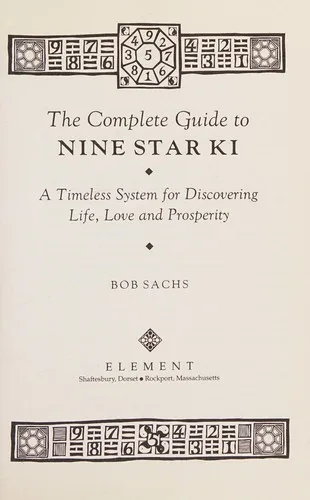
More Free Astrology & Cosmology Books
View all →