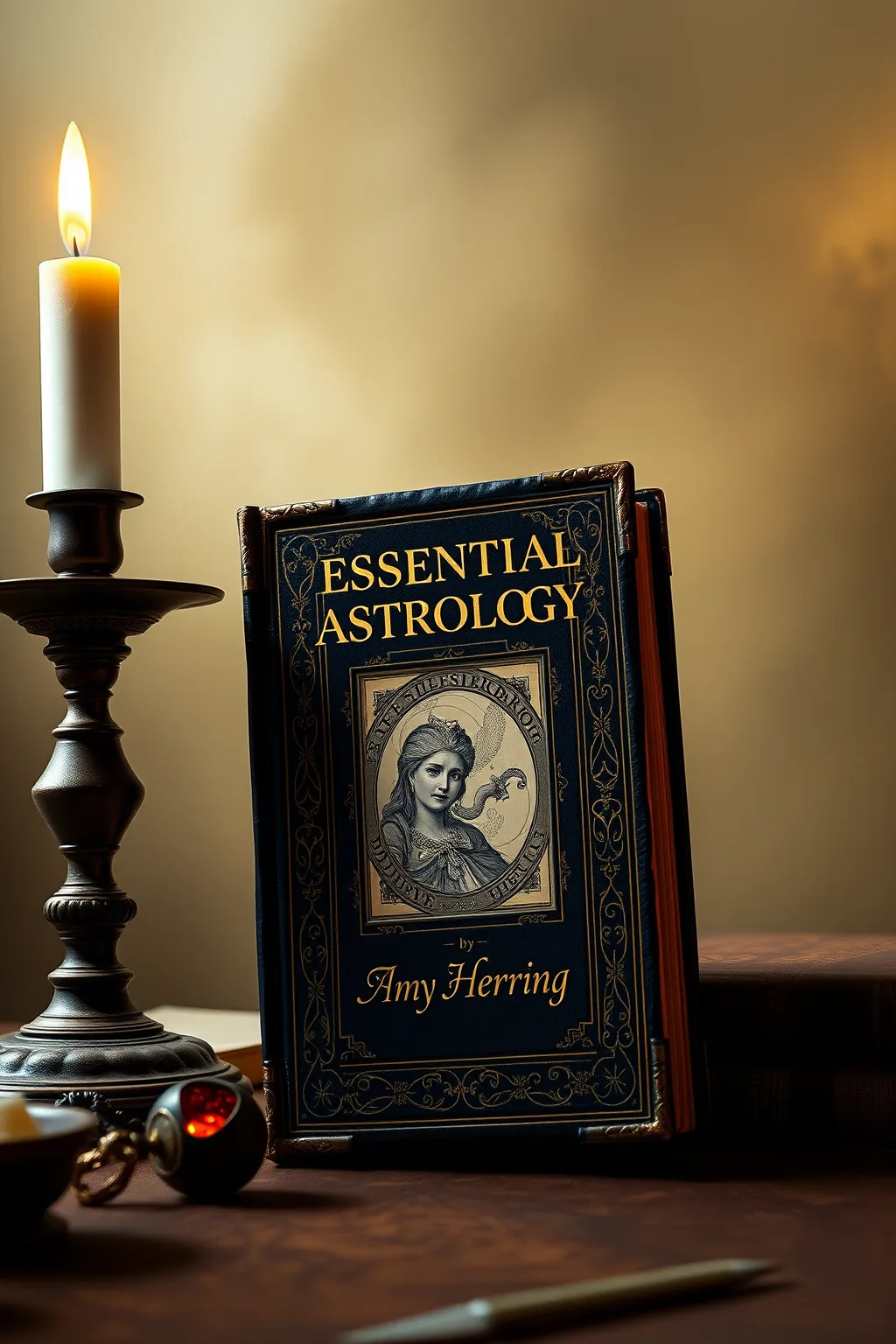
Essential Astrology
 73
73

Essential Astrology
Amy Herring’s Essential Astrology offers a clear, if somewhat conventional, entry point into the mechanics of natal chart interpretation. The book’s strength lies in its systematic breakdown of core components—planets, signs, houses, and aspects—presented in a logical, accessible manner. Herring avoids overly mystical jargon, focusing instead on the archetypal qualities and practical applications of each element. A particularly well-executed section details the house system, explaining each domain of life experience with lucid examples. However, the work occasionally feels constrained by its commitment to foundational principles, sometimes lacking the more nuanced, psychological depth found in later astrological literature. While it meticulously explains *what* each component signifies, it could benefit from more extensive exploration of *how* these elements synthesize into a cohesive, unique personality. Nevertheless, for the neophyte seeking a solid, structured introduction, Essential Astrology serves as a capable and reliable guide.
📝 Description
73
Amy Herring's Essential Astrology, published in 2016, breaks down astrological principles for new practitioners.
Essential Astrology aims to demystify celestial language for a new generation of practitioners. The book moves beyond simplistic horoscopes to examine the core components of an astrological chart. These include planetary archetypes, zodiacal signs, houses, and aspects. Herring provides readers with a framework for understanding how these elements interact to describe individual potentials and life experiences. This text is crafted for individuals beginning their study of astrology who seek a structured, analytical approach. It caters to students wanting to understand the mechanics of chart interpretation, not just predictive outcomes. Those with backgrounds in psychology or philosophy might find the archetypal discussions particularly engaging, bridging esoteric symbolism and humanistic inquiry.
Published in 2016, Essential Astrology emerged during a period of resurgent interest in esoteric subjects. This era saw a proliferation of accessible astrological texts, a departure from more academic or insular approaches. Herring's work contributes to this contemporary wave by emphasizing clarity and practical application, making complex astrological concepts digestible for a broad audience.
💡 Why Read This Book?
• Understand the fundamental building blocks of a birth chart, including the distinct energies of each of the twelve zodiac signs and their associated elements, as detailed in the early chapters of Essential Astrology. • Learn how the twelve houses function as specific arenas of life experience, from self-expression to public reputation, as explained through Herring’s structured approach. • Grasp the significance of planetary aspects, the angular relationships between celestial bodies, and how their interplay shapes internal dynamics and potential life events, a concept explored thoroughly in the text.
⭐ Reader Reviews
Honest opinions from readers who have explored this book.
❓ Frequently Asked Questions
What is the primary focus of Essential Astrology by Amy Herring?
Essential Astrology focuses on demystifying the core principles of astrological chart interpretation. It systematically explains planets, zodiac signs, houses, and aspects, aiming to provide readers with a foundational understanding of how these elements interact.
Who is the intended audience for this book?
The book is primarily intended for individuals new to astrology who seek a structured and analytical approach. It suits students interested in the mechanics of chart reading and those who appreciate an archetypal perspective.
When was Essential Astrology first published?
Essential Astrology was first published in 2016, placing it within a contemporary resurgence of interest in esoteric and metaphysical subjects.
Does the book cover advanced astrological techniques?
No, the book is designed as a foundational text. It concentrates on the essential components of a natal chart, providing a solid basis before moving on to more complex techniques.
How does Essential Astrology differ from typical horoscope columns?
Unlike simplified horoscope columns, Essential Astrology delves into the intricate relationships between planetary placements, zodiac signs, houses, and aspects within an individual's birth chart, offering a comprehensive interpretive framework.
What are the key astrological concepts explained in the book?
The book meticulously explains the twelve zodiac signs, the ten planets, the twelve houses, and the geometric aspects between planets, presenting them as interconnected elements of astrological interpretation.
🔮 Key Themes & Symbolism
Planetary Archetypes
The work meticulously details the archetypal energies of the planets, from the Sun's core identity to Saturn's lessons in structure and limitation. Each celestial body is presented not merely as a point of light but as a distinct psychological force or principle that manifests in human experience. Herring emphasizes understanding these archetypes as fundamental building blocks of the personality, crucial for deciphering the complexities within an astrological chart. The interaction between these planetary energies, as expressed through signs and houses, forms the basis of astrological interpretation.
Zodiacal Sign Dynamics
Essential Astrology breaks down the twelve zodiac signs, exploring their elemental (Fire, Earth, Air, Water) and modal (Cardinal, Fixed, Mutable) classifications. This framework helps readers understand the distinct styles of expression, motivation, and approach associated with each sign. The text explains how a planet or personal point located in a particular sign will color its expression. Understanding these sign dynamics is presented as vital for grasping the nuances of individual temperament and behavior patterns described in a natal chart.
The Twelve Houses
The book systematically explains the twelve houses, which represent different spheres of life and experience. From the Ascendant (House 1), signifying self-identity and outward presentation, to the Midheaven (House 10), representing career and public standing, each house is described as a domain where specific astrological energies play out. Herring guides the reader to see how the planets and signs located within these houses illuminate particular areas of focus, challenge, or potential in a person's life.
Aspectual Relationships
A significant portion of Essential Astrology is dedicated to understanding aspects – the geometric angles formed between planets in a birth chart. The work differentiates between harmonious aspects (like trines and sextiles) that facilitate expression, and challenging aspects (like squares and oppositions) that indicate tension and areas for growth. Learning to interpret these relationships is presented as key to understanding the internal dynamics and how different facets of the personality interact or conflict.
💬 Memorable Quotes
Direct passages from the work, attributed to the author.
“The Sun represents the core ego, the essential self, and the life force.”
— This highlights the Sun's central role in astrology as the primary indicator of identity, vitality, and conscious awareness. It's the fundamental spark around which the rest of the chart's energies organize.
“Each house describes a specific area of life where the planetary energies manifest.”
— This emphasizes the functional aspect of the houses, illustrating them as distinct stages or arenas of experience through which the astrological forces depicted in a chart are expressed and enacted.
“Aspects show how different parts of the psyche communicate or conflict with each other.”
— This interpretation underscores the dynamic interplay between planetary energies. Aspects are framed as the 'dialogue' or 'tension' between psychological components, revealing internal integration or discord.
“Understanding Mercury reveals how you think and communicate.”
— This concisely points to Mercury's domain, focusing on its influence over cognitive processes, mental faculties, and modes of expression, offering a practical insight into personal communication styles.
“The Ascendant is your personal mask and how you initially meet the world.”
— This captures the essence of the Ascendant as the outward persona and the immediate impression one makes upon others, framing it as the initiatory point of contact with the external environment.
🌙 Esoteric Significance
Tradition
Essential Astrology operates within the broad tradition of Western Esotericism, specifically drawing from the principles of Hellenistic and Renaissance astrology. While not explicitly aligned with a single lineage like Hermeticism or Kabbalah, it utilizes the foundational astrological language that underpins many of these traditions. The work departs from highly ritualistic or purely divinatory approaches by focusing on the psychological and archetypal dimensions of the birth chart, a trend seen in modern astrological discourse influenced by psychological thought.
Symbolism
Key symbols explored include the twelve zodiacal signs, each representing a distinct archetypal energy or mode of expression (e.g., Aries as the initiator, Cancer as the nurturer). The planets are treated as potent archetypal forces (e.g., Mars as the warrior, Venus as the lover). Furthermore, the twelve houses symbolize different life arenas, from personal identity (House 1) to career (House 10), providing a symbolic map of human experience.
Modern Relevance
This work continues to be relevant for contemporary practitioners and students exploring self-understanding through astrology. Its clear, foundational approach makes it accessible to those engaging with modern psychological astrology, as well as individuals interested in comparative mythology and archetypal psychology, fields that often intersect with astrological symbolism in contemporary thought.
👥 Who Should Read This Book
• Aspiring astrologers seeking a structured, step-by-step introduction to reading birth charts, moving beyond superficial horoscope interpretations. • Individuals interested in psychological archetypes and self-discovery who wish to understand how celestial patterns may correlate with personality traits and life potentials. • Students of comparative religion or Western Esotericism looking for a practical primer on astrological symbolism as a significant historical and contemporary framework.
📜 Historical Context
Amy Herring’s Essential Astrology, published in 2016, entered a vibrant range of contemporary esoteric literature. This period saw a significant public re-engagement with astrology, often facilitated by online platforms and a general shift towards personal development and self-exploration. Herring’s work aligns with this trend by offering a clear, accessible, and systematically organized introduction to natal chart interpretation, eschewing the more arcane or highly specialized language that characterized some earlier astrological traditions. It contrasts with the psychological astrology that gained prominence in the mid-20th century through figures like Dane Rudhyar, which often focused on deeper therapeutic applications. Herring’s approach prioritizes foundational knowledge and practical understanding for a broad audience, reflecting a broader cultural moment where self-knowledge through various symbolic systems was increasingly sought after.
📔 Journal Prompts
Reflect on the archetypal meaning of your Sun sign and how it manifests in your daily life.
Consider the house placement of your Mercury and how it influences your communication style.
Map the areas of your life corresponding to the twelve houses and identify potential areas of focus.
Analyze the primary aspects involving your Moon and their impact on your emotional nature.
Describe how the energy of your Ascendant influences your initial interactions with new people.
🗂️ Glossary
Ascendant
The zodiac sign and degree rising on the eastern horizon at the exact moment of birth. It represents the outward persona, physical appearance, and initial approach to life.
Descendant
The zodiac sign and degree directly opposite the Ascendant on the western horizon. It governs relationships, partnerships, and the projection of what is perceived as 'other'.
Midheaven (MC)
The highest point in the chart at the time of birth, typically corresponding to the 10th House cusp. It relates to career, public reputation, and life direction.
Imum Coeli (IC)
The lowest point in the chart, opposite the Midheaven, typically corresponding to the 4th House cusp. It relates to home, family, roots, and private life.
Aspect
The angular relationship between two or more planets or sensitive points in an astrological chart, indicating how their energies interact or influence each other.
Trine
A harmonious aspect representing a 120-degree angle between planets, indicating ease, flow, and natural talent in the areas represented by the planets involved.
Square
A challenging aspect representing a 90-degree angle between planets, indicating tension, friction, and obstacles that require effort and conscious work to overcome.
🔮 Readers Also Liked
Browse all →









More by Amy Herring
All books →
More Free Astrology & Cosmology Books
View all →