The body
 78
78

The body
Robinson's "The Body" presents a compelling case for the psychosomatic unity of human beings, a perspective that feels both timely and essential. He meticulously deconstructs the prevalent dualistic thinking that segregates the physical from the spiritual, arguing instead for a holistic understanding of personhood. A particular strength lies in his clear articulation of how this unified view impacts our understanding of existence itself. However, the prose, while precise, can occasionally feel dense, demanding a focused reader. The exploration of the body as the site of both physical and spiritual encounter, particularly in his discussions on embodiment, is a concept that warrants significant attention. For those seeking to move beyond mind-body dichotomies, "The Body" offers a vital, albeit challenging, philosophical foundation.
📝 Description
78
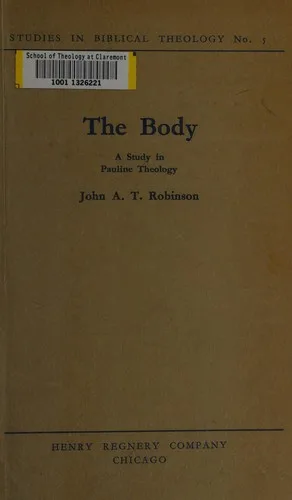
John A. T. Robinson's 1952 book, The Body, argues against separating mind and spirit from physical existence.
Published in 1952, John A. T. Robinson's The Body challenges the common notion of the human body as merely a physical container. Robinson posits that the body is an inseparable aspect of a unified human existence, integrating mind and spirit. He critiques dualistic thinking that creates a divide between the material and the immaterial, advocating instead for a holistic understanding of being. This early work predates Robinson's more widely recognized theological writings, yet it lays down a rigorous foundation for his later ideas on embodied existence.
This book speaks to readers interested in philosophical anthropology and the historical debates surrounding the mind-body problem. It is for those who seek a view of human nature that moves beyond strict materialism or disembodied spirituality. Students of theology and philosophy will find in The Body a significant contribution to early 20th-century thought on the self and human experience. Robinson's arguments offer a valuable perspective for anyone considering the relationship between our physical form and our inner life.
The Body emerged during a mid-20th century intellectual climate where existentialism and new theological thought were questioning traditional separations. Robinson's focus on the integrated self echoes broader trends in philosophy and mysticism that sought to overcome dualistic frameworks. Thinkers like Martin Buber, with his emphasis on relationality in 'I-Thou,' represent a parallel intellectual current interested in a holistic view of humanity, distinct from atomistic or reductionist philosophies. Robinson's work contributes to this tradition by examining the physical body not as an obstacle, but as the very ground of consciousness and spiritual life.
💡 Why Read This Book?
• Gain a unified understanding of human existence, moving beyond the mind-body split, as articulated in Robinson's exploration of psychosomatic unity. • Grasp the early philosophical underpinnings of John A. T. Robinson's thought, predating his later theological works, by examining his 1952 arguments on embodiment. • Challenge simplistic materialist or spiritualist views of humanity by engaging with Robinson's integrated model of the person, central to his 1952 publication.
⭐ Reader Reviews
Honest opinions from readers who have explored this book.
❓ Frequently Asked Questions
When was John A. T. Robinson's "The Body" first published?
John A. T. Robinson's "The Body" was first published in 1952. This early work lays the groundwork for his later, more widely recognized theological writings.
What is the central argument of "The Body" by John A. T. Robinson?
The central argument is that the human person should be understood as an integrated psychosomatic whole, rejecting the traditional dualism between mind and body.
How does "The Body" relate to Robinson's later works like "Honest to God"?
"The Body" reveals the foundational philosophical and theological ideas that informed Robinson's later work, particularly his views on human nature and existence.
Is "The Body" a theological or philosophical text?
It is primarily a philosophical text that engages with theological implications. Robinson uses philosophical reasoning to explore the nature of the human body and personhood.
What intellectual currents influenced Robinson's thinking in "The Body"?
The work reflects mid-20th-century philosophical discussions, including existentialism and critiques of Cartesian dualism, as it seeks a more holistic view of human existence.
Does "The Body" discuss the spiritual significance of the physical form?
Yes, a core theme is the inseparable connection between the physical body and spiritual or conscious life, positing the body as the very locus of human experience.
🔮 Key Themes & Symbolism
Psychosomatic Unity
Robinson challenges the long-standing philosophical and theological tradition of mind-body dualism. He argues that the human being is a single, unified entity, a psychosomatic whole, where the physical and the spiritual are not separable but are intrinsically interconnected. This perspective means that our physical existence is not merely a vessel but is integral to our consciousness, will, and spiritual life. The work posits that true understanding of human personhood requires embracing this integrated view, moving beyond reductionist or disembodied conceptions of the self.
The Body as Locus of Experience
Central to Robinson's thesis is the idea that the body is not just a passive object but the very ground and medium through which all human experience occurs. Whether it's physical sensation, emotional response, or intellectual thought, it is always an embodied experience. This reframes our understanding of identity and selfhood, suggesting that who we are is inextricably linked to our physical being. This concept offers a counterpoint to ascetic traditions that seek to transcend the physical and to materialist views that reduce consciousness to mere biological processes.
Critique of Dualism
The book systematically dissects the historical roots and implications of Cartesian dualism, which separates the thinking substance (mind) from the extended substance (body). Robinson demonstrates how this division has led to problematic understandings of human nature, ethics, and theology. By advocating for a monistic or holistic approach, he seeks to restore a more integrated and authentic vision of human existence, one that respects the full spectrum of embodied reality. This critique provides a crucial philosophical basis for reconsidering traditional anthropologies.
Embodied Theology
While primarily philosophical, "The Body" lays significant groundwork for an embodied theology. Robinson's insistence on the unity of the human person has wide implications for how we understand spiritual life, faith, and the divine encounter. It suggests that spiritual realities are not separate from or superior to our physical existence but are experienced and expressed through it. This perspective encourages a more grounded and holistic approach to religious thought and practice, where the material world is seen as a valid arena for spiritual engagement.
💬 Memorable Quotes
Direct passages from the work, attributed to the author.
“The body is the self.”
— This concise statement captures Robinson's core argument: that the human person is an indivisible unity, and our physical being is not separate from our identity or consciousness.
“We are not souls inhabiting bodies, but embodied beings.”
— This rephrases the common dualistic notion, asserting that our existence is fundamentally integrated. It suggests that 'soul' or 'spirit' is not an entity distinct from the body, but rather an aspect of our unified, embodied reality.
“The separation of mind and body creates a false dichotomy.”
— Robinson critiques the historical tendency in Western thought to divide humans into two distinct parts. He argues this division is artificial and leads to incomplete understandings of human experience and personhood.
“Every experience is an embodied experience.”
— This highlights the pervasive role of the physical in our lives. It means that even our most abstract thoughts or spiritual feelings are mediated through, and inseparable from, our physical existence.
“Holistic understanding of the person is essential.”
— Robinson advocates for a view of humanity that embraces all aspects—physical, mental, emotional, and spiritual—as interconnected components of a single whole, rather than fragmented pieces.
🌙 Esoteric Significance
Tradition
While not strictly within a single esoteric lineage like Kabbalah or Hermeticism, Robinson's work speaks to traditions that emphasize the unity of the cosmos and the individual, such as certain Gnostic or Neoplatonic streams that view the material world as a necessary manifestation of spirit. His rejection of dualism aligns with holistic philosophies found in various mystical traditions that see the divine immanent within creation, including the human body. It departs from ascetic traditions that seek to transcend the physical, instead advocating for its integration into a complete spiritual understanding.
Symbolism
The primary 'symbol' Robinson engages with is the human body itself, reframed from a mere biological mechanism into the sacred vessel of consciousness and spirit. He deconstructs the symbolic opposition between 'spirit' and 'flesh' that pervades many religious and philosophical systems. The concept of 'embodiment' itself becomes a potent motif, symbolizing the inseparable union of the material and the immaterial, the earthly and the divine, challenging us to see the sacred in the mundane aspects of physical existence.
Modern Relevance
Robinson's emphasis on psychosomatic unity finds echoes in contemporary fields like embodied cognition, somatics, and integral psychology. Thinkers and practitioners exploring mindfulness, trauma-informed care, and holistic wellness often draw upon similar principles that reject mind-body separation. His work provides an early philosophical articulation that informs modern discussions about the interconnectedness of physical health, mental well-being, and spiritual awareness, making his 1952 text relevant to current dialogues on integrated approaches to human flourishing.
👥 Who Should Read This Book
• Beginning students of philosophical anthropology seeking to understand the mind-body problem from a non-dualistic perspective. • Comparative religion scholars interested in how different traditions have conceptualized the human person and the role of the body. • Individuals interested in the historical development of 20th-century theological and philosophical thought, particularly Robinson's early contributions.
📜 Historical Context
John A. T. Robinson's "The Body," published in 1952, emerged during a period of intense intellectual reevaluation in post-war Britain. The dominant philosophical currents included existentialism, with its focus on human freedom and responsibility, and linguistic analysis, which often scrutinized metaphysical claims. Theological discourse was also undergoing significant shifts, moving away from neo-orthodoxy towards more existential and humanistic interpretations. Robinson's work can be seen as participating in this broader trend of seeking a more grounded, less dualistic understanding of human existence. It offered a counterpoint to both traditional Thomistic anthropology and more reductionist scientific materialism. While not as controversial as his 1963 book "Honest to God," "The Body" was part of a larger intellectual movement that sought to reconcile Christian thought with modern philosophical and scientific perspectives, challenging long-held assumptions about the nature of man.
📔 Journal Prompts
The concept of psychosomatic unity and its implications for self-perception.
How the idea of the body as the locus of experience changes one's view of spirituality.
Reflecting on instances where mind-body separation has influenced personal beliefs or actions.
The impact of rejecting dualistic thinking on daily life.
Exploring the integration of physical and spiritual dimensions in personal practice.
🗂️ Glossary
Psychosomatic Unity
The concept that the mind (psyche) and the body (soma) are not separate entities but form an integrated, unified whole. Robinson argues this is the fundamental nature of human existence.
Dualism
In philosophy, the view that reality is composed of two fundamental, distinct, and often irreconcilable substances or principles, most commonly mind and matter (or spirit and body).
Holism
The philosophical principle that properties of a system as a whole cannot be understood or predicted by analyzing its parts in isolation. Applied to humans, it emphasizes the interconnectedness of physical, mental, and spiritual aspects.
Cartesian Dualism
The specific form of dualism proposed by René Descartes, which posits a radical separation between the material substance of the body and the immaterial substance of the mind (res extensa vs. res cogitans).
Embodiment
The philosophical concept that emphasizes the role of the body in shaping human consciousness, experience, and understanding of the world. It posits that the body is not merely a vehicle for the mind but is integral to our very being.
Personhood
The state or quality of being a person. In the context of Robinson's work, personhood is understood as an integrated psychosomatic reality, not reducible to either mind or body alone.
Materialism
The philosophical view that matter is the fundamental substance in nature, and that all phenomena, including mental states and consciousness, are ultimately explainable in terms of material interactions.
🔮 Readers Also Liked
Browse all →







More Free Mysticism & Contemplation Books
View all →