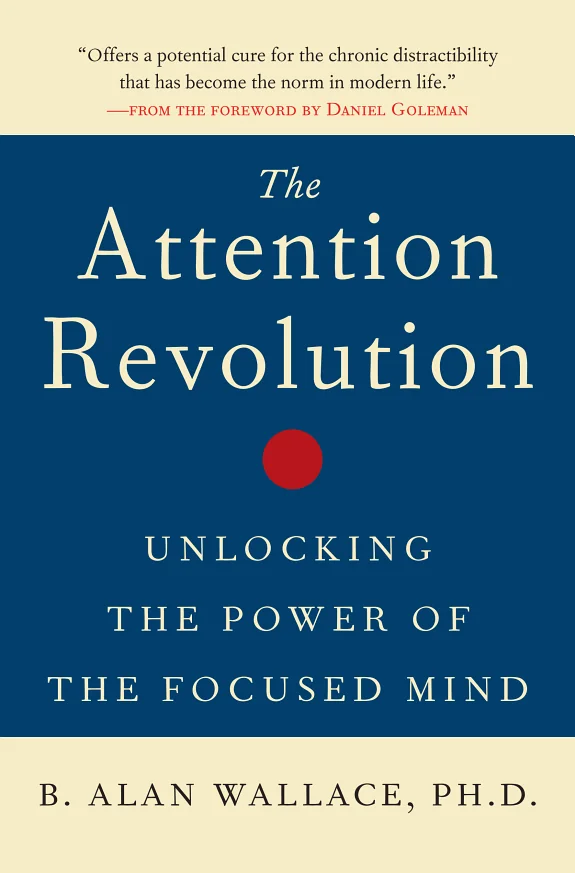
The Attention Revolution
 74
74

The Attention Revolution
B. Alan Wallace's "The Attention Revolution" is a meticulously crafted guide that elevates the discourse around meditation beyond simple relaxation techniques. Wallace, a scholar with decades of contemplative practice and participation in Buddhist-science dialogues, offers a rigorous framework for understanding and developing attention. His strength lies in articulating the sophisticated mechanics of meditative concentration, drawing parallels between Buddhist concepts like shamatha and cognitive science. The book's precise language, especially when detailing the "attentional spectrum" and the nature of mental "hindrances," provides a valuable map for practitioners. However, the very rigor that makes the book authoritative can also be its limitation. For absolute beginners to meditation, the detailed philosophical and psychological distinctions might initially feel dense, requiring a dedicated effort to fully grasp. A particularly insightful passage details the subtle ways the mind "wanders" even during seemingly focused states, underscoring the sophisticated nature of the practice. Ultimately, "The Attention Revolution" is an indispensable resource for those committed to a deep, analytical exploration of mental training.
📝 Description
74
B. Alan Wallace published 'The Attention Revolution' in 2006, arguing focused attention underpins spiritual and intellectual growth.
In 'The Attention Revolution,' B. Alan Wallace makes the case for developing focused attention as central to both spiritual and intellectual advancement. He connects ancient contemplative methods with contemporary scientific research, proposing a clear system for improving concentration. Wallace utilizes his extensive experience with Buddhist meditation, including time spent in retreat with the Dalai Lama, to explain how consistent mental exercises can lead to tangible improvements in cognitive function and overall well-being.
This book is intended for anyone seeking a deeper grasp of consciousness and mental discipline. It particularly suits meditators, whether new to the practice or seasoned, who want to move past basic exercises toward a more disciplined and systematic approach to attention. Readers interested in the connections between science and spirituality, specifically the neurological and psychological benefits of meditative practices, will find Wallace's analytical approach useful. It also holds relevance for academics and professionals examining the effectiveness of mindfulness and attention training techniques.
Published in 2006, 'The Attention Revolution' appeared as interest in mindfulness and its secular uses grew. Wallace grounds these practices in a Buddhist philosophical context, engaging with scientific discourse. His background in Buddhist scholarship and dialogue with scientists informed his perspective, offering a more traditional and philosophical approach to attention training.
💡 Why Read This Book?
• Understand the Buddhist concept of shamatha and its practical application for sustained concentration, as detailed in the book's exploration of "tranquil abiding." • Learn to identify and overcome subtle mental hindrances that impede focus, drawing from Wallace's analysis of the "attentional spectrum" developed through decades of practice. • Gain a scientifically informed perspective on the benefits of focused attention, informed by B. Alan Wallace's participation in dialogues between Buddhist scholars and scientists since the late 20th century.
⭐ Reader Reviews
Honest opinions from readers who have explored this book.
❓ Frequently Asked Questions
What is B. Alan Wallace's background in meditation?
B. Alan Wallace has nearly thirty years of experience in Buddhist meditation, including a retreat under the Dalai Lama. He is also a key figure in dialogues between Buddhist traditions and Western science.
What is the core concept presented in 'The Attention Revolution'?
The core concept is the systematic cultivation of focused attention, termed 'shamatha' in Buddhist tradition, as a means to enhance cognitive abilities and achieve deeper states of consciousness.
How does this book differ from secular mindfulness guides?
Unlike many secular guides, 'The Attention Revolution' grounds its practices in a robust Buddhist philosophical and psychological framework, offering a more nuanced and historically informed approach to attention training.
What is the 'attentional spectrum' mentioned in the book?
The 'attentional spectrum' refers to the range of different qualities and intensities of focus the mind can achieve, from gross to subtle, which Wallace maps out for systematic development.
When was 'The Attention Revolution' first published?
The book was first published on April 10, 2006, reflecting a period of increasing interest in contemplative practices and their scientific investigation.
Does the book discuss the relationship between attention and insight?
Yes, Wallace argues that a highly developed capacity for sustained attention (shamatha) is a crucial prerequisite for the development of profound insight (vipashyana) in meditation.
🔮 Key Themes & Symbolism
Shamatha Meditation
This theme centers on the Buddhist practice of 'shamatha,' or tranquil abiding, which Wallace presents not just as a relaxation technique but as a rigorous method for developing sustained, unwavering attention. He meticulously breaks down the process, detailing how to stabilize the mind and overcome common distractions. The book elaborates on the stages of shamatha, from initial stages of focus to more subtle and enduring states of concentration, emphasizing its foundational role for deeper contemplative work and cognitive enhancement.
The Attentional Spectrum
Wallace introduces the concept of the 'attentional spectrum' to categorize the varying degrees of focus the mind is capable of. This framework moves beyond a simple dichotomy of 'focused' versus 'unfocused,' instead mapping a continuum from gross, coarse attention to subtle, refined awareness. Understanding this spectrum allows practitioners to identify their current level of concentration and to systematically cultivate progressively higher states of mental clarity and stability, crucial for advanced practices.
Bridging Contemplation and Science
A significant aspect of the book is its engagement with contemporary scientific understanding of the mind. B. Alan Wallace, drawing on his participation in dialogues between Buddhist scholars and scientists, explores how contemplative practices like shamatha can be understood through a cognitive and neurological lens. This interdisciplinary approach validates traditional methods with empirical research and offers a bridge for those interested in both the spiritual depth of meditation and its measurable psychological benefits.
Mental Hindrances
The work thoroughly examines the 'five hindrances'—sensual desire, ill-will, sloth and torpor, restlessness and worry, and doubt—as obstacles to achieving stable attention. Wallace provides detailed analysis of how these common mental states manifest and disrupt concentration. The book offers practical strategies derived from Buddhist tradition for recognizing, weakening, and ultimately transcending these hindrances, thereby clearing the path for deeper meditative states and enhanced cognitive function.
💬 Memorable Quotes
Direct passages from the work, attributed to the author.
“Attention is the faculty of the mind that grasps, holds, and surveys objects.”
— This statement defines attention not as a passive state but as an active cognitive tool. It highlights attention's capacity to engage with, retain, and examine mental or sensory objects, forming the basis for all higher cognitive functions and contemplative practices.
“The development of shamatha is a gradual process, requiring diligent effort and patience.”
— This emphasizes that achieving profound concentration is not instantaneous. It requires consistent practice and a patient, step-by-step approach, acknowledging that progress in meditation unfolds over time and demands sustained commitment.
“Our minds are prone to distraction, constantly flitting from one thought to another.”
— This observation points to the inherent restlessness of the untrained mind. It serves as a relatable starting point for readers, illustrating the common challenge that 'The Attention Revolution' aims to address through its techniques.
“Insight depends on a stabilized mind.”
— This highlights the crucial relationship between concentration and wisdom in Buddhist practice. Wallace asserts that true understanding or insight cannot arise from a scattered or agitated mind; it requires the clarity and stability cultivated through practices like shamatha.
“The goal is not to suppress thoughts, but to observe them without entanglement.”
— This clarifies a common misconception about meditation. It suggests that effective practice involves a non-judgmental awareness of mental content, rather than forceful suppression, allowing thoughts to arise and pass without hijacking attention.
🌙 Esoteric Significance
Tradition
Wallace's work is deeply rooted in the Indo-Tibetan Buddhist tradition, specifically drawing from the contemplative methodologies found in Mahayana Buddhism. It fits within this lineage by presenting established practices like shamatha and vipashyana, but departs by framing them within a modern, interdisciplinary context that explicitly engages with Western science and philosophy. This approach aims to make these profound, traditionally esoteric methods accessible and comprehensible to a contemporary global audience, while preserving their core spiritual and psychological aims.
Symbolism
While not heavily reliant on overt symbolism in the Western esoteric sense, the book implicitly uses the concept of the 'mind' itself as a central symbol for consciousness and the locus of transformation. The 'attentional spectrum' can be seen as a symbolic mapping of the inner landscape, charting progress from gross mental states to refined awareness. The 'hindrances' function as symbolic representations of internal obstacles that must be overcome on the path to liberation or enlightenment, akin to overcoming inner demons in other traditions.
Modern Relevance
Contemporary thinkers and practitioners in fields like secular mindfulness, contemplative neuroscience, and positive psychology frequently reference or draw upon the foundational principles outlined by Wallace. His emphasis on the systematic cultivation of attention aligns with research into neuroplasticity and executive functions. Institutions exploring contemplative education and well-being programs often utilize concepts derived from his work, making it relevant for modern applications seeking to enhance focus, emotional regulation, and cognitive performance through established contemplative techniques.
👥 Who Should Read This Book
• Individuals seeking to deepen their meditation practice beyond basic mindfulness, particularly those interested in the systematic cultivation of concentration as taught in Buddhist traditions. • Researchers and students in psychology, neuroscience, and philosophy of mind interested in the cognitive and neurological effects of sustained attention training and contemplative practices. • Anyone feeling overwhelmed by mental distraction and seeking practical, philosophically informed methods to enhance focus, clarity, and mental stability in daily life.
📜 Historical Context
Published in 2006, "The Attention Revolution" arrived during a significant period for contemplative studies. The secular mindfulness movement, popularized by figures like Jon Kabat-Zinn, was gaining considerable traction in Western psychology and wellness circles. Simultaneously, the nascent field of contemplative neuroscience was actively exploring the brain's response to meditation. B. Alan Wallace, with his unique position as a scholar-monk and active participant in dialogues between Buddhist thinkers and Western scientists since the late 1980s, was exceptionally well-placed to synthesize these currents. His work provided a more philosophically grounded and historically informed perspective than much of the contemporary secular mindfulness literature. Unlike purely therapeutic approaches, Wallace’s book engaged with the deeper, traditional aims of Buddhist meditation, offering a rigorous framework for attention training that appealed to both practitioners seeking depth and academics interested in comparative psychology and philosophy of mind.
📔 Journal Prompts
The nature of the "attentional spectrum" and its stages.
Recognizing and working with the five "hindrances" during practice.
The role of shamatha in achieving deeper states of awareness.
Bridging Buddhist contemplative methods with scientific inquiry.
The mind's capacity for sustained focus and its potential.
🗂️ Glossary
Shamatha
A Sanskrit term referring to the Buddhist practice of 'tranquil abiding' or sustained, calm attention. It is the cultivation of a stable, undisturbed state of mind, often considered a prerequisite for insight meditation.
Vipashyana
A Sanskrit term meaning 'insight' or 'clear seeing.' It refers to a type of Buddhist meditation focused on developing wisdom and direct understanding of the nature of reality, often practiced after developing stable concentration through shamatha.
Attentional Spectrum
A concept used by Wallace to describe the range of different qualities and intensities of focus the mind can achieve, from gross, coarse attention to subtle, refined awareness.
Five Hindrances
In Buddhist meditation, these are five common mental states that obstruct concentration and insight: sensual desire, ill-will, sloth and torpor, restlessness and worry, and doubt.
Contemplative Neuroscience
An interdisciplinary field that studies the effects of contemplative practices, such as meditation, on the brain and mind, using scientific methods to investigate subjective experience and its neural correlates.
Dalai Lama
The spiritual leader of Tibetan Buddhism and the former political head of state of Tibet. He is a prominent figure in promoting Buddhist philosophy and interfaith dialogue worldwide.
Cognitive Science
The interdisciplinary study of the mind and its processes, including perception, language, memory, attention, reasoning, and emotion, drawing from fields like psychology, computer science, linguistics, philosophy, and neuroscience.
This book appears in 1 collection
🔮 Readers Also Liked
Browse all →









From the “Dream Yoga” Collection
View all →






More Free Occult Philosophy Books
View all →