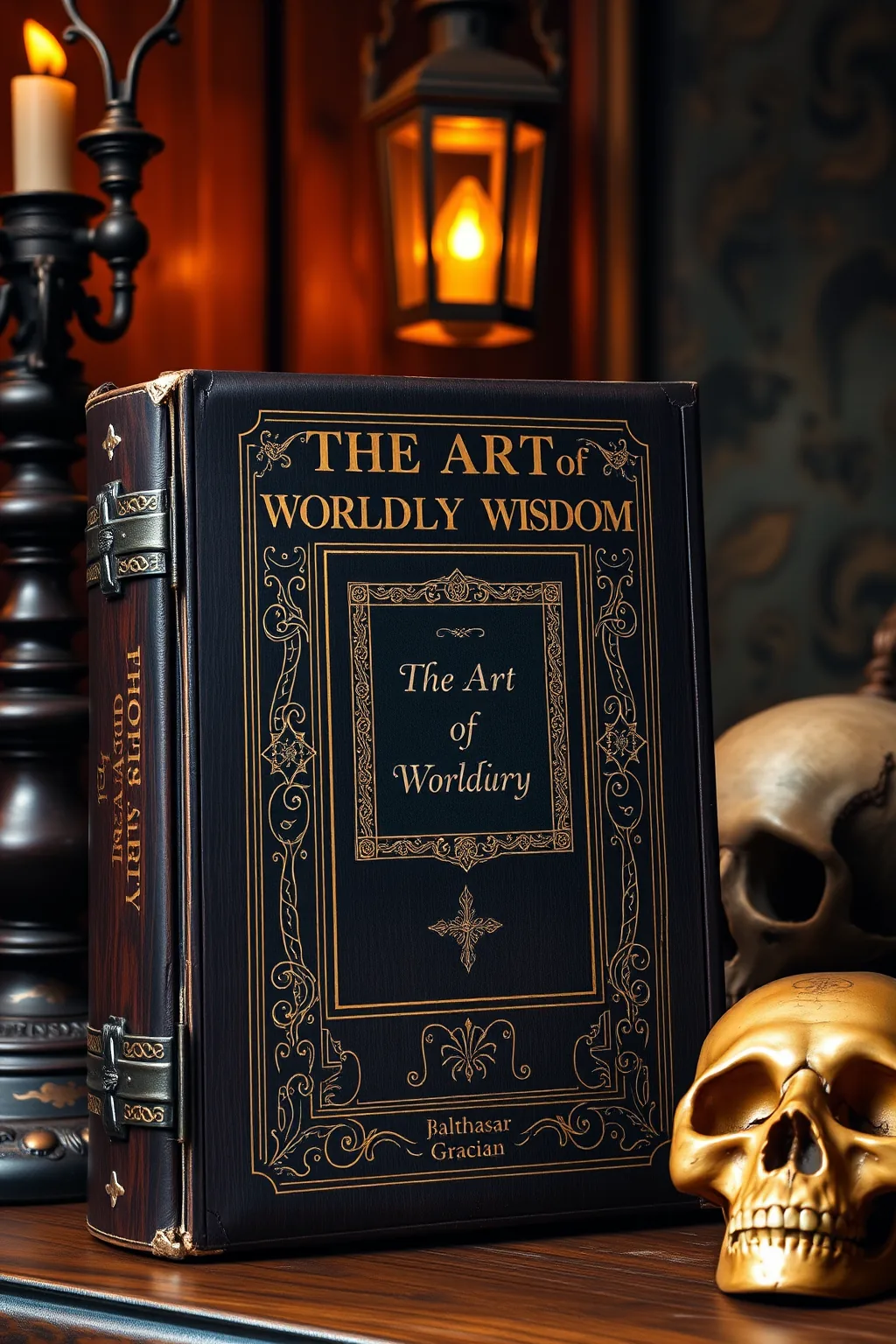
The Art of Worldly Wisdom
 75
75

The Art of Worldly Wisdom



Ophelia Vance (Mystical Literature Reviewer) — Balthasar Gracian's "The Art of Worldly Wisdom," expertly translated by Joseph Jacobs, transcends its era to offer profound esoteric insights. Gracian's aphorisms function as potent spells for navigating the intricate alchemy of human interaction. He guides the reader through the symbolic landscape of ambition, deception, and virtue, revealing hidden truths about power dynamics and personal sovereignty. This work is essential for serious students of practical philosophy and those seeking to refine their understanding of the 'great work' of life. Its strength lies in its concise, aphoristic style, making complex psychological and philosophical concepts accessible yet deeply resonant.
📝 Description
75
Balthasar Gracian's 1647 book, 'The Art of Worldly Wisdom,' examines the subtle strategies for succeeding in life.
Balthasar Gracian's "The Art of Worldly Wisdom," translated by Joseph Jacobs, presents a collection of aphorisms on practical philosophy and human nature. Gracian, writing in the 17th century, did not aim to provide simple social advice but rather a deeper understanding of how to achieve success and inner calm. He viewed his maxims as tools for developing discernment, prudence, and self-control.
The book's aphorisms are designed to be symbolic keys, unlocking principles for navigating worldly affairs and finding personal peace. Gracian suggests that genuine strength comes from comprehending human psychology and the unpredictable nature of fortune. This work is for individuals who seek to manage life's challenges with insight and a degree of detachment, preparing them for the complexities of existence.
Though not overtly mystical, Gracian's work shares common ground with esoteric traditions through its emphasis on inner transformation and practical application of hidden knowledge. The focus on discernment, self-mastery, and understanding the subtle forces that shape outcomes aligns with practices found in Hermeticism and certain schools of Renaissance Neoplatonism. The aphoristic style, akin to alchemical texts, suggests that profound truths can be condensed into potent symbols. Gracian's approach encourages a disciplined inner life as a means to effectively engage with the external world, reflecting a holistic view of personal development often found in esoteric thought.
💡 Why Read This Book?
Uncover the hidden architecture of human interaction and elevate your personal power. This book is for the discerning seeker, the scholar of esoteric thought, and the practitioner of mindful living who understands that true wisdom lies in mastering oneself and understanding the subtle forces at play in the world. Read it to gain an edge in life's grand theatre, not through manipulation, but through profound self-awareness and strategic insight.
⭐ Reader Reviews
Honest opinions from readers who have explored this book.
❓ Frequently Asked Questions
Is "The Art of Worldly Wisdom" a book of manipulation?
While it offers strategies for navigating social complexities, its core is about self-mastery and understanding human nature, aiming for wisdom and virtue rather than mere manipulation. It's about discernment and prudent action.
Who was Balthasar Gracian?
Balthasar Gracian (1601-1658) was a Spanish Jesuit priest, scholar, and writer, renowned for his profound philosophical maxims on life, ethics, and worldly wisdom, often imbued with a subtle mystical and practical understanding.
What is the significance of Joseph Jacobs' translation?
Joseph Jacobs, a prominent folklorist, brought a keen eye for narrative and cultural nuance to his translation, making Gracian's dense aphorisms accessible and preserving their potent impact for English-speaking readers.
Can this book be considered hermetic?
Yes, it shares principles with hermetic philosophy through its emphasis on hidden knowledge, understanding underlying principles of reality, and the art of self-transformation, akin to the alchemical transmutation of base metals into gold.
What makes this book relevant today?
Gracian's insights into human psychology, leadership, and strategic thinking remain remarkably pertinent in our complex modern world, offering timeless guidance for personal and professional success.
🔮 Key Themes & Symbolism
The Alchemy of Prudence
This theme explores Gracian's meticulous guidance on the art of prudence, not as mere caution, but as a sophisticated alchemical process of transforming raw experience and observation into actionable wisdom. It explores the symbolic representation of discernment as a tool to separate the dross of deception from the gold of truth, enabling the adept to work through the treacherous currents of the world with foresight and equanimity. Understanding the 'elements' of human interaction—ambition, weakness, virtue—is presented as a foundational step in this transformative practice.
The Hermetic Mirror of Self
Gracian's aphorisms act as a hermetic mirror, reflecting the deepest aspects of the self and the external world. This theme examines how the book encourages introspection and the development of an inner citadel, a fortified sanctuary of self-knowledge and control. It highlights the concept of 'knowing oneself' as the primary key to unlocking external success, drawing parallels to alchemical practices where the inner transformation of the practitioner is paramount to achieving the Major work. The pursuit of virtue is depicted as the refined essence extracted from the crucible of life's trials.
The Great Work of Life
This theme frames the entirety of human existence as a grand alchemical endeavor, a 'Great Work' requiring skill, patience, and profound understanding. Gracian's wisdom is presented as the alchemist's grimoire, offering the formulae and techniques for successfully transmuting the challenges and opportunities of life into personal growth and fulfillment. The book emphasizes the importance of timing, strategic action, and the cultivation of a discerning mind, all essential components for the successful completion of this ultimate, lifelong experiment in mastering one's destiny.
💬 Memorable Quotes
Direct passages from the work, attributed to the author.
“It is better to have a great deal of wit than to have it said that you have it.”
— True intelligence is demonstrated through action and application, not mere reputation. It’s the substance of wit that matters, not its public acknowledgment.
“To know how to wait is the secret of all success.”
— Patience is a powerful tool in the alchemist's arsenal, allowing for the opportune moment to act and ensuring that efforts are not wasted through haste.
“The greatest wisdom is to know yourself.”
— Self-knowledge is the foundation of all other wisdom, the primary substance upon which all external understanding and mastery are built.
“He who makes an idol of his virtue will want for followers.”
— An overly rigid or ostentatious display of virtue can alienate others. True virtue is subtle and adaptable, drawing people in through its natural grace.
“Discretion is the soul of all business.”
— Prudence and careful judgment are paramount in all endeavors, guiding actions and safeguarding against potential pitfalls, much like a skilled alchemist’s precise measurements.
🌙 Esoteric Significance
Tradition
This work deeply appeals to the Hermetic tradition, particularly its emphasis on understanding the hidden principles that govern the cosmos and human life. Gracian's aphorisms function as keys to unlocking these underlying laws, akin to the Hermetic maxim 'As above, so below.' It also aligns with practical Neoplatonism, focusing on the ascent of the soul through knowledge and virtue towards a higher state of being.
Symbolism
Gracian employs a body of symbolism, often drawing parallels between worldly success and alchemical processes. Concepts like 'discretion' become the purified 'solvent,' 'prudence' the careful 'heating process,' and 'self-knowledge' the 'Philosopher's Stone.' Human nature itself is a complex compound to be understood and refined. His maxims are potent 'symbols' that, when meditated upon, reveal deeper layers of meaning and practical application.
Modern Relevance
In an age saturated with information but often lacking in wisdom, Gracian's "The Art of Worldly Wisdom" offers a vital counterpoint. Its focus on discernment, strategic thinking, emotional intelligence, and the cultivation of inner resilience remains profoundly relevant for navigating personal relationships, professional challenges, and the digital landscape. It provides timeless tools for ethical leadership and personal empowerment.
👥 Who Should Read This Book
This important work is essential for a diverse readership. **Beginners** in philosophy will find a clear and engaging entry point into profound ethical and psychological concepts. **Scholars** of history, literature, and philosophy will appreciate its place within the Spanish Golden Age and its enduring intellectual legacy. **Seekers** of personal growth and self-improvement will discover a wealth of practical wisdom for navigating life's complexities with grace and efficacy. **Practitioners** of mindfulness, strategy, and leadership will find its aphorisms to be potent tools for honing their skills and deepening their understanding of human nature and influence.
📜 Historical Context
Written in the heart of the Spanish Golden Age (1647), Balthasar Gracian's "The Art of Worldly Wisdom" emerged from a period of intellectual ferment and societal upheaval. Spain, though outwardly powerful, was grappling with internal challenges, fostering a climate where shrewd political and social maneuvering was a necessity for survival and influence. Gracian, a Jesuit, operated within a sophisticated intellectual tradition that valued logic, ethics, and a nuanced understanding of human affairs. His work reflects the era's fascination with stoicism, practical philosophy, and the subtle arts of statecraft, often couched in allegorical and aphoristic language. The translation by Joseph Jacobs in the late 19th century, a period of great interest in folklore and ancient wisdom, brought these clear insights to a wider English-speaking audience, bridging centuries of cultural and intellectual evolution.
📔 Journal Prompts
Reflect on a recent situation where greater discernment could have altered the outcome. How can Gracian's wisdom be applied?
Identify one 'idol of virtue' you might unintentionally be presenting to the world. How can you embody virtue more authentically?
Consider a goal you are currently pursuing. How can the principle of 'knowing how to wait' be beneficial in achieving it?
What is one aspect of your own nature that you are still striving to fully understand? How does this self-knowledge impact your interactions?
Gracian speaks of the 'soul of all business' being discretion. In what area of your life could practicing greater discretion yield significant positive results?
🗂️ Glossary
Aphorism
A concise and memorable statement expressing a general truth or principle. Gracian's work is composed entirely of these potent, distilled pieces of wisdom.
Discernment
The ability to judge well, to perceive differences, and to make wise distinctions. It is a crucial skill for navigating complex situations and understanding underlying truths.
Prudence
The quality of being cautious and sensible in practical affairs. It involves foresight, careful planning, and the ability to make wise decisions, particularly in matters of conduct.
Fortuna
In a classical and Renaissance context, Fortuna represents chance, luck, or fate. Gracian's work offers strategies for navigating and influencing the unpredictable currents of Fortuna.
Virtue
Moral excellence; the quality of being good, righteous, and honorable. Gracian explores the practical application and presentation of virtue in worldly affairs.
This book appears in 2 collections
🔮 Readers Also Liked
Browse all →









From the “Hermeticism” Collection
View all →






More Free Alchemy & Hermeticism Books
View all →