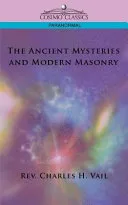
The Ancient Mysteries and Modern Masonry
 79
79

The Ancient Mysteries and Modern Masonry
Charles H. Vail's "The Ancient Mysteries and Modern Masonry" attempts to bridge the chasm between the speculative origins of esoteric thought and the structured rituals of Freemasonry. The author's central thesis, that Masonic practices are direct descendants of ancient Atlantean Mystery cults, is ambitious. Vail argues that the secrecy surrounding occult knowledge necessitated the development of initiatory systems, a concept he illustrates by referencing the "Divine Dynasties" of early ages. The work's strength lies in its earnest attempt to synthesize disparate historical and mythological threads into a coherent narrative of esoteric transmission. However, the primary limitation is the speculative nature of its foundational claims regarding Atlantis and the direct, unbroken lineage of these "Mysteries." While the book offers a compelling interpretation, it often relies on circumstantial evidence and broad assumptions rather than verifiable historical documentation, particularly when discussing pre-historical civilizations. The passage concerning the "necessity to withhold such knowledge from the unworthy" highlights the book's reliance on a narrative of lost wisdom and guarded secrets, which, while evocative, is difficult to substantiate empirically. Vail's work is best approached as an exploration of esoteric theory rather than a definitive historical account.
📝 Description
79
Charles H. Vail's 2005 book connects ancient occult traditions with Masonic symbolism.
First published in 2005, Charles H. Vail's "The Ancient Mysteries and Modern Masonry" examines the historical links between early occult traditions and the development of Masonic symbolism. Vail argues that Freemasonry did not appear in isolation but inherited ancient religious and philosophical systems. He specifically points to origins in Atlantean or pre-diluvian cultures as a source of this esoteric knowledge.
The book traces the transmission of this hidden knowledge through various historical periods. Vail suggests its secrecy was often necessary due to misuse by those unqualified, which led to the formation of formal Mystery cults. This work is intended for students of esotericism, comparative religion, and secret societies who wish to understand Freemasonry beyond its fraternal aspects, viewing it as a holder of ancient wisdom. It will appeal to those interested in the roots of Western occultism, the impact of Gnosticism, Hermeticism, and Kabbalah, and the idea of a continuous stream of hidden knowledge.
Vail's work is situated within the late 19th and early 20th-century intellectual climate that was deeply interested in ancient civilizations and esoteric thought. This era saw significant study in comparative mythology and occult philosophy, influenced by figures like Helena Blavatsky and the Theosophical Society. Vail's focus on Atlantean origins and "Divine Dynasties" reflects a common interest in pre-historical, advanced societies within esoteric circles of his research period. His perspective blends scholarly inquiry with a mystical outlook, aiming to synthesize science, religion, and philosophy through ancient traditions.
💡 Why Read This Book?
• Understand the proposed lineage of Masonic symbolism back to "Atlantean" or pre-diluvian "Divine Dynasties," offering a unique perspective on its ancient roots. • Grasp the concept of "occult knowledge" being initially public and later systematized into "Mysteries" due to societal misuse, providing context for the evolution of esoteric teachings. • Explore Vail's argument for Freemasonry as a modern manifestation of primeval wisdom, distinct from purely historical or sociological analyses, appealing to those seeking deeper spiritual connections to the craft.
⭐ Reader Reviews
Honest opinions from readers who have explored this book.
❓ Frequently Asked Questions
When was "The Ancient Mysteries and Modern Masonry" first published?
Charles H. Vail's "The Ancient Mysteries and Modern Masonry" was first published on December 1, 2005. This edition makes his research on the historical connections between ancient esoteric traditions and Freemasonry accessible to contemporary readers.
What is the main argument of "The Ancient Mysteries and Modern Masonry"?
The book's central argument is that modern Freemasonry evolved directly from ancient Mystery cults, which themselves originated in advanced, primeval civilizations like Atlantis, preserving esoteric knowledge across millennia.
Does the book discuss Atlantis?
Yes, "The Ancient Mysteries and Modern Masonry" heavily features Atlantis, positing it as a source civilization where "occult knowledge was taught openly" before the establishment of "Mysteries" to safeguard it from misuse.
Who were the "Divine Dynasties" mentioned in the book?
According to Vail, the "Divine Dynasties" were the "King-Priests" of early ages, likely in Atlantean times, who established the "Mysteries" as a means of preserving and transmitting sacred, esoteric knowledge.
Is this book suitable for someone new to esoteric studies?
While it offers historical context, the book assumes some familiarity with esoteric concepts. Beginners might find it dense, but it serves as a valuable resource for understanding the historical arguments connecting ancient traditions to modern esoteric practices like Masonry.
What is the significance of "withholding knowledge from the unworthy" in the book?
This concept explains the transition from open dissemination of esoteric teachings to the creation of secret "Mysteries." Vail suggests that the abuse of power by selfish individuals necessitated this secrecy to protect sacred wisdom.
🔮 Key Themes & Symbolism
The Genesis of Mysteries
Vail posits that in primordial ages, occult knowledge was universally accessible, much like modern science. However, due to human selfishness and the abuse of power, this wisdom had to be withdrawn from the unworthy. This necessity led to the establishment of formal Mystery cults by figures he identifies as "King-Priests" of "Divine Dynasties," a foundational concept for understanding the esoteric lineage discussed throughout the work.
Atlantean Roots of Esotericism
Central to Vail's thesis is the idea that Atlantis served as a cradle for advanced spiritual and philosophical traditions. The book explores how the "Mysteries" originated in this lost continent, suggesting that much of the esoteric lore found in later civilizations, including Masonic symbolism, traces its lineage back to Atlantean teachings and practices.
Transmission of Hidden Knowledge
The work examines the historical process by which esoteric knowledge has been preserved and transmitted across ages. Vail argues for a continuous stream of "occult knowledge," often veiled or symbolized to protect it from those unprepared. This transmission is presented as a vital thread connecting ancient wisdom to contemporary esoteric systems, particularly Freemasonry.
Freemasonry as Modern Mystery
Vail interprets Freemasonry not just as a fraternal order but as a modern embodiment of ancient Mystery traditions. He suggests that Masonic rituals, symbols, and degrees serve as vehicles for conveying the same essential spiritual truths that were once taught in the primeval "Mysteries," linking the modern craft directly to its ancient, esoteric origins.
💬 Memorable Quotes
Direct passages from the work, attributed to the author.
“In the early ages occult knowledge was taught openly, as the sciences are taught in our colleges to-day.”
— This sets the stage for Vail's argument that esoteric wisdom was once universally understood, contrasting it with its later, more guarded transmission, implying a fall from an earlier state of enlightened awareness.
“But in the course of time many allowed their selfishness to rule and so abused their power that it became necessary to withhold such knowledge from the unworthy.”
— This explains the critical shift from public knowledge to secret "Mysteries." It highlights a recurring theme in esoteric thought: the corruption of pure wisdom by human failings, necessitating protective measures for its preservation.
“This was the condition of religious affairs when the Mysteries were necessarily established by the King-Priests of the Divine Dynasties, in the early days of Atlantis.”
— This statement directly links the establishment of formal Mystery cults to the "Divine Dynasties" and places their origin in Atlantis, forming a core pillar of Vail's historical and esoteric thesis.
“Though the author cannot, alas, provide definitive proof of these remote origins, he aims to illuminate the probable path of their transmission.”
— This is an honest admission of the speculative nature of his claims, acknowledging the difficulty of verifying prehistoric events while signaling the book's intent to explore plausible connections and symbolic lineages.
“The author analyzes the symbolic language and rituals that have been preserved and passed down through various cultures and secret societies.”
— This indicates the book's methodology: tracing esoteric truths through the study of symbols and rituals, suggesting that these are the enduring carriers of ancient wisdom across historical epochs.
🌙 Esoteric Significance
Tradition
Vail's work sits within the Hermetic and Gnostic traditions, particularly drawing from speculative theories of pre-diluvian civilizations and a continuous stream of esoteric knowledge. It reflects the Hermetic principle of "As Above, So Below," suggesting that the macrocosmic truths of ancient mysteries are reflected in the microcosm of human understanding and rituals, such as those found in Masonry.
Symbolism
The book likely examines symbols associated with ancient cults and Freemasonry, such as the Square and Compasses, the All-Seeing Eye, or geometric forms. These are interpreted not merely as decorative elements but as carriers of profound cosmological and spiritual truths, representing universal principles of order, divine oversight, and the path of initiation inherited from "Atlantean" or similar ancient systems.
Modern Relevance
Contemporary esotericists and Masonic researchers interested in the philosophical underpinnings of their traditions continue to engage with Vail's thesis. His work provides a framework for understanding Freemasonry as a living repository of ancient wisdom, influencing modern interpretations of ritual, symbolism, and the pursuit of spiritual enlightenment within fraternal contexts.
👥 Who Should Read This Book
• Students of Western Esotericism: Those seeking to understand the historical arguments connecting ancient Mystery cults, including alleged Atlantean traditions, to the origins and symbolism of Freemasonry. • Comparative Religion Scholars: Individuals interested in exploring theories about the transmission of religious and philosophical ideas from antiquity to modern secret societies. • Freemasons seeking deeper meaning: Members of the Craft who wish to explore speculative historical and philosophical interpretations of their order's roots beyond conventional historical accounts.
📜 Historical Context
Charles H. Vail's "The Ancient Mysteries and Modern Masonry" emerged from the fertile intellectual soil of the late 19th and early 20th centuries, a period marked by intense interest in comparative mythology, occultism, and ancient civilizations. Figures like Helena Blavatsky and the Theosophical Society were popularizing theories of ancient wisdom and lost continents, including Atlantis. Vail's work aligns with this milieu, seeking to connect modern esoteric practices, specifically Freemasonry, to these alleged primeval sources. This era also saw significant developments in archaeology and the study of ancient religions, which provided both inspiration and material for esoteric interpretations, though often diverging from mainstream academic consensus. Vail's exploration of "Divine Dynasties" and "Atlantean" origins reflects a broader tendency within esoteric circles to reinterpret history through a lens of spiritual evolution and hidden knowledge, positioning him alongside authors attempting to synthesize science, religion, and philosophy.
📔 Journal Prompts
The concept of "occult knowledge" being initially public and later guarded.
The "Divine Dynasties" and their role in establishing "Mysteries."
The necessity of "withholding knowledge from the unworthy."
Atlantis as the origin point for "Mysteries."
The connection between "Atlantean" teachings and Masonic symbolism.
🗂️ Glossary
Occult Knowledge
Esoteric or hidden knowledge concerning the fundamental nature of reality, the cosmos, and the spiritual world, believed to be possessed by ancient sages and passed down through select traditions.
Mysteries
Ancient religious rites and secret teachings, often involving initiation, that were practiced in cults of the Greco-Roman world and, according to Vail, originated in earlier civilizations like Atlantis.
Divine Dynasties
A term used by Vail to describe the ancient ruling or priestly classes, particularly in Atlantis, who were believed to have custodianship over sacred and esoteric knowledge.
Atlantis
A legendary island or continent, first mentioned by Plato, often depicted in esoteric literature as a highly advanced civilization that predated recorded history and influenced global cultures.
King-Priests
Rulers or spiritual leaders in ancient societies, particularly in Vail's concept of Atlantis, who combined secular authority with sacerdotal functions, overseeing the "Mysteries."
Unworthy
Individuals perceived as lacking the moral or spiritual preparedness to receive and responsibly use esoteric knowledge, leading to its withdrawal and the creation of secret initiatory systems.
Esotericism
A broad category of spiritual or religious traditions, often characterized by initiation and the pursuit of hidden knowledge, aiming for spiritual transformation or union with the divine.