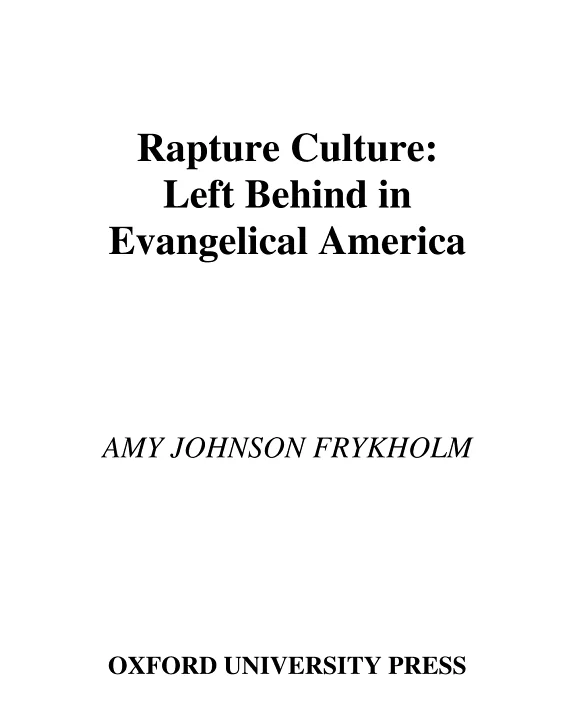
Rapture Culture
 77
77

Rapture Culture
Amy Johnson Frykholm's *Rapture Culture* offers a sober, academic dissection of a potent eschatological belief. Rather than sensationalizing the phenomenon, Frykholm anchors her analysis in historical and theological context, tracing the development of Rapture doctrine from its biblical roots to its 20th-century popularization. A particular strength is her examination of the *cultural output*—the novels, films, and even music—that both reflected and amplified these beliefs, demonstrating how theological concepts seep into the collective imagination. The book's limitation, perhaps inherent to its academic approach, is a certain detachment; the fervent emotional and spiritual conviction of believers sometimes feels more observed than deeply understood. However, passages detailing the anxieties and hopes embedded in the belief, such as the anticipation of an imminent, world-altering event, are compelling. Frykholm’s work provides a valuable, dispassionate overview of a significant strand of modern religious thought.
📝 Description
77
Amy Johnson Frykholm's 2004 book examines the cultural force of the Rapture belief.
Rapture Culture, published in 2004, analyzes the Christian doctrine of the Rapture. Amy Johnson Frykholm's work details the theological foundations of this belief, which anticipates Christ's immediate return to take believers to heaven, followed by global upheaval, the Antichrist's reign, and Christ's final return. The book traces how these ideas have shaped popular culture.
Frykholm looks at core Rapture theology, such as pretribulationism and the signs of the end times. She also shows how these beliefs affect literature, film, and the daily lives of those who hold them. The book connects these ideas to a history of millennial expectations and the social and political conditions that gave rise to them, especially in the United States.
While the Rapture is a specific Christian doctrine, its focus on imminent divine intervention, hidden knowledge for believers, and future world events places it within a broader esoteric interest in prophecy and apocalypse. Like other esoteric traditions, it offers a framework for understanding history and the present through a divinely ordained narrative. The belief system also shares with esoteric thought a concern for distinguishing between those who will be 'taken' and those left behind, suggesting a form of spiritual discernment.
💡 Why Read This Book?
• Gain an understanding of dispensationalist theology, a significant 20th-century Christian interpretive framework, and its specific teachings on the 'secret return' of Christ. • Explore the cultural impact of eschatological beliefs, learning how concepts like the Antichrist and the Tribulation have been translated into popular media since the 1970s. • Analyze the historical development of Rapture doctrine, tracing its rise in influence through figures like Cyrus I. Scofield and the Scofield Reference Bible.
⭐ Reader Reviews
Honest opinions from readers who have explored this book.
❓ Frequently Asked Questions
What is the central theological concept discussed in Rapture Culture?
The central concept is the Christian doctrine of the Rapture, which posits that believers will be secretly taken to heaven by Jesus Christ before a period of global tribulation.
When was Rapture Culture first published?
Rapture Culture was first published on March 4, 2004, by Amy Johnson Frykholm.
What historical figures influenced the ideas presented in Rapture Culture?
The book likely discusses figures associated with dispensationalist theology, such as Cyrus I. Scofield, whose 1909 Scofield Reference Bible significantly popularized these eschatological views.
Does Rapture Culture focus on the literal interpretation of biblical prophecy?
Yes, the book examines the literal interpretation of biblical passages that form the basis of Rapture theology, including those concerning the end times and Christ's second coming.
What kind of cultural phenomena does Rapture Culture analyze?
It analyzes how Rapture beliefs have permeated popular culture, influencing literature, film, and public discourse surrounding end-times scenarios.
Is this book a theological defense of the Rapture?
No, Rapture Culture is primarily an academic and cultural analysis of the Rapture belief system, rather than a theological endorsement or refutation.
🔮 Key Themes & Symbolism
Dispensationalist Eschatology
The book examines the specific theological framework of dispensationalism, which underpins the Rapture doctrine. This system divides biblical history into distinct periods ('dispensations') and interprets prophecy, particularly concerning Israel and the Church, in a literal manner. Frykholm examines how this approach leads to the expectation of a pre-tribulation Rapture, a secret, imminent event where believers are removed from Earth before a period of unprecedented suffering.
Cultural Manifestations of Belief
Beyond theological tenets, Frykholm investigates how Rapture beliefs translate into tangible cultural products and societal attitudes. This includes the proliferation of 'Left Behind' style novels, films depicting apocalyptic scenarios, and the pervasive influence of these narratives on popular imagination. The work highlights how these cultural outputs both reflect and reinforce the core tenets of the faith for adherents.
The Role of the Antichrist
A significant element explored is the figure of the Antichrist. Frykholm analyzes how this character is understood within Rapture theology—often as a future global dictator who will persecute believers during the Tribulation. The book examines the symbolic and narrative function of this antagonist in shaping the perceived urgency and stakes of end-times prophecy.
Historical Roots and Modern Popularity
The work traces the historical trajectory of Rapture theology, acknowledging its biblical inspirations but focusing on its significant development and popularization in the late 19th and 20th centuries. Frykholm contextualizes its rise within specific socio-religious movements in America, explaining why this particular eschatological vision gained such a fervent following among millions.
💬 Memorable Quotes
Direct passages from the work, attributed to the author.
“Jesus secretly returns to earth and gathers to him all believers in the 'twinkling of an eye.'”
— This captures the core tenet of the Rapture: a swift, supernatural event where the faithful are instantly transported to heaven, leaving the unprepared world behind.
“As they are taken to heaven, the world they leave behind is plunged into chaos.”
— This highlights the immediate consequence of the Rapture in theological narratives: widespread societal breakdown and confusion as believers vanish.
“Plagues, famine, and suffering follow. The antichrist emerges to rule the world.”
— This describes the post-Rapture period, often termed the Tribulation, characterized by divine judgment and the rise of a malevolent global power.
“Finally, Christ comes again in glory, defeats the antichrist and reigns over the earth.”
— This outlines the ultimate resolution within this eschatological framework: the triumphant second coming of Christ and the establishment of his eternal kingdom.
“This apocalyptic scenario is anticipated by millions.”
— This emphasizes the widespread nature of Rapture belief, indicating its significant cultural and demographic reach within certain Christian communities.
🌙 Esoteric Significance
Tradition
While rooted in Protestant Christianity, the Rapture doctrine exhibits characteristics that resonate with certain esoteric traditions focused on spiritual ascension and cosmic timelines. Its emphasis on a divinely ordained, imminent end-times event and the separation of the faithful from the unfaithful echoes Gnostic ideas of dualism and salvation through selective enlightenment. The highly structured, sequential nature of the predicted events also aligns with the calendrical and prophetic interests found in some forms of Western esotericism.
Symbolism
The core symbolism revolves around 'ascension'—the literal, physical removal of believers to heaven. This contrasts with more inward, spiritual ascension common in other traditions. The 'twinkling of an eye' signifies divine immediacy and inscrutability. The figure of the Antichrist functions as a potent symbol of worldly power and opposition to the divine, a recurring archetype in various mystical narratives. The ensuing chaos and judgment represent a purification process, aligning with cyclical views of destruction and renewal.
Modern Relevance
Contemporary thinkers and practitioners in fields like the sociology of religion and cultural studies frequently cite *Rapture Culture* when examining the enduring influence of apocalyptic narratives. It remains a key text for understanding the specific brand of Christian millennialism that has shaped political discourse and popular culture, particularly in the United States. Its analysis is relevant to those studying the intersection of faith, media, and political movements today.
👥 Who Should Read This Book
• Students of comparative religion and eschatology seeking to understand specific Christian end-times beliefs and their cultural footprint. • Cultural critics and sociologists interested in how theological doctrines influence popular media and societal anxieties. • Readers curious about the historical development of modern evangelicalism and its distinctive prophetic interpretations originating in the late 19th century.
📜 Historical Context
Published in 2004, Amy Johnson Frykholm's *Rapture Culture* emerged during a period of heightened interest in Christian eschatology, significantly fueled by the success of the *Left Behind* book series, which began in 1995. The theological underpinnings of the Rapture, particularly dispensationalism, gained widespread visibility through Cyrus I. Scofield's influential Scofield Reference Bible (first published 1909), which provided literalistic, pre-millennial, and pre-tribulation interpretations of scripture. Frykholm's work situates itself within this context, analyzing how these specific theological ideas, once confined to niche evangelical circles, became a dominant cultural force. While not a direct engagement, her analysis implicitly contrasts with more historicist or amillennial interpretations prevalent in other Christian traditions. The book's reception contributed to the broader academic and public discourse on the sociology and cultural impact of apocalyptic beliefs in late 20th and early 21st-century America.
📔 Journal Prompts
The concept of the 'twinkling of an eye' and its implications for divine timing.
The Antichrist's role as a symbol of worldly power versus spiritual authority.
The cultural translation of theological tenets into popular narratives like the 'Left Behind' series.
Personal reflections on the appeal of structured end-times prophecies.
The historical shift of Rapture theology from niche belief to mainstream cultural phenomenon.
🗂️ Glossary
Rapture
A core doctrine in some Christian eschatologies, positing the imminent, secret return of Jesus Christ to gather all believers, living and dead, into heaven.
Dispensationalism
A theological system that divides biblical history into distinct eras or 'dispensations,' often emphasizing a literal interpretation of prophecy and a future role for national Israel.
Pretribulationism
The belief that the Rapture of believers will occur before the seven-year period of intense tribulation prophesied in the Book of Revelation.
Antichrist
A figure, often depicted as a charismatic world leader, who will oppose Christ and persecute believers during the end times, according to certain biblical interpretations.
Tribulation
A period of intense suffering, divine judgment, and cosmic upheaval believed to occur before the final establishment of God's kingdom on Earth.
Eschatology
The theological study of end times, including doctrines about death, judgment, the afterlife, and the ultimate destiny of humanity and the cosmos.
Scofield Reference Bible
An annotated edition of the King James Bible first published in 1909, which significantly popularized dispensationalist theology and Rapture beliefs through its marginal notes.
This book appears in 1 collection
🔮 Readers Also Liked
Browse all →









From the “Apocalyptic Literature” Collection
View all →






More Free Occult Philosophy Books
View all →