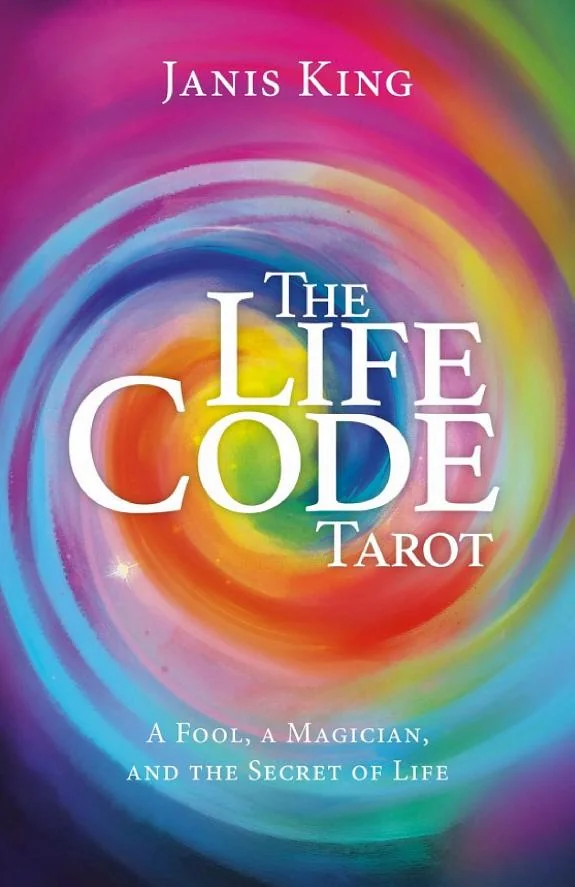
Tarot - The Life Code
 80
80

Tarot - The Life Code
Janis King’s "Tarot - The Life Code" endeavors to pull back the curtain on what she suggests are the conventional, superficial readings of the Tarot. The book’s core argument – that the card meanings are merely the "tip of the iceberg" – is certainly a bold claim, aiming to reposition the Tarot from a divinatory tool to a systematic code. Her account of the deck’s genesis, appearing piece by piece over eighteen months after her studies at The Arthur Findlay College, lends a certain narrative weight. The conceptual shift from seeing Tarot meanings as solely symbolic to understanding them as part of a re-defined relationship between Major and Minor Arcana is the work’s most intriguing aspect. However, the execution sometimes feels more like an introduction to a system than a complete explication. While King successfully outlines the *idea* of a deeper code, the actual mechanics of this "Life Code" could benefit from more granular detail and illustrative examples beyond the conceptual. The strength lies in its ambitious re-framing; its limitation is in the depth of its practical application presented within these pages. The claim that the "meanings are just the tip of the iceberg" is effectively established conceptually, but the iceberg's submerged mass remains somewhat obscured. It’s an invitation to a new perspective, rather than a fully mapped territory.
📝 Description
80
Janis King's Tarot - The Life Code proposes a coded system for understanding the Tarot's Major and Minor Arcana.
Janis King's Tarot - The Life Code moves past standard divinatory meanings to propose a systemic understanding of the Tarot cards. King argues that typical interpretations are superficial, concealing a more detailed code within the Major and Minor Arcana. She details the development of her "Life Code Tarot Deck," a project that took eighteen months after extensive study at The Arthur Findlay College. This book is not about a new deck; it is about a new way to interact with Tarot archetypes. The volume is for experienced Tarot readers who feel they have gone beyond common interpretations and want a more analytical approach. It will also interest those who study esoteric systems that aim to codify universal principles, especially individuals drawn to numerology, astrology, and symbolic language. Students of consciousness studies and those who use Tarot as a psychological or philosophical tool will find value here.
King's work draws from the late 19th and early 20th-century esoteric thought. Theosophy, for instance, synthesized Eastern and Western mystical traditions. Later, Carl Jung's psychological approach to archetypes in the mid-20th century offered another way to understand Tarot's symbolic depth. King's "Life Code" updates these ideas with a specific, coded system that redefines the connection between the Major and Minor Arcana. This offers a structured alternative to the more intuitive or divinatory methods seen since A.E. Waite's publications.
This work emerges from the esoteric currents of the late 19th and early 20th centuries, a period that saw the synthesis of Eastern and Western mystical traditions, notably in Theosophy. Carl Jung's mid-20th-century work on archetypes also provided a significant framework for interpreting Tarot's symbolic depth through a psychological lens. Janis King's "Life Code" builds upon these foundations, proposing a specific, coded system. It redefines the relationship between the Major and Minor Arcana, offering a structured methodology that departs from purely intuitive or divinatory approaches.
💡 Why Read This Book?
• Learn a new framework for understanding Tarot beyond standard interpretations, as detailed in King's "Life Code" system, which proposes a redefinition of the relationship between the Major and Minor Arcana. • Gain insight into a personal esoteric development process, as King recounts the eighteen-month period during which her "Life Code Tarot Deck" and its underlying system revealed themselves. • Explore a structured approach to symbolic systems, moving from intuitive readings to a more analytical engagement with the archetypal energies presented in the Tarot.
⭐ Reader Reviews
Honest opinions from readers who have explored this book.
❓ Frequently Asked Questions
When was Janis King's 'Tarot - The Life Code' first published?
The book 'Tarot - The Life Code' by Janis King was first published on December 16, 2025. This publication date marks the public release of her unique system for interpreting Tarot.
What is the central concept of Janis King's 'Tarot - The Life Code'?
The central concept is that traditional Tarot meanings are superficial, and the cards contain a deeper 'Life Code' that redefines the relationship between the Major and Minor Arcana, offering a systemic understanding.
Where did Janis King study prior to developing her Tarot system?
Janis King undertook studies at The Arthur Findlay College, a renowned institution for psychic and spiritual development, before the concepts for her 'Life Code' Tarot system began to emerge.
How long did it take for the 'Life Code' system and deck to develop?
The development of the 'Life Code' Tarot Deck and its accompanying system unfolded over an eighteen-month period, described as a process of revelation for Janis King.
What does the book suggest about the relationship between Major and Minor Arcana?
The book proposes a new system that redefines the relationship between the Major and Minor Arcana, suggesting they are interconnected parts of a larger coded structure rather than distinct sets of meanings.
Is 'Tarot - The Life Code' primarily a book about divination?
While rooted in Tarot, the book's focus is less on traditional divination and more on uncovering a systemic, coded understanding of the cards, aiming for a deeper analytical and philosophical engagement.
🔮 Key Themes & Symbolism
The Life Code System
The core of King's work is the 'Life Code,' a framework that posits the Tarot as an integrated system rather than a collection of disparate divinatory symbols. This code suggests a deeper, structural logic connecting the Major and Minor Arcana, moving beyond the 'tip of the iceberg' of common interpretations. It implies a method for decoding universal patterns through the archetypal language of the cards, offering practitioners a more analytical approach to Tarot study.
Archetypal Reinterpretation
King challenges conventional understandings of Tarot archetypes, proposing that their significance lies not just in their individual meanings but in their relational dynamics within the 'Life Code.' The book suggests that the traditional separation or hierarchical view of Major and Minor Arcana is a simplification. By redefining this relationship, King aims to unlock a more profound psychological and philosophical understanding of human experience as mapped by the Tarot.
Esoteric Development and Revelation
The book frames the creation of the 'Life Code Tarot Deck' and its system as a process of esoteric revelation. King recounts how the system emerged over an eighteen-month period following her studies at The Arthur Findlay College. This narrative emphasizes the idea that profound esoteric knowledge can be received through dedicated practice and openness, presenting the book as a record of such a channeled or discovered system.
Systemic Tarot Engagement
Moving away from purely intuitive or predictive readings, 'Tarot - The Life Code' advocates for a systemic approach to the Tarot. This involves understanding the cards as components of a larger, interconnected code. Such a method encourages practitioners to see the Tarot as a map of consciousness and existence that can be analyzed and understood through its internal logic, rather than solely as a tool for foretelling future events.
💬 Memorable Quotes
Direct passages from the work, attributed to the author.
“The meanings are just the tip of the iceberg.”
— This foundational statement suggests that the commonly known interpretations of Tarot cards represent only a superficial layer of their true significance, implying a much deeper, more complex structure of meaning awaits discovery.
“A new system that redefines the relationship between the Major and Minor Arcana.”
— This highlights the book's central innovation: proposing a fundamental shift in how the two major divisions of the Tarot deck are understood, suggesting they are not separate but intricately linked within a coherent code.
“The award-winning Life Code Tarot Deck... revealed itself, piece by piece.”
— This describes the organic, almost intuitive development process of King's deck and system, implying a form of channeled inspiration or emergent design rather than purely intellectual construction.
“What began was an idea for a new deck. But what emerged next was a way of seeing Tarot through a different lens.”
— This articulates the evolution of King's project from a simple deck design to a comprehensive re-conceptualization of Tarot, emphasizing a shift in perspective that underpins the entire work.
“A whole new dimension of Tarot.”
— This captures the book's ambitious goal: to expand the reader's understanding of the Tarot by introducing novel perspectives and layers of meaning not typically explored in standard Tarot literature.
🌙 Esoteric Significance
Tradition
The work positions itself within the Western esoteric tradition, drawing implicitly from the lineage of symbolic systems that seek to map consciousness and the cosmos. While not explicitly aligning with Hermeticism, Kabbalah, or Theosophy, it echoes their ambition to create a comprehensive, symbolic language for understanding existence. King's approach departs by focusing on a self-contained 'Life Code' within the Tarot itself, re-evaluating the established relationships between its components rather than strictly adhering to external systems.
Symbolism
The core symbolism King explores is the internal architecture of the Tarot deck. She reinterprets the relationship between the 22 Major Arcana, representing archetypal forces or life stages, and the 56 Minor Arcana, detailing their practical manifestations. The 'Life Code' itself functions as a meta-symbol, suggesting an underlying order or divine blueprint within the cards that dictates their interconnectedness and function.
Modern Relevance
King's work speaks to contemporary interests in structured esoteric systems and the potential for Tarot to function beyond simple divination. Thinkers and practitioners exploring symbolic logic, comparative mythology, and psychological archetypes may find her systemic approach valuable. It offers a method for those seeking to integrate Tarot study into broader frameworks of consciousness and meaning-making in the 21st century.
👥 Who Should Read This Book
• Advanced Tarot students seeking to move beyond traditional interpretations and explore systemic analytical frameworks for the cards. • Practitioners of esoteric studies interested in how symbolic systems can be decoded and understood as interconnected codes of meaning. • Individuals drawn to the intersection of psychology, philosophy, and symbolic language who view Tarot as a map of consciousness.
📜 Historical Context
Janis King's "Tarot - The Life Code," published in 2025, enters a field with a long history of esoteric interpretation. The late 19th and early 20th centuries saw a surge in systemic approaches to the Tarot, notably through the Hermetic Order of the Golden Dawn, which codified relationships between the cards, Hebrew letters, and astrological correspondences. A.E. Waite's 1909 publication of the Rider-Waite deck, with its richly illustrated Minor Arcana, cemented a particular visual and symbolic language. By the mid-20th century, Carl Jung's theories on archetypes provided a psychological framework that resonated deeply with Tarot study. King's work, emerging decades later, can be seen as building upon these foundations, yet proposing a distinct 'Life Code.' This system seeks to redefine the intrinsic connections between the Major and Minor Arcana, potentially offering a structured alternative to the more fluid, intuitive methods that gained prominence, and perhaps even challenging the dominance of systems that prioritize astrological or Kabbalistic assignments above all else.
📔 Journal Prompts
The concept of the 'Life Code' implies a hidden structure; what aspects of your own life feel coded or patterned?
Reflect on the revelation of the 'Life Code Tarot Deck' over eighteen months; how do significant personal insights typically unfold for you?
Consider the redefined relationship between the Major and Minor Arcana; how might this alter your interpretation of a specific card spread?
The book suggests meanings are the 'tip of the iceberg'; what deeper layers might be present in a symbol you frequently encounter?
Analyze a personal challenge using the framework of the Major Arcana; what underlying archetypal energy might be at play?
🗂️ Glossary
Life Code
Janis King's proposed system for understanding the Tarot, suggesting an inherent, interconnected logic that redefines the relationship between the Major and Minor Arcana beyond conventional meanings.
Major Arcana
The 22 trump cards in a Tarot deck, traditionally representing significant life events, archetypal forces, or spiritual lessons. King's work offers a new perspective on their role within a larger coded system.
Minor Arcana
The 56 cards of a Tarot deck, divided into four suits (Wands, Cups, Swords, Pentacles/Coins), typically representing everyday events, situations, and challenges. King's system re-contextualizes their relationship with the Major Arcana.
Esoteric Revelation
The concept that profound spiritual or symbolic knowledge can be revealed through dedicated practice and openness, as described in the development process of King's 'Life Code' system and deck.
Systemic Interpretation
An approach to Tarot that views the cards not in isolation but as interconnected elements of a larger, logical structure or code, emphasizing relationships and patterns over individual meanings.
Arthur Findlay College
A well-known institution for spiritualist and psychic studies where Janis King undertook training, influencing her subsequent development of the 'Life Code' Tarot system.
Tip of the Iceberg
A metaphor used by King to describe conventional Tarot meanings, implying they are only a small, visible part of a much larger, hidden system of understanding within the cards.
This book appears in 1 collection
🔮 Readers Also Liked
Browse all →









From the “Minor Arcana” Collection
View all →





More Free Occult Philosophy Books
View all →