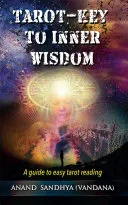
Tarot-Key to Inner Wisdom: A guide to easy tarot reading
 81
81

Tarot-Key to Inner Wisdom: A guide to easy tarot reading
Anand Sandhya's "Tarot-Key to Inner Wisdom" offers a refreshing perspective on a practice often shrouded in mystique and predictive fervor. Sandhya rightly observes that the frustration of wanting to change external circumstances stems from a disconnect with our internal landscape. The book’s strength lies in framing tarot as a sophisticated psychological tool, a mirror reflecting the reader’s own conscious and unconscious patterns. This is particularly evident in the discussion of how the cards reveal "reality as it is." However, the initial blurb's intensity regarding frustration with uncontrollable events might set expectations for a more direct, problem-solving narrative than the book ultimately delivers. While insightful, some readers might desire more explicit guidance on transitioning from self-awareness to actionable change. Overall, "Tarot-Key to Inner Wisdom" provides a valuable, introspective lens for tarot exploration, urging readers toward self-understanding as the primary key.
📝 Description
81
Anand Sandhya published Tarot-Key to Inner Wisdom in 2019, viewing tarot as a mirror to the psyche.
This 2019 guide by Anand Sandhya reframes tarot reading not as a tool for predicting external events, but as a method for introspection. Sandhya suggests the cards reflect conscious and unconscious thought patterns, making them a mirror to the reader's own psyche. The book’s central idea is that understanding internal awareness, facilitated by the tarot deck's imagery and archetypes, leads to genuine self-knowledge and transformation.
Tarot-Key to Inner Wisdom is written for individuals who feel powerless against life's circumstances or are curious about tarot beyond simple fortune-telling. It appeals to those seeking personal growth through a psychological interpretation of the cards. Readers new to tarot will find a grounded framework here, shifting the focus from external predictions to internal exploration. The book emphasizes that the cards reveal 'reality as it is' by illuminating inner workings.
Published in 2019, Anand Sandhya's work enters a period of renewed interest in tarot, often situated within New Age and self-help contexts. While many contemporary guides focus on prediction or eclectic spirituality, Sandhya distinguishes this book by its psychological lens. This approach aligns with modern esoteric studies that seek to integrate ancient practices with contemporary psychological theories, moving beyond the purely mystical or divinatory interpretations common in the mid-20th century. It grounds tarot practice in introspection and self-understanding.
💡 Why Read This Book?
• Gain a psychological framework for interpreting tarot beyond simple prediction, as presented in the book's core concept of tarot as a mirror to conscious and unconscious thought patterns. • Understand how the frustration with "unpredictable events" can be reframed through self-awareness, a central theme inspired by Anand Sandhya's personal journey. • Learn to view tarot cards as revealing "reality as it is," fostering personal transformation by shifting focus from external control to internal understanding, as detailed in the 2019 publication.
⭐ Reader Reviews
Honest opinions from readers who have explored this book.
❓ Frequently Asked Questions
What is the main difference between Anand Sandhya's tarot approach and traditional fortune-telling?
Anand Sandhya's "Tarot-Key to Inner Wisdom" emphasizes tarot as a psychological mirror for self-understanding, reflecting internal thought patterns. Traditional fortune-telling often focuses on predicting external future events and circumstances, a method the author found frustrating.
Who is Anand Sandhya (Vandana)?
Anand Sandhya, also known as Vandana, is the author of "Tarot-Key to Inner Wisdom." First published in 2019, her work draws from personal experience to present tarot as a tool for introspection and life transformation.
Can beginners use this book to learn tarot reading?
Yes, the book is subtitled 'A guide to easy tarot reading' and is designed for those curious about tarot. It offers a psychological framework that simplifies the learning process by focusing on self-reflection rather than complex divinatory systems.
What does the book mean by 'reality as it is' in relation to tarot?
The phrase 'reality as it is' suggests that tarot cards, when interpreted psychologically, show situations and internal states objectively, without the filter of personal desires or expectations. This clarity facilitates self-awareness and transformation.
When was 'Tarot-Key to Inner Wisdom' first published?
The book 'Tarot-Key to Inner Wisdom: A guide to easy tarot reading' by Anand Sandhya (Vandana) was first published on October 3, 2019.
What personal challenge led the author to explore tarot?
The author experienced significant frustration with wanting to change uncontrollable external events and people. This led her to explore tarot cards as a means to understand reality objectively and transform her own life through self-awareness.
🔮 Key Themes & Symbolism
Tarot as Psychological Mirror
The central thesis posits tarot cards not as mere fortune-telling devices, but as profound mirrors reflecting the reader's inner world. Anand Sandhya emphasizes how the archetypes and imagery within the deck can illuminate subconscious patterns, desires, and fears. This perspective encourages a shift from seeking external answers to cultivating internal awareness, aligning with psychological principles of introspection and self-discovery. The book guides readers to observe their reactions to the cards as insights into their own minds.
Transforming Frustration Through Awareness
A core motivation for the author, and thus a key theme, is overcoming the frustration that arises from trying to control uncontrollable external situations. The book suggests that this frustration stems from a misalignment between our expectations and reality. By using tarot to perceive 'reality as it is,' readers can begin to understand the internal roots of their dissatisfaction. This self-knowledge becomes the catalyst for personal transformation, moving away from a desire to change the world towards changing one's perception of it.
The Nature of Reality and Expectation
This theme directly addresses the conflict between our make-beliefs and the actual unfolding of events. The book critiques the tendency to impose our desires onto situations, leading to disappointment. Tarot, in Sandhya's view, offers a neutral, objective perspective, stripping away these expectations to reveal the underlying truth of a situation. Understanding this 'reality as it is' is presented as essential for navigating life more effectively and harmoniously, fostering acceptance and reducing conflict.
Easy Tarot Reading for Self-Discovery
The subtitle 'A guide to easy tarot reading' highlights the book's accessibility. It aims to explain tarot for newcomers by providing a straightforward method focused on personal insight rather than arcane rituals. The emphasis is on practical application for self-discovery, making the wisdom of the tarot accessible for daily life. This approach empowers readers to use the cards as a consistent tool for personal growth and enhanced self-understanding.
💬 Memorable Quotes
Direct passages from the work, attributed to the author.
“I had a great longing to know about the unpredictable events...”
— This opening statement reveals the author's initial motivation: a deep desire to understand and gain insight into life's unpredictable nature, setting the stage for exploring tarot as a tool for this understanding.
“Wanting to change people and situations was utterly frustrating...”
— This reflects a common human experience of powerlessness when facing external circumstances. It highlights the internal conflict arising from unmet expectations and the need for a different approach to life's challenges.
“...this made me so curious to explore into tarot cards, showing me the reality as it as and not as I wanted.”
— This is a central realization: tarot is presented not as a wish-fulfillment tool, but as an objective mirror reflecting truth, which is key to the book's psychological and transformative approach.
“Mirroring my conscious and unconscious thought patterns...”
— This concisely explains the book's core methodology – using tarot imagery to externalize and examine the hidden workings of the psyche, facilitating self-awareness.
“...which literally helped me, shift and transform my life knowing that I”
— This fragment points to the ultimate benefit proposed by the book: that the self-awareness gained through tarot can lead to profound personal change and a transformed perspective on life.
🌙 Esoteric Significance
Tradition
This work situates itself within the modern psychological interpretation of esoteric tools, diverging from purely divinatory or ceremonial traditions. While not strictly adhering to a single lineage like Hermeticism or Kabbalah, it draws upon the archetypal psychology explored by figures like Carl Jung, who saw universal patterns in mythology and symbolism. Sandhya's approach can be seen as a contemporary evolution, applying ancient symbolic systems like the tarot to the modern quest for self-understanding and personal growth.
Symbolism
The primary symbolism explored is the tarot deck itself as a symbolic language reflecting the human psyche. Key motifs implicitly include the Fool's Journey, representing the path of self-discovery and transformation, and the archetypal figures within the Major Arcana, which serve as mirrors to internal states. The concept of 'reality as it is' functions symbolically, representing an unvarnished truth that the cards help to reveal, contrasting with the often-illusory nature of personal expectations.
Modern Relevance
Sandhya's emphasis on tarot as a psychological tool finds resonance with contemporary practices in mindfulness, self-help, and therapeutic adjuncts. Therapists and coaches increasingly utilize symbolic systems for client insight. Thinkers and practitioners exploring archetypal psychology, Jungian analysis, and even secular spirituality often reference tarot's capacity for self-reflection, making this book relevant to those seeking practical, introspective methods outside of traditional religious or occult frameworks.
👥 Who Should Read This Book
• Individuals frustrated with feeling powerless over life circumstances: This book offers a psychological reframing, using tarot to understand internal patterns rather than focusing on external control. • Beginners seeking an accessible introduction to tarot: The guide to 'easy tarot reading' makes it suitable for newcomers who want a practical, self-discovery-oriented approach. • Those interested in the intersection of psychology and esotericism: Readers curious about how ancient symbolic systems like tarot can be applied to modern self-awareness and personal growth will find value.
📜 Historical Context
Published in 2019, Anand Sandhya's "Tarot-Key to Inner Wisdom" arrived during a period of intense popularization for tarot, largely within the New Age movement and self-help industries. This era saw a flood of tarot guides, many focusing on predictive accuracy or eclectic spiritual interpretations. Sandhya's work stands apart by foregrounding a psychological lens, aligning with contemporary trends that seek to integrate esoteric practices with modern psychology. While figures like Carl Jung explored archetypes that resonate with tarot imagery, Sandhya applies these concepts directly to accessible tarot readings. Unlike earlier, more mystical interpretations or specific decks like the Rider-Waite-Smith (first published 1909), which emphasized divinatory meanings, Sandhya’s approach prioritizes the cards as tools for introspection and understanding personal patterns, distinguishing it from purely occult or predictive traditions.
📔 Journal Prompts
Reflect on a situation where your expectations clashed with reality, as discussed in the book's exploration of 'reality as it is'.
Examine your conscious and unconscious thought patterns mirrored by specific tarot cards.
Consider the 'unpredictable events' in your life through the lens of internal reflection.
How can the concept of tarot as a mirror facilitate personal transformation?
Identify one expectation about life that causes frustration and explore its roots using the book's psychological framework.
🗂️ Glossary
Tarot Cards
A deck of typically 78 cards featuring symbolic imagery, used here not for prediction but as a tool to reflect conscious and unconscious thought patterns and gain self-awareness.
Inner Wisdom
The innate understanding and insight residing within an individual, accessed through introspection and self-reflection, which the book suggests tarot can help unlock.
Psychological Mirror
The concept of tarot cards acting as a reflection of the user's internal state, revealing thoughts, feelings, and subconscious patterns rather than external events.
Conscious Thought Patterns
The ways of thinking and perceiving that an individual is aware of during their waking moments.
Unconscious Thought Patterns
Deep-seated beliefs, desires, and motivations that influence behavior and perception without the individual's direct awareness.
Reality as it Is
An objective perception of situations and circumstances, free from personal desires, expectations, or biases, which the book posits tarot can help reveal.
Personal Transformation
A significant and fundamental change in an individual's life, perspective, or character, often resulting from increased self-awareness and understanding.