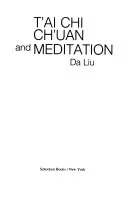
T'ai Chi Ch'uan and I Ching

 61
61

T'ai Chi Ch'uan and I Ching



Ophelia Vance, Mystical Literature Reviewer — Liu Da's 'T'ai Chi Ch'uan and I Ching' is a masterful exploration of interconnected esoteric systems. The author brilliantly elucidates the profound resonance between the physical discipline of T'ai Chi and the philosophical depth of the I Ching. This work stands as a testament to Liu Da's deep understanding, offering practitioners and scholars alike a unique lens through which to view these ancient arts. Its strength lies in its ability to illuminate the subtle energetic connections and symbolic parallels, making complex concepts accessible without sacrificing their inherent mystery. An indispensable read for those seeking to deepen their understanding of Eastern philosophy, energy cultivation, and the art of harmonious living.
📝 Description
61
Liu Da's 1973 book connects the physical practice of T'ai Chi Ch'uan with the philosophical principles of the I Ching.
Liu Da's 'T'ai Chi Ch'uan and I Ching' examines the relationship between the movements of T'ai Chi and the wisdom of the I Ching. The book details how the circular, yielding nature of T'ai Chi practice reflects the cyclical changes described in the I Ching's hexagrams. Liu Da suggests that practicing T'ai Chi can be a way to embody the philosophical concepts of the I Ching, leading to a deeper understanding of universal principles.
This work goes beyond a simple martial arts guide or a method for divination. It seeks to show how the interplay of yin and yang, fundamental to both systems, can help individuals align themselves with the natural order. The book aims to bridge the gap between physical discipline and metaphysical insight, offering a perspective for those interested in ancient Chinese traditions and their practical application.
This book belongs to the tradition of Chinese internal arts and philosophy, which often seek correspondences between the human body, the natural world, and cosmic patterns. It follows a lineage of thought that views martial practices not merely as combat techniques but as paths for self cultivation and understanding of universal laws. The integration of T'ai Chi, a practice rooted in Daoist principles of yielding and flow, with the I Ching, an ancient text on change and divination, places it within a specific branch of esoteric Chinese thought that emphasizes interconnectedness and cyclical patterns.
💡 Why Read This Book?
Unlock the synergistic power of movement and divination. 'T'ai Chi Ch'uan and I Ching' offers a profound pathway to understanding life's constant flux through the embodied wisdom of T'ai Chi and the oracle of the I Ching. Ideal for spiritual seekers, practitioners of martial arts and divination, and scholars of Eastern philosophy yearning for deeper, integrated knowledge.
⭐ Reader Reviews
Honest opinions from readers who have explored this book.
❓ Frequently Asked Questions
What is the primary connection between T'ai Chi and the I Ching presented in this book?
The book posits that the dynamic principles and energetic flow of T'ai Chi movement directly embody the philosophical concepts and cyclical changes described in the I Ching, offering a practical, lived experience of its wisdom.
Is this book suitable for beginners in T'ai Chi or the I Ching?
Yes, while it delves into profound esoteric connections, Liu Da’s explanations are designed to be accessible, guiding both novice and experienced practitioners toward a richer understanding of both disciplines.
How does this book contribute to personal growth?
By harmonizing the physical practice of T'ai Chi with the philosophical insights of the I Ching, the book provides a holistic approach to self-awareness, balance, and navigating life's challenges with grace and wisdom.
What kind of esoteric knowledge can one expect to find?
Readers can expect to uncover hidden symbolism, the energetic correspondences between movement and hexagrams, and a deeper appreciation for the interconnectedness of the physical and spiritual realms.
What makes this book unique among other texts on T'ai Chi or the I Ching?
Its uniqueness lies in its synthesized approach, demonstrating how these two seemingly disparate disciplines are fundamentally intertwined, offering a unified path to enlightenment and understanding.
🔮 Key Themes & Symbolism
The Dance of Yin and Yang in Motion
This theme explores the fundamental duality of yin and yang as it manifests in both the yielding, receptive nature of T'ai Chi movements and the complementary forces represented within the I Ching's hexagrams. Liu Da illustrates how the practitioner's body becomes a microcosm where these opposing yet complementary energies are harmonized, leading to a state of dynamic equilibrium. The book reveals how the constant interplay of softness and hardness, stillness and movement, mirrors the perpetual transformations described by the Book of Changes, offering a profound understanding of balance in all aspects of life.
The I Ching as a Blueprint for Energetic Cultivation
Here, the focus is on how the philosophical insights and symbolic language of the I Ching can serve as a profound guide for the practice of T'ai Chi. Liu Da elucidates how specific hexagrams and their associated imagery offer profound metaphors for understanding energetic principles, postural alignment, and the cultivation of chi. The book demonstrates that by contemplating the wisdom of the I Ching, practitioners can gain deeper intuition and precision in their T'ai Chi movements, transforming the physical practice into a meditative and divinatory art form.
Embodied Wisdom: The Living Oracle
This theme emphasizes the concept of T'ai Chi as a 'living oracle' – a practice that allows one to directly experience and understand the principles of the I Ching through the body. Liu Da argues that through dedicated practice, the movements themselves become a form of divination, offering insights into one's own internal state and external circumstances. The book invites readers to move beyond intellectual understanding and to cultivate embodied wisdom, where the body's responses and the flow of energy provide direct answers and guidance, mirroring the predictive and insightful nature of the I Ching.
💬 Memorable Quotes
Direct passages from the work, attributed to the author.
“Within the stillness, the universe unfolds.”
— This emphasizes the paradox of T'ai Chi and I Ching: profound revelation and understanding are found not through forceful action, but through inner quietude and receptivity.
“Each hexagram a breath, each movement a change.”
— This beautifully illustrates the fundamental connection, portraying the I Ching's wisdom as a continuous flow of natural cycles, mirrored by the dynamic, ever-transforming nature of T'ai Chi practice.
“To know the flow is to master the current.”
— This speaks to the practical application of the book's teachings, suggesting that by understanding universal principles (I Ching) and energetic dynamics (T'ai Chi), one can navigate life's challenges with skill and ease.
“The oracle speaks in the language of the body.”
— This points to the core of the book's thesis: that through the mindful practice of T'ai Chi, the body becomes a conduit for receiving wisdom and insight, much like a divinatory tool.
💡 Key Ideas
Editorial paraphrase of the work's core concepts — not direct quotes.
The body is a temple, the movement a prayer.
This quote highlights the sacredness of physical practice, suggesting that T'ai Chi is not merely exercise but a devotional act that connects the practitioner to higher consciousness.
🌙 Esoteric Significance
Tradition
This work is deeply rooted in the Taoist tradition, drawing heavily on its core principles such as the concept of Tao (the Way), the balance of yin and yang, and the importance of living in harmony with the natural order. It also draws from the rich philosophical underpinnings of Confucianism, particularly as expressed through the I Ching's ethical and societal guidance. The integration of T'ai Chi as a practice further connects it to the field of internal alchemy and Qigong, emphasizing the cultivation and circulation of vital energy (chi) for spiritual and physical well-being.
Symbolism
The book is replete with potent symbolism. The yin-yang symbol itself is central, representing the dynamic interplay of opposites that governs the universe and is embodied in T'ai Chi movements. The eight trigrams (Bagua) and sixty-four hexagrams of the I Ching serve as symbolic maps of cosmic forces and human situations. Specific T'ai Chi postures and transitions also carry symbolic weight, often representing natural phenomena like 'parting the wild horse's mane' or 'pushing the monkey,' each imbued with philosophical meaning that appeals to the I Ching's wisdom of adapting to circumstances.
Modern Relevance
In an era characterized by rapid change, stress, and a disconnect from nature, the principles of T'ai Chi and the I Ching offer profound relevance. The book provides practical tools for cultivating inner stillness, emotional resilience, and a sense of balance amidst chaos. Its emphasis on harmonious movement and mindful awareness is useful for mental and physical health. Furthermore, the I Ching's timeless wisdom on decision-making and adapting to change offers guidance for navigating personal and professional challenges, making this ancient synthesis a potent resource for contemporary seekers.
👥 Who Should Read This Book
This clear text is a valuable collection for a diverse audience. **Beginners** to T'ai Chi or the I Ching will find it an accessible yet profound introduction, revealing the interconnectedness of these arts from the outset. **Practitioners** of T'ai Chi will discover new depths in their movements, transforming their practice into a form of embodied divination and philosophical exploration. **Scholars** of Eastern philosophy and esoteric traditions will appreciate the rigorous analysis and unique synthesis of these two powerful disciplines. **Spiritual seekers** yearning for a holistic approach to self-understanding and alignment with universal principles will find 'T'ai Chi Ch'uan and I Ching' an indispensable guide on their journey.
📜 Historical Context
Written during a period of burgeoning interest in Eastern philosophies and practices in the West, 'T'ai Chi Ch'uan and I Ching' emerged at a time when traditional Chinese wisdom was being re-examined and integrated into modern life. The mid-to-late 20th century saw a significant cultural exchange, with many seeking alternative paths to spiritual and personal development. Liu Da's work contributed to this movement by offering a sophisticated synthesis of two foundational pillars of Chinese thought: the martial art of T'ai Chi Ch'uan, often viewed as a form of embodied philosophy, and the I Ching, one of the oldest and most revered texts in Chinese history. The book resonated with individuals exploring meditation, martial arts, and divination, positioning itself as a bridge between ancient esoteric traditions and contemporary spiritual seeking.
📔 Journal Prompts
How does the concept of 'yielding' in T'ai Chi relate to the advice given by a specific I Ching hexagram in your life?
Reflect on a recent challenge you faced. Which T'ai Chi movement or I Ching concept could have provided guidance or a different perspective?
Explore the symbolism of a particular T'ai Chi posture and its potential connection to a hexagram's meaning. Journal your insights.
How can the principle of constant change, central to the I Ching, be observed and embraced within your daily T'ai Chi practice?
Consider the energetic flow in your T'ai Chi practice. How does this internal flow mirror or contrast with the energetic descriptions found in specific I Ching readings?
🗂️ Glossary
T'ai Chi Ch'uan
A Chinese internal martial art practiced for both its defense training and health benefits. It is known for its slow, flowing, meditative movements that emphasize relaxation, balance, and the cultivation of vital energy (chi).
I Ching
Also known as the Book of Changes, this ancient Chinese divination text and philosophical classic contains a system of cosmology and philosophy involving a wide range of layered meanings, intended to be used to understand the past and present and to guide future actions.
Yin and Yang
Fundamental concepts in Chinese philosophy that describe how seemingly opposite or contrary forces are actually complementary, interconnected, and interdependent in the natural world, and how they give rise to each other as they interrelate.
Hexagram
In the I Ching, a hexagram is a symbol composed of six horizontal lines, each of which is either broken (yin) or solid (yang). There are 64 possible hexagrams, each representing a particular state or situation.
Chi (Qi)
In traditional Chinese culture, chi is the vital force or energy that flows through all living things. T'ai Chi practice is fundamentally about cultivating, balancing, and circulating this energy for health and spiritual development.
This book appears in 3 collections
🔮 Readers Also Liked
Browse all →






More by Liu Da
All books →


From the “I Ching” Collection
View all →








More Free Divination & Tarot Books
View all →