Taoism

 73
73

Taoism
Isabelle Robinet’s "Taoism" presents a formidable intellectual undertaking, offering a dense but rewarding exploration of its subject. The book excels in charting the historical and philosophical currents that shaped Taoist thought from its earliest stirrings to its more organized religious expressions. Robinet's strength lies in her meticulous attention to textual lineages and the evolution of key concepts, particularly her treatment of the *Tao* as both a cosmological principle and a guide for living. A notable area of depth is the discussion surrounding the *Zhuangzi*, illustrating its unique philosophical contributions. However, the sheer academic rigor, while commendable, can render certain sections challenging for the casual reader, requiring sustained concentration. The original publication date, 1997, means some newer archaeological findings or interpretive shifts in scholarship may not be reflected, though the core analysis remains robust. "Taoism" stands as a substantial scholarly resource for serious students of the tradition.
📝 Description
73
Isabelle Robinet’s "Taoism" (1997) examines the evolution of this enduring philosophical tradition.
Isabelle Robinet's "Taoism" offers a scholarly look at one of the world's most enduring philosophical and religious traditions. Published in 1997, the book moves past simple ideas to examine the development of Taoist thought and practice. It follows the growth of core beliefs from their ancient beginnings through different historical eras, giving a broad view for those interested in this spiritual path. The work analyzes key texts and later writings, showing how Taoism changed and lasted through centuries of intellectual and social shifts.
This book is for students and academics of comparative religion, Eastern philosophies, and religious history. It gives a thorough understanding of Taoism's complexities, going beyond basics to discuss its doctrines and historical progression. Readers interested in how spiritual traditions develop, the connection between philosophy and practice, or the influence of Chinese thought on global culture will find much here. It suits those who value detailed historical analysis and a scholarly viewpoint.
Isabelle Robinet’s "Taoism" emerged in the late 20th century, a period of significant academic attention to Eastern religions. This era saw a rise in critical studies and translations of key texts like the *Tao Te Ching* and *Zhuangzi*. Robinet's work contributes to scholarly discussions by synthesizing the historical development of Taoism, differentiating between early philosophical interpretations and later religious forms. It places Taoism within its historical and intellectual context, addressing the interplay between its philosophical underpinnings and its institutionalized practices.
💡 Why Read This Book?
• Gain a nuanced understanding of the *Tao* beyond simplistic definitions, exploring its role as a generative cosmic principle and a guide for ethical conduct, as detailed in Robinet's analysis of foundational texts. • Grasp the historical evolution of Taoist thought, tracing its development through distinct dynasties and philosophical schools, offering context that generic introductions often overlook. • Understand the practical implications of *Wu Wei* (effortless action) not as passivity, but as a strategic alignment with natural processes, a concept rigorously explored within its historical and philosophical framework.
⭐ Reader Reviews
Honest opinions from readers who have explored this book.
❓ Frequently Asked Questions
What is the primary focus of Isabelle Robinet's "Taoism"?
The book provides a comprehensive academic examination of Taoism, tracing its historical development, core philosophical concepts like the Tao and Wu Wei, and its evolution as both a philosophy and a religion in China.
When was Isabelle Robinet's "Taoism" first published?
Isabelle Robinet's "Taoism" was first published in 1997, offering a scholarly perspective from that period on the tradition.
Does the book cover both philosophical and religious Taoism?
Yes, Robinet's work addresses the intricate relationship and historical progression between philosophical Taoism, rooted in texts like the Tao Te Ching, and its later, more institutionalized religious forms.
What are some key concepts discussed in the book?
Key concepts explored include the nature of the Tao (the Way), the principles of Yin and Yang, the practice of Wu Wei (non-action), and the historical development of various Taoist schools and their cosmologies.
Is this book suitable for beginners in Taoism?
While comprehensive, the book's scholarly depth makes it most suitable for students, academics, or those with a serious interest in the historical and philosophical intricacies of Taoism, rather than absolute beginners.
What is the significance of the Tao Te Ching mentioned in relation to this book?
The Tao Te Ching is presented as a foundational text whose interpretations and influence are central to understanding the early development of Taoist philosophy, a subject Robinet rigorously analyzes.
🔮 Key Themes & Symbolism
The Tao as Cosmic Principle
Robinet's work meticulously details the concept of the Tao, presenting it not just as a philosophical ideal but as the fundamental, ineffable source and governing principle of the universe. The book explores how this concept, central to texts like the *Tao Te Ching*, informs the Taoist worldview, emphasizing its role in natural order and cosmic harmony. It moves beyond simplistic translations to examine the Tao's function as the origin of all things and the ultimate reality that practitioners strive to align with, providing a deep dive into its ontological and cosmological significance within the tradition.
Evolution of Taoist Practice
This theme examines the historical shifts and diversification within Taoism, from early philosophical schools to later organized religious movements. Robinet traces the development of practices such as meditation, internal alchemy, and ritual, highlighting how they emerged and transformed across different dynasties. The book underscores the dynamic nature of Taoist practice, showing its adaptation to varying social and intellectual contexts and its integration with other spiritual traditions within China, such as Buddhism.
Wu Wei and Effortless Action
The concept of *Wu Wei*, often translated as non-action or effortless action, is a core part of Robinet's analysis. The work elucidates this principle not as passivity or idleness, but as a mode of being that aligns with the natural flow of the Tao. It explores how *Wu Wei* manifests in governance, personal conduct, and spiritual cultivation, advocating for a spontaneous and unforced approach to life that minimizes resistance and maximizes harmony with universal patterns. This theme provides practical philosophical insights for navigating human affairs.
Cosmology and Human Existence
Robinet looks at the intricate Taoist cosmology, exploring the interplay of fundamental forces like Yin and Yang and their role in shaping the manifest world. The book connects these cosmic principles directly to human existence, examining how understanding the universal patterns can lead to personal well-being and spiritual realization. It discusses concepts of vital energy (*qi*), the pursuit of longevity, and the integration of self-cultivation with the broader cosmic order, offering a holistic perspective on the human place in the universe.
💬 Memorable Quotes
Direct passages from the work, attributed to the author.
“The Tao gives birth to One; One gives birth to Two; Two gives birth to Three; Three gives birth to the ten thousand things.”
— This foundational quote, often cited from the *Tao Te Ching*, illustrates the Taoist cosmological principle of emanation. It describes how the ineffable Tao, the ultimate source, progressively unfolds into the multiplicity of the universe through a series of generative stages, highlighting a hierarchical yet interconnected creation narrative.
“The greatest clarity comes from the greatest simplicity.”
— This interpretation of a core Taoist tenet emphasizes the value of returning to fundamental truths and shedding unnecessary complexity. It suggests that profound understanding and peace are achieved not through elaborate systems, but by embracing a clear, unadorned approach to life and thought.
“The practice of Taoism involves harmonizing oneself with the natural Way.”
— This is a conceptual summary of the practical aim of Taoism. It suggests that spiritual and ethical development is achieved by aligning one's actions, thoughts, and life with the inherent patterns and flow of the Tao, the natural order of the universe.
💡 Key Ideas
Editorial paraphrase of the work's core concepts — not direct quotes.
The sage manages affairs without acting, teaches without speaking.
This paraphrased concept reflects the principle of *Wu Wei* (effortless action). It suggests that true wisdom and effective leadership lie not in forceful intervention, but in acting in accordance with natural principles, allowing things to unfold organically and guiding through example rather than command.
Yin and Yang are the parents of transformation.
This conceptual paraphrase highlights the dynamic interplay between Yin (passive, dark, feminine) and Yang (active, light, masculine). It signifies that these complementary forces are not static but are the very engine of change and evolution in the universe, constantly interacting and transforming.
🌙 Esoteric Significance
Tradition
Robinet's "Taoism" primarily engages with the historical and philosophical lineage of Taoism, a tradition distinct from Western esoteric systems like Hermeticism or Kabbalah. While Taoism possesses its own rich esoteric dimensions, particularly in practices like internal alchemy and meditation, Robinet's work focuses on its scholarly explication. It situates Taoism as a foundational Eastern spiritual path, offering insights into concepts that, while not directly part of Western occult traditions, share universal concerns with self-cultivation, cosmology, and the nature of reality.
Symbolism
Key symbols explored include the *Yin* and *Yang* icons, representing the fundamental duality and dynamic balance within the cosmos. The *Taijitu* (the Yin-Yang symbol) visually expresses this principle of complementary opposition. Another significant motif is the concept of the *Ba Gua* (Eight Trigrams), used in divination and cosmology, representing fundamental natural forces and their interactions. The book may also touch upon symbols related to longevity and immortality sought in religious Taoism, such as the *lingzhi* mushroom or the peach of immortality.
Modern Relevance
Contemporary thinkers and practitioners in fields like mindfulness, holistic health, and integral philosophy often draw upon Taoist principles, particularly *Wu Wei* and the emphasis on natural flow. While Robinet's work is scholarly, its detailed exposition of Taoist cosmology and ethics provides a robust foundation for understanding these modern applications. Scholars of comparative religion and Eastern philosophies continue to cite Robinet's research, and her nuanced historical account remains relevant for those exploring the enduring influence of Chinese thought on global spiritual and ethical discourse.
👥 Who Should Read This Book
• Students of Eastern philosophy and comparative religion seeking a scholarly overview of Taoism's historical and conceptual development. • Academics and researchers requiring a detailed textual and historical analysis of foundational Taoist thought and its evolution. • Individuals interested in the philosophical underpinnings of mindfulness, natural living, and ethical systems that emphasize harmony with universal principles.
📜 Historical Context
Isabelle Robinet's "Taoism" emerged in 1997 amidst a vibrant period of Sinological scholarship and increasing global interest in Eastern philosophies. The late 20th century saw significant critical engagement with foundational Taoist texts, building upon earlier influential works by scholars like Arthur Waley and Marcel Granet. Robinet’s contribution placed Taoism within a complex intellectual history, differentiating its philosophical strands from its religious institutionalization, a discourse prominent at the time. This era also witnessed a growing academic dialogue on the relationship between Taoism and other Chinese traditions, particularly the influence and reception of Buddhism in China. While not a period marked by significant censorship of Taoist studies, the academic reception of works like Robinet's was generally positive within scholarly circles, solidifying its place as a key resource for understanding the tradition's many-sided development.
📔 Journal Prompts
The Tao's generative principle: reflect on a time when apparent simplicity masked profound complexity.
The practice of Wu Wei: consider an instance where effortless action yielded superior results compared to forceful effort.
Yin and Yang dynamics: analyze a personal situation through the lens of complementary forces in balance or imbalance.
Alignment with the Tao: describe a personal experience of acting in flow with natural circumstances.
The ten thousand things: contemplate the interconnectedness of seemingly disparate elements in your life.
🗂️ Glossary
Tao (Dao)
The fundamental, ineffable principle of the universe in Taoism; the Way. It is considered the source of all existence, the natural order, and the ultimate reality that practitioners seek to understand and align with.
Wu Wei
A central Taoist concept often translated as 'non-action' or 'effortless action.' It signifies acting in accordance with the natural flow of the Tao, without force or excessive striving, leading to effective and harmonious outcomes.
Yin and Yang
Two complementary, interdependent, and opposing forces that constitute all phenomena in the universe. Yin represents passive, dark, feminine qualities, while Yang represents active, light, masculine qualities.
Tao Te Ching
A foundational text of Taoism, traditionally attributed to Lao Tzu. It is a collection of aphorisms and verses exploring the nature of the Tao, Wu Wei, and virtuous living.
Zhuangzi
A seminal Taoist text attributed to the philosopher Zhuang Zhou (Zhuangzi). It is known for its allegorical stories, paradoxical reasoning, and profound philosophical explorations of freedom, relativity, and the Tao.
Qi (Chi)
Vital energy or life force that permeates all things in the universe according to Taoist philosophy and Chinese traditional medicine. Cultivating and balancing Qi is central to many Taoist practices.
Ba Gua
The 'Eight Trigrams,' a set of eight three-line symbols used in Taoist cosmology and divination (e.g., in the I Ching). They represent fundamental natural forces and states of being.
🔮 Readers Also Liked
Browse all →









More by Isabelle Robinet
All books →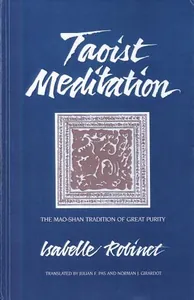
More Free Occult Philosophy Books
View all →