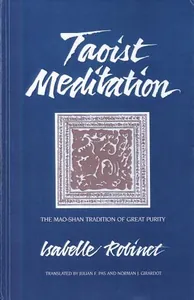
Isabelle Robinet was a sinologist who studied Taoism, emphasizing its complex, unified nature beyond simple philosophical or religious divides.
Isabelle Robinet was a scholar who specialized in Taoism, a tradition originating in China that emphasizes living in harmony with the Tao, often translated as 'the Way'. Taoism encompasses a broad range of practices, including meditation, alchemy, and astrology, with a common aim of self-cultivation and achieving a more natural existence. Historically, Taoism developed from early philosophical texts like the Tao Te Ching and Zhuangzi, accumulating a vast body of scripture that was eventually canonized.
Robinet's work contributed to understanding Taoism not as a strictly divided philosophy and religion, but as an integrated system. She noted that Taoist thought has always been syncretic, drawing from and influencing various other Chinese traditions, including Confucianism and Buddhism. The distinction between 'Daojia' (philosophical schools) and 'Daojiao' (organized religion) is often seen as artificial by scholars like Robinet, who view Taoism as a continuously evolving tradition with both philosophical depth and religious practices, without a clear historical separation.
Taoism: Philosophy and Religion
Isabelle Robinet, alongside other sinologists, viewed Taoism as a complex tradition that resists easy categorization into distinct philosophical and religious branches. She argued that the separation into 'Daojia' (philosophical schools) and 'Daojiao' (organized religion), while common in Western scholarship, is not entirely accurate. Robinet highlighted that Taoism has consistently been a blend of teachings rooted in various revelations, incorporating elements of both deep philosophical inquiry and practical religious observance. This perspective challenges earlier views that sought to divide the tradition, suggesting instead a more unified and integrated historical development.
Syncretic Nature and Influences
Robinet's research touched upon the deeply syncretic nature of Taoism. This tradition has historically absorbed and interacted with numerous other belief systems and practices within China. Early Taoism drew from state religions, Naturalism, Mohism, Confucianism, and Legalist theories. Later, the introduction of Buddhism led to significant discourse and mutual influence, contributing to the development of the 'Three Teachings' discourse that sought to harmonize Taoism, Confucianism, and Buddhism. Robinet acknowledged that due to this extensive blending, it can be difficult to definitively label certain denominations or practices as purely Taoist.
Core Concepts and Practices
The fundamental concept in Taoism, as studied by Robinet, is the Tao (or Dao), an ineffable principle often translated as 'the Way' or 'the Path,' representing the underlying reality of the universe. Practices within Taoism aim for harmony with this principle, encompassing meditation, astrology, qigong, feng shui, and internal alchemy. The ultimate goals typically involve self-cultivation, a profound appreciation of the Tao, and achieving a more harmonious existence. Taoist ethics often emphasize naturalness, simplicity, effortless action, and virtues such as compassion, frugality, and humility.
Key Ideas
- Taoism is a unified tradition, not strictly divisible into philosophy and religion.
- Taoism is inherently syncretic, influenced by and influencing other Chinese traditions.
- The Tao is the fundamental, ineffable principle of reality.
- Taoist practices aim for harmony with the Tao through self-cultivation.
Notable Quotes
“Taoism has never been a unified religion, and has constantly consisted of a combination of teachings based on a variety of original revelations.”
Books by
2 free public domain books · Read online or download