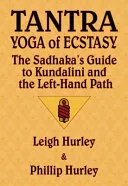
Tantra, Yoga of Ecstasy: the Sadhaka's Guide to Kundalinin and the Left-Hand Path
 83
83

Tantra, Yoga of Ecstasy: the Sadhaka's Guide to Kundalinin and the Left-Hand Path
Leigh and Phillip Hurley's "Tantra, Yoga of Ecstasy" offers a compelling, if at times dense, exploration of Tantric sadhana, particularly focusing on Kundalini and the Vama Marga. The work commendably avoids sensationalism, instead presenting a disciplined approach to what is often a misunderstood subject. Its strength lies in grounding abstract principles in tangible, sensory experience, urging the practitioner to view every moment as a site of alchemical transformation. The initial chapters, which lay out the fundamental cosmic principles through the lens of Shiva and Shakti, are particularly effective in establishing a felt sense of the Tantric worldview. However, the book's density can be a barrier; the intricate philosophical underpinnings and detailed ritualistic concepts require significant reader investment. While the authors meticulously detail the 'how,' the 'why' behind certain advanced practices could benefit from more explicit contextualization for those not already steeped in esoteric lore. Nevertheless, for the serious student of Tantra, the meticulous exposition of the sadhaka's path makes this a valuable, albeit challenging, resource.
📝 Description
83
Published in 2013, Tantra, Yoga of Ecstasy details a lived, sensory engagement with the cosmos.
Leigh and Phillip Hurley's "Tantra, Yoga of Ecstasy" views Tantra as a direct, sensory engagement with the universe, not just a philosophy. Every action, from the ordinary to the significant, is framed as an opportunity for personal change. The authors examine the interplay of Shiva and Shakti, showing how these forces appear in our physical, mental, social, and spiritual lives. The book guides practitioners, or sadhakas, in awakening and unifying these core cosmic energies.
This work serves as a practical guide for committed practitioners of esoteric paths, especially those familiar with yoga philosophy and interested in Tantra's less conventional paths. It is for individuals ready to move from theory to practice, particularly those attracted to Kundalini energy and Left-Hand Path methods. Readers should be prepared for intense personal transformation and ideas that question common spiritual views. This book is for the serious sadhaka seeking self-realization through direct experience, not the casual observer.
The text places Tantra within a historical framework stretching back to ancient India. It discusses how Tantric thought and practice developed, emphasizing its unique spiritual approach that sees the material world as sacred and embraces the full range of human experience, contrasting with more ascetic traditions.
This book situates Tantra as a lineage originating in ancient Indian traditions, acknowledging its deep roots. It traces the historical development of Tantric thought and practice. The text highlights Tantra's distinct spiritual perspective, which emphasizes immanence and the inherent sacredness of the material world. It contrasts this holistic approach with more ascetic or renunciatory spiritual paths.
💡 Why Read This Book?
• Learn the specific Tantric interpretation of Shiva and Shakti as presented by the Hurleys, understanding how their union forms the basis for cosmic manifestation and personal transformation, a concept detailed in the early sections of the book. • Gain practical insights into the methodology of the Left-Hand Path (Vama Marga), moving beyond common misconceptions to grasp its role in alchemical transmutation, as discussed throughout the guide. • Understand the concept of the sadhaka as an active agent in cosmic ritual, recognizing how every moment and action can become a site for spiritual alchemy, a core tenet explored in the text's practical applications.
⭐ Reader Reviews
Honest opinions from readers who have explored this book.
❓ Frequently Asked Questions
What is the primary focus of "Tantra, Yoga of Ecstasy"?
The book focuses on Tantra as a path of embodied spiritual practice, emphasizing the awakening of Kundalini and the principles of the Left-Hand Path (Vama Marga) for alchemical transformation and holistic enlightenment.
Who are Leigh and Phillip Hurley?
Leigh and Phillip Hurley are the authors of "Tantra, Yoga of Ecstasy," first published in April 2012. They present Tantra as a system of lived ritual and cosmic engagement.
What does the book mean by 'Yoga of Ecstasy'?
It refers to the Tantric pursuit of spiritual realization through intense, often ecstatic, engagement with all aspects of existence, utilizing sensory experience and cosmic energies like Kundalini.
Is this book suitable for beginners in Tantra?
While it explains core concepts, the book is geared towards dedicated practitioners (sadhakas) who are ready for advanced exploration of Kundalini and the Left-Hand Path, rather than absolute beginners.
What is the 'Left-Hand Path' as described in the book?
The Left-Hand Path (Vama Marga) is presented as a Tantric methodology that embraces unconventional practices and engages with all aspects of life for spiritual transmutation, contrasting with more ascetic approaches.
What is the role of Shiva and Shakti in this work?
Shiva and Shakti are central figures representing fundamental cosmic principles. The book explains how their dynamic interplay is experienced and integrated by the sadhaka for enlightenment across multiple life dimensions.
🔮 Key Themes & Symbolism
Sadhaka's Alchemical Path
The text frames the practitioner, the sadhaka, as an active participant in a cosmic ritual. Every moment and action is presented as an opportunity for alchemical transmutation, a core principle of Tantric practice. This involves integrating Shiva and Shakti principles not just intellectually, but through full sensory engagement, leading to enlightenment across physical, psychological, sociological, and spiritual planes. The book details how this lived experience constitutes the 'Yoga of Ecstasy'.
Kundalini Awakening
Central to the book is the concept of Kundalini, the dormant spiritual energy believed to reside at the base of the spine. The work serves as a guide to its awakening and ascent, detailing the processes and experiences involved. It connects Kundalini's energetic flow to the manifestation of Shiva and Shakti, suggesting that its controlled release and integration are key to the sadhaka's transformation and the attainment of higher consciousness.
The Left-Hand Path
Hurley and Hurley's work specifically addresses the Vama Marga, or Left-Hand Path, within Tantra. This path is characterized by its use of methods that engage directly with the material world and conventional taboos, often involving potent symbolism and practices designed for rapid spiritual alchemy. The book clarifies this approach, distinguishing it from more orthodox spiritual disciplines and highlighting its role in the sadhaka's comprehensive integration of existence.
Cosmic Manifestation
The book explains Tantra as a discipline rooted in understanding cosmic creation. Every movement in space and time is viewed as a ritualistic expression of fundamental principles, embodied by Shiva (consciousness) and Shakti (energy). The sadhaka learns to recognize and interact with these forces in their own life, facilitating a deep connection to the underlying reality of existence and fostering enlightenment through this recognition.
💬 Memorable Quotes
Direct passages from the work, attributed to the author.
“Shiva and Shakti bring us back to first principles in a feeling way that engages all of our senses, and all levels of our being.”
— This highlights the embodied, sensory nature of Tantric understanding, emphasizing that the divine masculine (Shiva) and feminine (Shakti) principles are not abstract concepts but forces experienced holistically.
“The Tantric sadhaka is enlightened by the manifestation of these first principles in their life - physically, psychologically, sociologically, and spiritually.”
— This points to the holistic aim of Tantric practice: to achieve enlightenment not in isolation, but through the palpable integration of cosmic forces across all facets of one's existence.
“Tantra, Yoga of Ecstasy detail[s] the Sadhaka's Guide to Kundalinin and the Left-Hand Path.”
— This statement clearly defines the book's purpose: to serve as a practical manual for practitioners (sadhakas) focused on awakening Kundalini and working through the specific methods of the Left-Hand Path.
“Tantra is an ancient discipline with deep cosmic roots.”
— This foundational statement emphasizes the profound historical and cosmological origins of Tantra, positioning it as a discipline with vast, foundational significance beyond superficial interpretations.
💡 Key Ideas
Editorial paraphrase of the work's core concepts — not direct quotes.
Every movement in time and space is ritual for the Tantric sadhaka, and every moment is a moment of transmutation, of alchemy.
This passage expresses the book's core message: Tantra is not confined to specific times or places but is a continuous, active process of spiritual transformation woven into the fabric of everyday life.
🌙 Esoteric Significance
Tradition
This work firmly belongs within the esoteric study of Tantra, specifically aligning with paths that emphasize the awakening of Kundalini and the principles of the Vama Marga (Left-Hand Path). It departs from purely philosophical or devotional approaches, focusing instead on the practical, often intense, sadhana required for alchemical transformation. It fits within the broader umbrella of Indian esoteric traditions but carves out a niche by detailing a specific, potent form of yogic practice.
Symbolism
Key symbols include Shiva and Shakti, representing the ultimate consciousness and cosmic energy, respectively. Their union and interplay are central to the Tantric cosmology presented. Kundalini is depicted as a coiled serpent-power, the dormant spiritual energy whose awakening is paramount. The concept of the sadhaka, the practitioner, is also symbolic, representing the individual engaged in the active process of self-realization through ritual and disciplined practice.
Modern Relevance
In contemporary esoteric discourse, this book remains relevant for practitioners seeking a serious, non-sensationalized understanding of Tantric sadhana. It speaks to modern seekers interested in embodied spirituality, energy work (Kundalini), and unconventional paths to liberation. Thinkers and practitioners exploring the integration of psychological shadow work with spiritual growth may find its approach to the Left-Hand Path particularly resonant.
👥 Who Should Read This Book
• Dedicated practitioners of yogic and Tantric disciplines seeking to deepen their understanding of Kundalini and the Left-Hand Path beyond introductory texts. • Students of comparative religion and esoteric philosophy interested in the practical application and historical roots of Indian Tantric traditions. • Individuals drawn to embodied spirituality and alchemical transformation who are prepared for rigorous, potentially intense, personal practice as detailed in the book.
📜 Historical Context
Published in April 2012, "Tantra, Yoga of Ecstasy" emerged during a period when interest in Eastern spiritual traditions, particularly Tantra, continued to grow in the West, often accompanied by significant misunderstanding and commercialization. The Hurleys' work sought to provide a more rigorous and authentic perspective, focusing on the sadhana (practice) rather than sensationalized aspects. This period saw various interpretations of Tantra circulating, from academic studies to popular self-help books, and sometimes controversial appropriations within Western esoteric circles. The book's emphasis on the Left-Hand Path (Vama Marga) positions it within a lineage of practitioners who engage with unconventional methods, differentiating it from more common, often simplified, presentations of the Right-Hand Path (Dakshina Marga). Its publication predates the significant online surge in Tantric misinformation, aiming to offer a grounded guide.
📔 Journal Prompts
The sadhaka's role as an agent of transmutation.
Manifestation of Shiva and Shakti in daily life.
Personal understanding of Kundalini's potential.
Engaging with the sensory aspects of ritual.
The alchemical potential of ordinary moments.
🗂️ Glossary
Sadhaka
An earnest practitioner of a spiritual discipline or yoga. In Tantra, the sadhaka actively engages in rituals and practices aimed at self-realization and cosmic integration.
Kundalini
A primordial, dormant spiritual energy believed to reside at the base of the spine. Its awakening and ascent through the subtle energy centers (chakras) are central to many yogic and Tantric traditions.
Left-Hand Path (Vama Marga)
A specific approach within Tantra that often employs unconventional methods, embracing aspects of life typically considered taboo, to achieve spiritual liberation and transformation.
Shiva
In Hindu philosophy, Shiva represents consciousness, the divine masculine principle, pure awareness, and the destructive/transformative aspect of the divine.
Shakti
In Hindu philosophy, Shakti represents energy, the divine feminine principle, the active force of creation, and the dynamic power that animates the universe.
Alchemy
In a spiritual context, alchemy refers to the transformative process of refining and purifying the self, often likened to the transmutation of base metals into gold, leading to spiritual enlightenment.
Ritual
A set of actions performed according to a prescribed order, often symbolic, used in spiritual traditions to connect with the divine, invoke energies, or facilitate transformation.