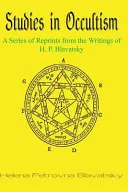
Studies in Occultism
 78
78

Studies in Occultism
Helena Blavatsky’s *Studies in Occultism* offers a direct, unvarnished look into her core philosophical tenets, eschewing the more elaborate narratives found in her larger works. The collection’s strength lies in its focused examination of key terms and ethical considerations within occultism, particularly the essay "Occultism versus the Occult Arts." Here, Blavatsky meticulously distinguishes between the genuine pursuit of spiritual knowledge and the manipulative use of psychic powers. A notable limitation, however, is the sometimes dense prose, which, while characteristic of the era, can present a barrier to modern readers unfamiliar with Theosophical jargon. The chapter on "Astral Bodies, or Doppelgangers" provides a particularly intriguing, if challenging, exploration of consciousness and identity. Ultimately, this volume serves as an indispensable, albeit demanding, primer for understanding Blavatsky’s unique contribution to esoteric thought.
📝 Description
78
Helena P. Blavatsky's 'Studies in Occultism' collects essays from her magazine *Lucifer*, published between 1887 and 1891.
This selection of essays from Helena P. Blavatsky's magazine *Lucifer* addresses core questions in occultism. Originally appearing between 1887 and 1891, these articles move beyond sensationalism to examine the philosophical foundations of esoteric thought. The book seeks to distinguish genuine occult study from its misuse.
It is intended for serious students of Theosophy and comparative religion. Readers interested in the historical development of Western esotericism in the late 19th century, especially its philosophical and ethical dimensions, will find material here. The essays engage with contemporary scientific and philosophical ideas, challenging materialist perspectives.
Published during a time of heightened interest in spiritualism and the occult in Victorian England, these essays appeared amidst a revival of esoteric thought. Blavatsky's work engaged with figures like Eliphas Lévi and movements such as the Hermetic Order of the Golden Dawn. Her writing often responded to prevailing materialist philosophies and the early development of psychology, asserting a spiritualist counterpoint.
💡 Why Read This Book?
• Understand the foundational distinction between genuine spiritual practice and manipulative psychic arts, as articulated in "Occultism versus the Occult Arts." This clarifies the ethical framework Blavatsky advocated for practitioners. • Explore Blavatsky's critical analysis of "Black Magic in Science," offering a 19th-century perspective on the potential dangers of unchecked scientific ambition when divorced from spiritual understanding. • Gain insight into Blavatsky's cosmological views through her discussion of "Kosmic Mind," providing a framework for understanding consciousness that predates many modern psychological theories.
⭐ Reader Reviews
Honest opinions from readers who have explored this book.
❓ Frequently Asked Questions
When was Helena Blavatsky's *Studies in Occultism* first published?
The collection *Studies in Occultism* was first compiled and published in 2017, containing articles originally written by Helena P. Blavatsky for her magazine *Lucifer* between 1887 and 1891.
What is the main difference between occultism and the occult arts according to Blavatsky?
Blavatsky distinguishes occultism as a path of spiritual development and self-knowledge, emphasizing ethical responsibility and inner transformation. The occult arts, in contrast, are presented as the often selfish or harmful manipulation of psychic forces for personal gain or control.
Does *Studies in Occultism* discuss hypnotism?
Yes, one of the essays in the collection is titled 'Hypnotism,' where Blavatsky examines the phenomenon from an occult perspective, likely questioning its potential dangers and its place within the broader study of consciousness.
What does Blavatsky mean by 'Kosmic Mind'?
The concept of 'Kosmic Mind' in Blavatsky's work refers to a universal, all-pervading consciousness or intelligence that underlies the manifested universe. It is the source of all thought and existence, distinct from individual human minds.
Are there discussions on the nature of the soul or spirit?
Indeed, the book features a chapter on the 'Constitution of the Inner Man,' which delves into the various planes of existence and the complex structure of the human spiritual constitution, often referred to as the 'Inner Man'.
What is the historical significance of the magazine *Lucifer*?
*Lucifer* was Helena Blavatsky's influential magazine, published from 1887 to 1891. It served as a primary vehicle for disseminating Theosophical teachings and engaging in debates on occultism, spirituality, and philosophy during the late Victorian era.
🔮 Key Themes & Symbolism
Practical Occultism Ethics
This collection rigorously defines 'Practical Occultism' not as mere magical feats but as a disciplined path of self-mastery and ethical development. Blavatsky emphasizes that true occultism requires profound inner transformation and a commitment to universal welfare. The essays explore the dangers of misusing psychic abilities and the importance of wisdom and compassion in their application, distinguishing this from the more superficial or potentially harmful practices often associated with 'occult arts'.
Cosmic Consciousness and Mind
Blavatsky posits a 'Kosmic Mind' as the fundamental, intelligent basis of the universe. This concept suggests an all-encompassing consciousness from which individual minds and all phenomena arise. The work explores the relationship between this universal mind and the human psyche, including 'Psychic and Noetic Action,' differentiating between intuitive knowledge (noetic) and psychic impressions, and examining the potential for human consciousness to align with this greater cosmic intelligence.
Esoteric Interpretation of Gospels
The essays engage in an 'Esoteric Character of the Gospels,' arguing that the Christian scriptures contain deeper, symbolic meanings beyond their literal interpretations. Blavatsky seeks to uncover the hidden spiritual teachings within these texts, viewing them as allegories for inner spiritual processes and universal truths. This approach challenges conventional religious exegesis and aligns with the Theosophical aim of revealing the underlying unity of world religions.
The Nature of the Astral Body
Discussions on 'Astral Bodies, or Doppelgangers' look at the subtle or non-physical aspects of human existence. Blavatsky examines the concept of the astral body as a vehicle of consciousness that can exist independently of the physical form, exploring phenomena such as apparitions or 'doubles.' This exploration touches upon the nature of perception, identity, and the possibility of consciousness operating on different planes of reality.
💬 Memorable Quotes
Direct passages from the work, attributed to the author.
“The Kosmic Mind is the universal consciousness from which all individual minds emanate.”
— This interpretation highlights Blavatsky's concept of a unified, intelligent principle underlying reality. It suggests that individual awareness is a manifestation or aspect of this greater, all-pervading cosmic intelligence.
“True wisdom has a dual aspect: one is the knowledge of good, the other is the knowledge of evil.”
— This concept underscores Blavatsky's view that understanding the nature of both light and shadow is crucial for true wisdom. It implies that one cannot fully grasp virtue without comprehending its opposite.
“The Gospels contain hidden, allegorical meanings accessible through esoteric study.”
— This interpretation reflects Blavatsky's belief that religious texts like the Gospels hold profound symbolic truths. It suggests that their true significance lies not in literal accounts but in their representation of spiritual processes and universal laws.
“Distinguishing between psychic impressions and genuine noetic insight is vital.”
— This captures the essence of Blavatsky's examination of 'Psychic and Noetic Action.' It emphasizes the need to discern between fleeting emotional or sensory perceptions (psychic) and direct, intuitive understanding (noetic).
💡 Key Ideas
Editorial paraphrase of the work's core concepts — not direct quotes.
Practical Occultism is a path of self-discipline and ethical growth, not mere psychic power.
This paraphrase captures Blavatsky's core argument that genuine occultism is fundamentally a moral and spiritual endeavor. It emphasizes inner transformation and responsible use of knowledge over the acquisition of sensational abilities.
🌙 Esoteric Significance
Tradition
This work is foundational to the modern Theosophical tradition, which Blavatsky herself largely established. It synthesizes elements from Eastern philosophies (particularly Vedanta and Buddhism), Neoplatonism, Hermeticism, and Kabbalah, creating a unique esoteric cosmology. *Studies in Occultism* functions as a critical exposition of Theosophical principles, aiming to clarify its doctrines and distinguish them from popular occultism and spiritualism.
Symbolism
Key symbols include the 'Inner Man,' representing the complex, multi-layered spiritual constitution of a human being beyond the physical body. The concept of the 'Dual Aspect of Wisdom' symbolizes the necessity of understanding both positive and negative forces in the universe for true spiritual discernment. 'Astral Bodies' themselves function as symbols of the soul's potential for independent existence and travel beyond the physical plane.
Modern Relevance
Contemporary esoteric practitioners, students of comparative religion, and New Age thinkers frequently draw upon Blavatsky's concepts. Her ideas on the 'Kosmic Mind' and the nature of consciousness continue to influence discussions in spiritual psychology and consciousness studies. Furthermore, her critical approach to the ethics of psychic powers remains relevant for those exploring modern occultism and energy work.
👥 Who Should Read This Book
• Students of Helena Blavatsky and Theosophy seeking direct engagement with her core philosophical arguments and definitions of key terms like 'Practical Occultism'. • Researchers of 19th-century esoteric movements interested in the intellectual currents that shaped Western occultism and Blavatsky's role within them. • Individuals exploring comparative religion and the esoteric interpretations of ancient texts, particularly the symbolic meanings within the Gospels.
📜 Historical Context
Helena Blavatsky's *Studies in Occultism*, drawing from articles in *Lucifer* (1887-1891), emerged during a fervent period of spiritual exploration in the late Victorian era. This was a time when scientific materialism clashed with a resurgent interest in mysticism, the occult, and Eastern philosophies. Blavatsky, a central figure in the Theosophical Society founded in 1875, was actively shaping a new esoteric synthesis. Her work engaged with, and often critiqued, contemporary spiritualist movements and the nascent field of psychology. While figures like Annie Besant would later champion Blavatsky's teachings, the Theosophical Society itself faced considerable controversy and scrutiny, including accusations of fraud. Blavatsky's writings provided a philosophical counterpoint to the rationalism of the era and offered an alternative framework for understanding consciousness and the universe, influencing many contemporary esotericists and thinkers.
📔 Journal Prompts
The distinction between 'Practical Occultism' and 'Occult Arts' as presented by Blavatsky.
Reflect on the concept of 'Kosmic Mind' and its potential implications for individual consciousness.
Analyze the 'Dual Aspect of Wisdom' in relation to ethical decision-making.
Consider the implications of 'Astral Bodies' for understanding identity and consciousness.
Examine the 'Esoteric Character of the Gospels' in the context of symbolic interpretation.
🗂️ Glossary
Practical Occultism
Blavatsky defines this as the disciplined, ethical pursuit of spiritual knowledge and self-mastery, emphasizing inner transformation and alignment with universal laws, distinct from the manipulation of psychic forces.
Occult Arts
The term used by Blavatsky to describe the often unethical or superficial use of psychic powers and hidden knowledge for personal gain, control, or sensational effects, contrasting with true occultism.
Psychic Action
Relates to impressions, intuitions, or phenomena perceived through the lower, personal consciousness or sensitive faculties, often influenced by the physical and emotional states.
Noetic Action
Refers to direct, intuitive apprehension of truth or knowledge that bypasses the ordinary senses and reasoning mind, stemming from a higher spiritual or intellectual faculty.
Kosmic Mind
The universal, all-pervading consciousness or intelligence that is the source and sustainer of the entire cosmos, from which individual minds derive their existence.
Astral Body
A subtle, non-physical body composed of 'astral' matter, considered by Blavatsky to be a vehicle of consciousness that can function independently of the physical body, particularly during dreams or altered states.
Inner Man
Refers to the complex constitution of the human being, encompassing not only the physical body but also the various spiritual, psychic, and mental principles or 'bodies'.