Stress for Success
 75
75

Stress for Success
Morse and Furst's 1979 text, Stress for Success, offers an intriguing, if somewhat dated, re-evaluation of stress. Its core strength lies in the bold assertion that stress, far from being purely negative, can be a potent engine for achievement. The concept of differentiating between 'destructive' and 'constructive' stress is a valuable lens, urging readers to consider their relationship with pressure. However, the work occasionally leans into a somewhat uncritical embrace of challenge, potentially overlooking the genuine harm that chronic, unmanaged stress can inflict. A passage discussing the 'controlled application of pressure' for intellectual breakthroughs, while stimulating, could benefit from more explicit caveats regarding individual limits. Ultimately, Stress for Success provides a provocative, albeit imperfect, framework for understanding pressure's role in personal advancement.
📝 Description
75
Published in 1979, Stress for Success argued that stress, when managed, could foster personal growth and goal achievement.
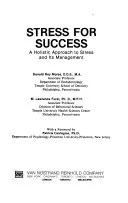
Donald Roy Morse and Merrick Lawrence Furst's 1979 book, Stress for Success, posits that not all stress is harmful. The authors differentiate between destructive and constructive stress, suggesting that specific applications of stress can be instrumental in achieving goals and promoting personal growth. This perspective moves beyond conventional views of stress as solely detrimental. The work is positioned within both psychology and self-improvement, yet it carries an esoteric current that sets it apart from mainstream self-help literature of the period.
This book is for readers who seek a deeper understanding of stress beyond simplistic explanations. It is particularly relevant for those interested in the psychological and philosophical aspects of achievement, including entrepreneurs and individuals focused on mental discipline and success. Those drawn to esoteric philosophy or less conventional psychological models will find its approach distinct. The authors' central idea is that stress, when understood and managed correctly, can act as a catalyst for improved focus, resilience, and overall performance.
Stress for Success emerged in 1979, a time when interest in human potential and alternative psychological theories was growing. This period saw a diversification in self-help literature, moving towards cognitive and even metaphysical explorations. Simultaneously, esoteric traditions were gaining more attention among Western intellectuals and creatives, often through less visible channels. This environment provided fertile ground for books that combined psychological insights with deeper philosophical questions, offering a perspective that blended the practical with the more abstract.
💡 Why Read This Book?
• Gain a novel perspective on stress by understanding the distinction between 'destructive' and 'constructive' stress, a core concept introduced by Morse and Furst. • Learn to identify and cultivate 'constructive stress' as a tool for enhanced focus and goal achievement, directly applicable to challenges you face. • Explore the philosophical underpinnings of pressure as a catalyst for growth, drawing parallels to the era's burgeoning interest in human potential and esoteric thought.
⭐ Reader Reviews
Honest opinions from readers who have explored this book.
❓ Frequently Asked Questions
What is the central argument of Stress for Success by Morse and Furst?
The book's central argument is that stress is not inherently negative. Morse and Furst propose a distinction between destructive and constructive stress, positing that the latter can be intentionally harnessed to enhance performance and achieve success.
When was Stress for Success first published?
Stress for Success was first published in 1979, placing it within the late 1970s surge of interest in personal development and psychological theories.
What kind of stress does the book advocate for?
The book advocates for 'constructive stress'—a form of pressure that is controlled, purposeful, and applied strategically to foster growth, focus, and achievement, rather than the debilitating 'destructive stress'.
Who are the authors of Stress for Success?
The authors are Donald Roy Morse and Merrick Lawrence Furst. The book was first published in 1979.
Does Stress for Success offer practical techniques for managing stress?
While not a typical stress-management guide, the book implies practical applications by suggesting how to identify and cultivate 'constructive stress' for goal attainment and personal advancement.
What is the esoteric angle of Stress for Success?
The esoteric angle lies in its philosophical approach to stress as a transformative force, moving beyond purely clinical psychology to explore stress as a catalyst for deeper personal development and achievement, aligning with broader esoteric interests of the era.
🔮 Key Themes & Symbolism
Constructive Stress as a Catalyst
The core of Morse and Furst's thesis is the redefinition of stress. They argue that rather than being solely a negative force to be avoided, stress can be a potent catalyst for growth and success when properly understood and applied. The work suggests that by differentiating between debilitating 'destructive stress' and empowering 'constructive stress,' individuals can learn to leverage challenging situations to sharpen focus, enhance problem-solving abilities, and ultimately achieve their goals. This perspective challenges conventional wisdom and invites readers to reconsider their relationship with pressure.
The Psychology of Achievement
Beyond mere stress management, the book examines the psychological architecture of achievement. It explores how the deliberate application of controlled pressure can serve as a mental crucible, forging resilience and driving individuals towards higher levels of performance. This theme positions stress not as an obstacle but as an integral component of a driven and successful life. The authors' approach encourages a proactive engagement with challenging circumstances, viewing them as opportunities for self-mastery and the realization of potential.
Esoteric Underpinnings of Pressure
While rooted in psychological concepts, Stress for Success carries an esoteric undertone. It touches upon the idea that mastering external and internal pressures is a path to self-transformation, a concept echoed in various mystical traditions. The work suggests that through a disciplined approach to managing stress, one can achieve a state of heightened awareness and efficacy. This aligns with esoteric philosophies that view adversity as a necessary element in the alchemical process of personal refinement and spiritual development.
Reframing Adversity
This book fundamentally reframes adversity and challenge. Instead of viewing setbacks or demanding situations as purely negative experiences, Morse and Furst propose that they can be powerful instruments for development. The work encourages a shift in perspective, where difficulties are seen not as impediments but as essential components for building strength, character, and ultimately, success. This reinterpretation is crucial for anyone seeking to develop a more resilient and growth-oriented mindset.
💬 Memorable Quotes
Direct passages from the work, attributed to the author.
“Stress is not inherently negative; its application determines its effect.”
— This statement captures the book's central argument: that stress itself is neutral. The authors propose that it is the context, intensity, and duration of stress, along with an individual's response, that dictate whether it leads to harm or benefit.
“The distinction between destructive and constructive stress is paramount.”
— This highlights the core concept distinguishing Morse and Furst's work. It implies that a critical first step is recognizing the different forms stress can take and understanding which type is being experienced or applied.
“Success often requires the controlled application of pressure.”
— This interpretation of the book's philosophy suggests that achieving significant goals necessitates engaging with challenging situations. The emphasis on 'controlled application' implies a deliberate and strategic approach rather than a chaotic or overwhelming experience of pressure.
“Adversity can be a tool for sharpening focus and building resilience.”
— This interpretation underscores the transformative potential of difficult experiences. The work posits that challenges, when met with the right mindset, serve to refine one's concentration and fortify one's ability to withstand future pressures.
💡 Key Ideas
Editorial paraphrase of the work's core concepts — not direct quotes.
Harnessing stress for achievement involves mental discipline and perspective.
This paraphrased concept points to the internal work required. It suggests that effectively using stress for success is not passive but demands active mental engagement, strategic thinking, and a conscious reorientation of one's viewpoint towards challenges.
🌙 Esoteric Significance
Tradition
While not explicitly aligned with a single named esoteric tradition, Stress for Success draws upon a broader Western esoteric current that emphasizes the power of the mind and consciousness to shape reality and achieve personal transformation. Its focus on harnessing internal states (stress response) for external achievement echoes Hermetic principles of 'As Above, So Below' and the alchemical concept of transforming base elements (stress) into gold (success). It fits within a lineage of thought that views challenges as necessary components for spiritual and psychological refinement.
Symbolism
The primary symbolic element is 'stress' itself, reframed from a negative force to a potent, dual-edged sword. 'Constructive stress' functions symbolically as a refined element, like the alchemist's purified substance, ready for purposeful application. The concept of 'success' acts as the transformed product, the desired outcome achieved through disciplined engagement with this potent force, symbolizing mastery and realization.
Modern Relevance
Contemporary fields such as positive psychology, performance coaching, and even certain branches of Stoicism echo Morse and Furst's ideas. Thinkers and practitioners exploring 'grit,' 'resilience,' and the concept of 'eustress' (beneficial stress) build upon the foundation laid by works like Stress for Success. Its emphasis on psychological reframing and proactive engagement with challenges remains relevant for modern high-achievers, entrepreneurs, and athletes seeking to optimize their mental approach to demanding situations.
👥 Who Should Read This Book
• Ambitious individuals seeking to understand the psychological mechanics of achievement, particularly those who feel conventional stress advice is insufficient. • Students of esoteric philosophy interested in how concepts of challenge and transformation are explored through psychological lenses, bridging into practical application. • Professionals and entrepreneurs aiming to optimize their performance under pressure, looking for frameworks that reframe adversity as a potential advantage.
📜 Historical Context
Published in 1979, Donald Roy Morse and Merrick Lawrence Furst's Stress for Success emerged during a period when the self-help and personal development industries were rapidly expanding, seeking to offer more sophisticated psychological frameworks. This era saw a divergence from strictly behavioral psychology towards cognitive and humanistic approaches. The book's perspective, which elevates stress as a potential tool for achievement rather than solely a pathology, contrasted with the more common advice of stress reduction prevalent at the time. While not directly engaging with a specific esoteric school, its philosophical underpinnings and emphasis on the mind's power over circumstance aligned with a growing interest in consciousness studies and Eastern philosophies, which were beginning to filter into Western thought. The work can be seen as an early exploration into the psychological dynamics of high performance, predating many contemporary discussions on grit and resilience, and existing alongside popular authors like Stephen Covey who were also exploring principles of effective living.
📔 Journal Prompts
The concept of 'constructive stress' and its potential applications.
Your personal experience with 'destructive stress' versus moments of high performance under pressure.
Identifying challenges that could be reframed as opportunities for growth.
The role of mental discipline in transforming pressure into productive energy.
How the 'controlled application of pressure' might align with your personal goals.
🗂️ Glossary
Constructive Stress
A type of stress that is perceived as challenging but manageable, leading to enhanced performance, focus, and personal growth. It is intentionally applied or experienced in a way that fosters achievement.
Destructive Stress
Stress that is overwhelming, chronic, or perceived as uncontrollable, leading to negative health outcomes, burnout, and impaired performance. It hinders rather than helps in achieving goals.
Controlled Application of Pressure
The deliberate and strategic use of challenging circumstances or demanding tasks to stimulate focus, creativity, and resilience, thereby driving progress towards a specific objective.
Psychological Crucible
A metaphor for a challenging situation or period that tests an individual's mental fortitude, resilience, and character, ultimately leading to significant personal development and strengthening.
Reframing Adversity
The cognitive process of altering one's perception of a difficult situation or challenge, viewing it not as a negative obstacle but as an opportunity for learning, growth, or advancement.
Achievement Psychology
The study of the mental processes, motivations, and behaviors associated with accomplishing goals and reaching high levels of performance.
Esoteric Undercurrent
A subtle, underlying philosophical or spiritual dimension within a text that explores deeper meanings beyond the literal or conventional interpretation, often touching on consciousness and transformation.