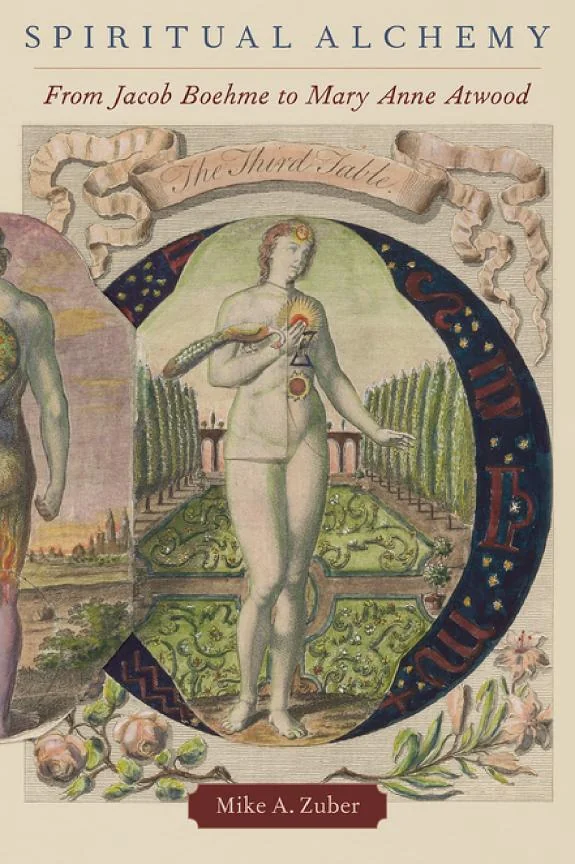
Spiritual Alchemy
 72
72

Spiritual Alchemy
Mike A. Zuber's *Spiritual Alchemy* offers a much-needed examination of an often-neglected stream within the Hermetic tradition. The author demonstrates a clear command of obscure manuscript sources, bringing to light the specific lineage of Jacob Boehme's followers and their unique contribution to alchemical thought. The strength of the book lies in its meticulous tracing of this intellectual descent, particularly its connection to Mary Anne Atwood's pivotal 1850 work, *Suggestive Inquiry into the Hermetic Mystery*. Zuber effectively argues for this thread as a precursor to modern spiritual alchemy. A potential limitation for some readers might be the density of the primary source material Zuber engages with, which, while essential for scholarly rigor, can make for challenging reading. The discussion around the reinterpretation of alchemical processes as metaphors for inner purification is particularly illuminating. Zuber's work is a vital contribution to understanding the nuanced evolution of esoteric thought.
📝 Description
72
Mike A. Zuber's Spiritual Alchemy traces modern esoteric thought to 17th-century mystic Jacob Boehme.
This book examines the development of spiritual alchemy, tracing its lineage back to the followers of Jacob Boehme, a 17th-century German mystic. Zuber highlights how Boehme's theosophical ideas were adapted and applied to the pursuit of inner transformation, creating a distinct spiritual current separate from traditional material alchemy. The work bridges the gap between Christian mystical traditions and alchemical literature, showing how symbolism like the Philosopher's Stone became a metaphor for soul purification.
The study places Boehme's followers outside academic and clerical structures, emphasizing their unique spiritual paths. It demonstrates how their interpretations of alchemical processes, such as the Great Work, were re-purposed for spiritual growth rather than physical transmutation. The book delves into Boehme's theological framework, particularly his concepts of the divine abyss and the 'ungrund,' as central to these later interpretations.
Spiritual Alchemy emerges from the Hermetic revival and early modern Christian mysticism. Jacob Boehme's writings in the early 17th century provided a unique theological basis that his followers adapted for spiritual ends. These disciples, often working outside established institutions, developed a unique approach to alchemy, focusing on the soul's purification and divine union. This tradition influenced later figures and contributed to the broader landscape of esoteric thought, demonstrating a path where alchemical imagery served internal, rather than material, goals.
💡 Why Read This Book?
• Understand the direct lineage of spiritual alchemy, tracing its roots through the followers of Jacob Boehme and their specific interpretations of alchemical symbolism. • Discover the intellectual pathways that led to Mary Anne Atwood's influential 1850 *Suggestive Inquiry into the Hermetic Mystery*, a cornerstone of modern Hermetic studies. • Gain insight into how traditional alchemical concepts were recontextualized within Christian mysticism for the purpose of inner spiritual transformation.
⭐ Reader Reviews
Honest opinions from readers who have explored this book.
❓ Frequently Asked Questions
What is the primary difference between spiritual alchemy and traditional alchemy?
Spiritual alchemy, as explored in this book, focuses on the inner transformation of the practitioner and the soul, using alchemical metaphors for purification and divine union. Traditional alchemy, while often having spiritual undertones, historically pursued material transmutation of metals.
Who was Jacob Boehme and why is he important to this book?
Jacob Boehme (1575-1624) was a German mystic and shoemaker whose theosophical writings profoundly influenced esoteric thought. This book highlights his followers' reinterpretation of alchemical concepts within a Christian mystical framework, forming the basis of spiritual alchemy.
How does this book relate to Mary Anne Atwood's work?
The book positions Spiritual Alchemy as a direct intellectual antecedent to Mary Anne Atwood's *Suggestive Inquiry into the Hermetic Mystery* (1850). Atwood's landmark work is presented as a modern interpretation heavily inspired by the Boehme tradition Zuber investigates.
What kind of sources does Mike A. Zuber use?
Zuber draws extensively on manuscript materials and obscure printed sources from the generations following Jacob Boehme. This allows for a deep dive into the specific interpretations and practices of his adherents.
Is this book about practical alchemical laboratory work?
No, this book is primarily historical and theoretical. It focuses on the philosophical and spiritual interpretations of alchemy, not on practical laboratory procedures or material experiments.
What historical period does 'Spiritual Alchemy' primarily cover?
The book focuses on the early-modern period, specifically examining the generations of followers of Jacob Boehme after his death in 1624, and tracing their influence into the mid-19th century.
🔮 Key Themes & Symbolism
Boehmian Theosophy
The work centers on the spiritual alchemy derived from Jacob Boehme's complex theosophical system. It explores how his unique cosmology, particularly concepts like the 'Ungrund' or divine abyss, provided a foundation for understanding alchemical processes not as material transformations, but as stages of divine manifestation and soul purification. Zuber details how Boehme's followers interpreted his writings through an alchemical lens, seeking inner enlightenment rather than external gold, thus establishing a distinct spiritual lineage.
Christian Mystical Alchemy
This theme distinguishes Spiritual Alchemy from purely Gnostic or Hermetic traditions by emphasizing its deep roots in Christian mysticism. The book illustrates how alchemical symbolism was integrated with Christian doctrines of redemption, the Trinity, and divine grace. The goal was often described as achieving a state of union with Christ or realizing the divine within the human soul, mirroring the alchemical process of perfecting base matter into gold through divine intervention.
The Great Work as Inner Transformation
Zuber unpacks the concept of the 'Major work' or Great Work, reinterpreting it as an internal, spiritual journey. Instead of focusing on the physical creation of the Philosopher's Stone, the emphasis is on the purification and refinement of the individual's spiritual essence. This involves overcoming inner 'impurities' and achieving a state of spiritual wholeness and divine illumination, aligning the microcosm of the human being with the macrocosm of creation.
Manuscript Traditions
A significant aspect is the reliance on manuscript sources. The book highlights how esoteric knowledge, particularly concerning spiritual alchemy, was often transmitted through handwritten texts rather than widely published works during certain periods. Zuber's engagement with these often-obscure manuscripts provides a more granular understanding of how ideas evolved and were preserved within specific circles of followers and initiates.
💬 Memorable Quotes
Direct passages from the work, attributed to the author.
“The transformation of base metals into gold was understood as a metaphor for the soul's purification.”
— This concisely captures the essence of spiritual alchemy, reframing the core alchemical goal from material gain to inner spiritual refinement and divine integration.
“Jacob Boehme's followers adapted his theosophy to an alchemical framework.”
— This highlights the intellectual lineage and adaptation process central to the book, showing how Boehme's complex theological ideas were specifically applied to the symbolic language of alchemy.
“Mary Anne Atwood's 1850 work drew heavily on this preceding tradition.”
— This statement emphasizes the book's focus on historical influence and establishes a concrete link between the early modern spiritual alchemists and a key figure in 19th-century esoteric studies.
“The 'Great Work' signified the perfection of the human spirit.”
— This interpretation explains the redefinition of a fundamental alchemical term, shifting its meaning from external achievement to internal spiritual development and wholeness.
“Christian mystical concepts were integral to this alchemical path.”
— This points to the specific theological underpinnings of the spiritual alchemy discussed, differentiating it from other esoteric schools by its explicit integration with Christian doctrine.
🌙 Esoteric Significance
Tradition
This work is firmly rooted in the Christian Hermetic tradition, specifically a branch influenced by the theosophy of Jacob Boehme. It departs from more purely Hermetic or Kabbalistic interpretations by foregrounding Christian doctrines of salvation, divine grace, and the Trinity within its alchemical framework. It represents a unique synthesis, adapting alchemical symbolism to express a specifically Christian path of inner spiritual perfection and union with the divine.
Symbolism
Central symbols include the Philosopher's Stone, reinterpreted not as a physical agent but as a state of divine consciousness or perfected soul. The alchemical process itself, from *nigredo* (blackening) to *rubedo* (reddening), symbolizes stages of spiritual purification: confronting the shadow self, undergoing trials, and achieving divine illumination. The concept of the 'Ungrund', Boehme's term for the primordial abyss from which all creation emerges, is also crucial, representing the unmanifest divine potential within.
Modern Relevance
The re-evaluation of spiritual alchemy presented here informs contemporary studies of Western esotericism, particularly concerning the evolution of Hermeticism beyond its Renaissance roots. Thinkers and practitioners interested in the intersection of Christian mysticism and esoteric philosophy find value in this lineage. It provides a specific historical and conceptual foundation for modern approaches to inner transformation that draw upon alchemical symbolism within a broadly spiritual or theosophical context.
👥 Who Should Read This Book
• Students of Western Esotericism: Those seeking to understand the historical development and specific branches of Hermeticism, particularly its post-Renaissance Christian interpretations. • Researchers of Jacob Boehme: Individuals interested in the direct impact and ongoing influence of Boehme's theosophy on subsequent generations of mystics and esoteric thinkers. • Comparative Mysticism Scholars: Readers exploring how alchemical imagery and concepts were adapted within different religious and spiritual frameworks, specifically Christian mysticism.
📜 Historical Context
The early modern period, following the Protestant Reformation, saw a surge in mystical and theosophical thought, often diverging from established religious dogma. Jacob Boehme (1575-1624), a Silesian mystic, emerged as an important figure, his complex theosophy sparking numerous interpretations. His followers, operating in the late 17th and 18th centuries, developed a distinct current of spiritual alchemy, seeking inner transformation rather than material transmutation. This tradition, often transmitted through manuscript circulation, stood in contrast to contemporary philosophical currents like nascent rationalism. The work highlights how this Boehme-inspired spiritual alchemy provided fertile ground for later esoteric revivalists. Notably, Mary Anne Atwood's 1850 publication, *Suggestive Inquiry into the Hermetic Mystery*, a foundational text for modern Hermeticism, is presented as a direct inheritor and interpreter of this specific lineage, demonstrating its enduring influence into the 19th century.
📔 Journal Prompts
The reinterpretation of the Philosopher's Stone as inner perfection.
Stages of the soul's purification mirroring alchemical processes.
The role of Jacob Boehme's 'Ungrund' in spiritual alchemy.
Connecting alchemical symbolism to Christian doctrines of salvation.
The influence of manuscript traditions on esoteric knowledge transmission.
🗂️ Glossary
Spiritual Alchemy
A branch of alchemy focused on the inner transformation of the practitioner's soul and spirit, using alchemical metaphors for purification and divine union, rather than material transmutation.
Jacob Boehme
A 17th-century German mystic and Christian theosopher whose writings, characterized by complex symbolism and cosmology, profoundly influenced subsequent esoteric movements.
Theosophy (Boehmian)
Boehme's unique spiritual philosophy, which attempts to explain the divine nature, the origin of good and evil, and the process of creation through allegorical and symbolic language, often incorporating alchemical ideas.
Ungrund
A central concept in Jacob Boehme's theology, referring to the primordial, unmanifest divine abyss or ground from which all existence arises; the source of both light and darkness.
Major work
Latin for 'Great Work,' traditionally referring to the process of creating the Philosopher's Stone in alchemy. In spiritual alchemy, it signifies the complete transformation and perfection of the individual soul.
Manuscript Tradition
The practice of transmitting knowledge, especially esoteric or forbidden knowledge, through handwritten copies of texts, often circulated privately among initiates or followers.
Mary Anne Atwood
A 19th-century English writer and esoteric scholar, author of *Suggestive Inquiry into the Hermetic Mystery*, considered a foundational text in modern Hermeticism and spiritual alchemy.
This book appears in 1 collection
🔮 Readers Also Liked
Browse all →








From the “Spiritual Alchemy” Collection
View all →







More Free Alchemy & Hermeticism Books
View all →