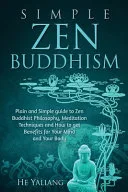
Simple Zen Buddhism
 79
79

Simple Zen Buddhism
He Yaliang’s *Simple Zen Buddhism* tackles the ambitious goal of making Zen accessible to the perpetually busy. The book's strength lies in its directness, cutting through academic jargon to present actionable advice. For instance, the section detailing simple breathing exercises for immediate stress relief is particularly well-executed, offering a concrete practice that even a hurried reader can implement. However, this very simplicity sometimes borders on oversimplification. While the blurb promises restorative benefits, the depth of Zen’s philosophical underpinnings, particularly its engagement with concepts like *śūnyatā* (emptiness), feels somewhat glossed over in favor of practical application. It’s a useful primer, but practitioners seeking a deeper philosophical engagement might find it wanting. Ultimately, it serves as an effective, if light, introduction to Zen for the time-pressed modern individual.
📝 Description
79
He Yaliang's 2022 book, Simple Zen Buddhism, offers a direct path to Zen practice for modern life.
This book presents a simplified approach to Zen Buddhist philosophy and practice, aiming to make its teachings accessible for everyday use. It focuses on the benefits of Zen meditation for individuals with busy lives, suggesting techniques for improved mental and physical well-being. The author designed the text for those experiencing stress and seeking practical methods for achieving mental calm. It is suitable for newcomers to Buddhist philosophy or meditation who want a clear, direct guide.
Readers can expect to find methods for tangible improvements in sleep quality and stress reduction without requiring significant time commitments. The core ideas center on applying Zen principles for stress management and gaining mental clarity. The book highlights the advantages of focused attention, practicing mindfulness in daily tasks, and developing inner peace. It provides techniques to lessen anxiety and enhance sleep, framing Zen as a practical system for a more balanced existence rather than an abstract belief.
Emerging in 2022, this work enters a cultural moment where mindfulness practices are widespread, often separated from their philosophical origins. Zen Buddhism itself has a long history, originating in China and developing through Japan. He Yaliang's book connects this ancient tradition to a contemporary audience familiar with self-help literature. It stands among other popular introductions to Eastern spiritual ideas, aiming to provide a particularly straightforward entry point into Zen.
💡 Why Read This Book?
• You will learn practical meditation techniques for stress reduction, directly applicable from the chapter on 'Restorative Sleep', enabling you to find calm amidst a hectic schedule. • You will gain an understanding of how Zen Buddhist meditation, as presented in the book's core principles, can be integrated into daily routines without requiring significant time investment. • You will explore simple methods for improving sleep quality, drawing from the specific guidance offered in the text, which addresses a common modern ailment.
⭐ Reader Reviews
Honest opinions from readers who have explored this book.
❓ Frequently Asked Questions
Can Zen Buddhism really help with stress if I have a very demanding job?
Yes, *Simple Zen Buddhism* is specifically designed for busy people. It offers techniques that can be integrated into short breaks during your workday, focusing on mindfulness and breathing exercises to manage stress effectively, even with limited time.
What are the main benefits of practicing Zen meditation as described in this book?
The book highlights benefits such as improved sleep quality, reduced anxiety and stress levels, and enhanced mental clarity. It presents Zen not as a complex philosophy but as a practical tool for daily well-being.
Is this book suitable for complete beginners to meditation?
Absolutely. *Simple Zen Buddhism* is intended as a plain and simple guide, breaking down Zen Buddhist meditation techniques into easy-to-follow steps for those with no prior experience.
How quickly can I expect to see results from these Zen techniques?
The book suggests that by following the right steps, you can begin noticing restorative benefits relatively quickly, particularly in areas like sleep and stress reduction, even in the shortest amount of time.
Does the book explain the historical origins of Zen Buddhism?
While the book focuses on practical application, it provides a basic historical context for Zen Buddhism, situating its teachings within a broader philosophical tradition for modern practitioners.
What makes this book different from other mindfulness or meditation guides?
Its unique selling proposition is the direct focus on Zen Buddhist principles presented in a simplified manner, specifically tailored to address the challenges faced by individuals with busy lives and limited time.
🔮 Key Themes & Symbolism
Mindfulness in Daily Life
The work emphasizes integrating Zen principles not just during formal meditation sessions but throughout everyday activities. It suggests that mindful attention to mundane tasks, like eating or walking, can be a potent practice. This approach transforms ordinary moments into opportunities for cultivating presence and reducing the mental clutter that often accompanies a busy existence, aligning with the book's promise of accessible spiritual benefit.
Stress Reduction Techniques
A core theme is the provision of practical, easy-to-implement techniques derived from Zen Buddhism aimed at mitigating the effects of modern life's stressors. The book focuses on actionable methods, such as specific breathing exercises and short meditative pauses, designed to bring immediate calm and promote restorative sleep, offering tangible relief for those feeling overwhelmed.
Restorative Sleep
The text directly links Zen practices to improvements in sleep quality. By calming the mind and reducing the constant stream of anxious thoughts, the techniques presented are intended to facilitate deeper, more restful sleep. This focus addresses a significant concern for many individuals, positioning Zen not just as a philosophical pursuit but as a therapeutic tool.
Simplicity and Accessibility
The overarching theme is the simplification of Zen Buddhist teachings. He Yaliang aims to present these profound concepts in a plain and simple manner, stripping away esoteric complexities. This makes the philosophy and practices accessible to a broad audience, particularly those new to spiritual disciplines or those who feel intimidated by traditional religious or philosophical texts.
💬 Memorable Quotes
Direct passages from the work, attributed to the author.
“Learning to apply the principles of Zen Meditation in your daily life need not be so hard.”
— This statement expresses the book's primary objective: to explain Zen and make its benefits attainable for everyone, regardless of their schedule or prior knowledge. It serves as an invitation to explore a path often perceived as difficult.
“If you follow the right steps, you will start noticing more restorative sleep, reduced anxiety, and improved focus.”
— This highlights the tangible, practical outcomes the author promises readers. It directly connects the practice of Zen meditation to concrete improvements in well-being, emphasizing results that appeal to a modern audience seeking self-improvement.
“Life can be stressful and filled with difficulties and mounting stress, especially for busy people.”
— This acknowledges the common challenges faced by many readers, establishing immediate relatability. It sets the stage for introducing Zen as a viable solution to these prevalent issues of modern existence.
“Enjoy the Restorative Benefits for Your Mind and Body Even if You Have a Busy Life.”
— This phrase acts as a core promise of the book, directly addressing the target audience's potential barriers to practice. It reassures readers that Zen's advantages are achievable despite a demanding lifestyle.
“Plain and Simple Guide to Benefit from the Zen Buddhist Meditation Techniques in the Shortest Amount of Time.”
— This further emphasizes the book's commitment to clarity and efficiency. It positions the text as a direct, no-frills manual for quickly accessing the advantages of Zen meditation.
🌙 Esoteric Significance
Tradition
While Zen Buddhism is a major school within Mahayana Buddhism, its practices and philosophical underpinnings can be viewed through an esoteric lens, particularly concerning the direct experience of enlightenment (*satori*) and the cultivation of non-dual awareness. This work, though simplified, touches upon these aims by focusing on inner transformation and the realization of a calmer, more present self, aligning with the esoteric pursuit of direct knowledge and liberation from ordinary limitations.
Symbolism
The book’s simplicity downplays overt symbolism, but the core practices themselves carry esoteric weight. The emphasis on the breath can be seen as a connection to the vital life force (*prana* or *qi*), a common motif in many esoteric traditions. Furthermore, the goal of stilling the 'monkey mind' relates to esoteric disciplines aimed at transcending the discursive intellect to access deeper states of consciousness.
Modern Relevance
In contemporary wellness and mindfulness movements, the principles championed in *Simple Zen Buddhism* find significant resonance. Thinkers and practitioners focused on mental health, stress reduction, and secular spirituality often draw upon Zen's emphasis on present-moment awareness and non-judgmental observation. The book's accessible format makes these ancient insights relevant to modern audiences seeking practical tools for psychological well-being, bridging traditional wisdom with contemporary needs.
👥 Who Should Read This Book
• Busy professionals seeking immediate stress-relief techniques, who will benefit from the book's focus on integrating Zen practices into short breaks throughout the workday. • Individuals new to meditation and Buddhist philosophy looking for a straightforward, jargon-free introduction, who will appreciate the plain language and step-by-step guidance. • Anyone experiencing sleep difficulties or high levels of anxiety, who can utilize the specific methods outlined for promoting restorative sleep and mental calm.
📜 Historical Context
He Yaliang's *Simple Zen Buddhism*, published in 2022, arrives in an era saturated with popular wellness trends and simplified spiritual practices. While Zen Buddhism's roots trace back to 6th-century China, evolving significantly in Japan, this particular work engages with a contemporary global audience increasingly drawn to mindfulness. It exists in dialogue with a vast ecosystem of self-help literature and apps that often secularize Eastern philosophies. Unlike earlier academic or devotional texts, *Simple Zen Buddhism* aims for immediate, practical application, reflecting a broader cultural shift towards experiential and results-oriented spirituality. It operates within a landscape where authors like Thich Nhat Hanh had already significantly popularized accessible Zen, yet He Yaliang's contribution focuses on an even more distilled, time-efficient approach, perhaps in response to the accelerated pace of 21st-century life.
📔 Journal Prompts
The 'restorative benefits' for mind and body promised by Zen practice.
Integrating Zen meditation techniques into a schedule with limited time.
The concept of achieving inner peace amidst life's difficulties.
Specific breathing exercises for immediate stress reduction.
The connection between Zen practice and improved sleep quality.
🗂️ Glossary
Zen Buddhism
A school of Mahayana Buddhism originating in China, emphasizing meditation and intuitive understanding over scripture. It seeks direct experience of enlightenment.
Meditation
A practice where an individual uses a technique – such as mindfulness, or focusing the mind on a particular object, thought, or activity – to train attention and awareness, and achieve a mentally clear and emotionally calm and stable state.
Mindfulness
The quality or state of being conscious or aware of something. In a Buddhist context, it refers to non-judgmental awareness of the present moment.
Stress
A state of mental or emotional strain or tension resulting from adverse or demanding circumstances.
Restorative Sleep
Sleep that is deeply refreshing and allows the body and mind to recover fully from the day's exertions.
Anxiety
A feeling of worry, nervousness, or unease, typically about an imminent event or something with an uncertain outcome.
Focus
The ability to direct one's attention towards a specific task or subject, excluding distractions.