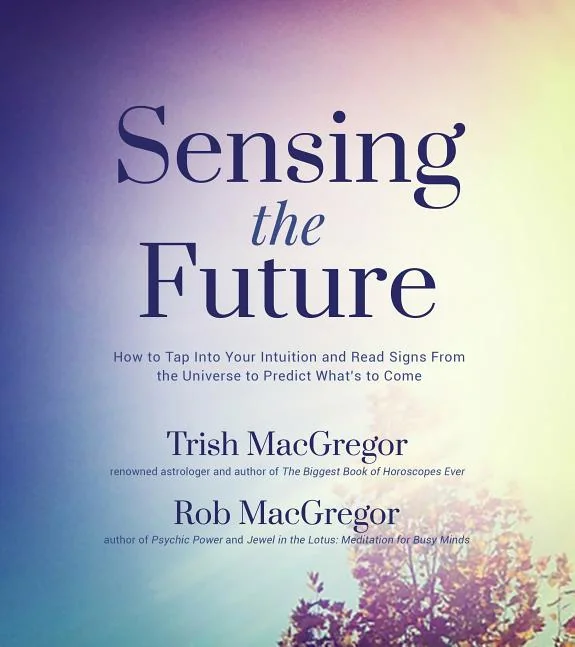
Sensing the Future
 82
82

Sensing the Future
The MacGregors' approach to precognition in Sensing the Future is commendably direct, sidestepping the usual mystical embellishments that often cloud discussions of psychic phenomena. They frame the subject not as a magical gift but as an aspect of human consciousness that can be understood and potentially developed. A particular strength is their grounding of abstract concepts in observable phenomena and personal accounts, making the subject feel more tangible. However, the book occasionally feels constrained by its desire for empirical validation, sometimes leaving the more subtle, subjective experiences of precognition underexplored. The section discussing dream analysis, for instance, offers practical advice but could benefit from a deeper dive into the archetypal symbolism that Jungian psychology associates with prophetic dreams. Ultimately, Sensing the Future serves as a pragmatic guide for those seeking to engage with precognition in a structured, rational manner.
📝 Description
82
Trish and Rob MacGregor's 1989 book, Sensing the Future, examines precognition as a latent human capacity.
Sensing the Future investigates the nature of precognition and psychic awareness, looking at different methods and theories for perceiving future events. The authors draw on historical accounts and practical examples to explain how this ability might work. They present precognition not as a mysterious art, but as a natural human potential that can be developed. The book is for anyone interested in psychic phenomena, especially precognition, who wants a clear and sensible introduction. It will interest those who study parapsychology, consciousness, and how to use intuition practically. Readers who want a balanced view, accepting both doubt and the possibility of unusual perception, will find this work valuable. The MacGregors place the study of precognition within the history of psychic research. They mention early investigations from the late 19th and early 20th centuries, a time when spiritualism and the paranormal were widely discussed.
This book fits within the broader Western esoteric tradition's interest in psychic phenomena and divination. It connects to the historical development of parapsychology, particularly the investigations into clairvoyance and telepathy that emerged in the late 19th century. The MacGregors' approach, emphasizing personal experience and structured exercises, echoes traditions that seek to develop inner faculties, often drawing parallels between subjective experience and objective reality. It stands as a practical guide for individuals exploring the potential for extrasensory perception within a modern context.
💡 Why Read This Book?
• Gain practical techniques for recognizing and interpreting precognitive signals, moving beyond passive observation to active engagement with your intuition, directly referencing the dream analysis methods discussed. • Understand the historical lineage of psychic research, placing precognition within the context of early 20th-century parapsychological investigations and societal interest. • Develop a framework for evaluating psychic experiences critically yet open-mindedly, learning to distinguish between genuine precognitive impressions and other psychological phenomena.
⭐ Reader Reviews
Honest opinions from readers who have explored this book.
❓ Frequently Asked Questions
What distinguishes precognition from simple intuition according to Sensing the Future?
Sensing the Future posits that precognition specifically involves foreseeing future events, often through symbolic dreams or sudden insights, whereas general intuition might relate to present circumstances or emotional states. The book offers methods to discern these future-oriented impressions.
Are there specific exercises in the book to develop precognitive abilities?
Yes, the book includes exercises designed to enhance psychic awareness and train the reader to recognize precognitive signals. These often involve focused attention on dreams and meditative practices, building on principles explored in the 1970s parapsychology research.
Does the book discuss the scientific basis for precognition?
The MacGregors touch upon various theories and research attempts to understand the mechanisms behind precognition, referencing parapsychological studies. While acknowledging the challenges in empirical verification, they present precognition as a phenomenon worthy of investigation.
What historical figures or movements are referenced in relation to precognition?
The work draws upon the broader history of psychic research, referencing early 20th-century investigations into clairvoyance and telepathy. It situates precognition within a lineage of inquiry that sought to understand consciousness beyond conventional scientific paradigms.
Can Sensing the Future help someone who is skeptical about psychic abilities?
The book aims for a balanced perspective, encouraging readers to approach the subject with an open yet critical mind. It provides a structured approach to personal exploration, allowing skeptics to examine the phenomena through their own experiences and rational analysis.
What is the role of dreams in the context of precognition as presented by the MacGregors?
Dreams are presented as a significant conduit for precognitive information. The book explores how to interpret dream imagery for future insights, suggesting that the subconscious mind may process information beyond the linear constraints of waking consciousness.
🔮 Key Themes & Symbolism
Nature of Precognition
The work examines precognition not as a supernatural gift but as a natural, albeit often undeveloped, human faculty. It posits that the ability to perceive future events can be understood through examining patterns in dreams, intuitive flashes, and subtle energetic shifts. The authors encourage readers to approach these experiences with curiosity and a willingness to explore their own inner landscape, moving away from sensationalized portrayals towards a more grounded, personal investigation of foresight.
Practical Development
Sensing the Future emphasizes the cultivation of precognitive abilities through specific techniques. This includes advice on dream journaling, developing heightened awareness during waking states, and learning to discern genuine future impressions from subconscious projections or wishful thinking. The book provides actionable steps, encouraging readers to engage in consistent practice to strengthen their intuitive channels and increase the clarity and reliability of their precognitive perceptions.
Historical Parallems
The MacGregors situate their exploration within the broader history of psychic research, referencing early 20th-century interest in clairvoyance and telepathy. By connecting contemporary understanding with past investigations, they provide context for the ongoing human fascination with and study of precognition. This historical lens highlights the persistent inquiry into consciousness and its potential to transcend linear time, showing that these explorations have deep roots.
Interpreting Psychic Impressions
A core theme is the interpretation of the subtle messages that precognition might offer. The book studies the symbolic language of dreams and intuitive nudges, suggesting that these are not always literal but often metaphorical. Readers are guided on how to decode these impressions, understanding that context, personal associations, and emotional resonance play crucial roles in unlocking the meaning behind future-oriented psychic information.
💬 Memorable Quotes
Direct passages from the work, attributed to the author.
“Precognition is not a gift bestowed upon a select few, but a latent capacity within the human psyche.”
— This statement reframes precognition from an extraordinary, rare ability to a potential inherent in everyone. It suggests that with the right understanding and practice, individuals can access and develop this foresight, making it a subject of personal exploration rather than distant wonder.
“Dreams often serve as a primary vehicle for precognitive impressions, encoding future events in symbolic language.”
— This highlights the significance of the dream state in accessing future information. It implies that understanding dream symbolism is key to unlocking precognitive insights, suggesting a direct link between our sleeping minds and potential future occurrences.
“Cultivating awareness involves learning to recognize the subtle shifts in perception that signal a precognitive event.”
— This emphasizes the importance of mindfulness and focused attention. It suggests that precognition manifests not always as dramatic visions, but often as faint signals that can be detected with practice and a heightened sense of inner awareness.
“The study of psychic phenomena requires both open-minded inquiry and a disciplined approach to verification.”
— This points to a balanced methodology for exploring precognition. It advocates for embracing the possibility of these experiences while simultaneously applying critical thinking and personal observation to validate them, avoiding both gullibility and outright dismissal.
“Intuitive flashes can provide glimpses of future possibilities, offering guidance beyond rational thought.”
— This underscores the value of spontaneous intuitive insights. It suggests that these sudden, unbidden thoughts or feelings can offer valuable perspectives on future outcomes, operating independently of logical deduction.
🌙 Esoteric Significance
Tradition
This work fits within the broad stream of Western Esotericism, particularly concerning divination and the exploration of consciousness beyond the physical senses. While not strictly tied to a single lineage like Hermeticism or Kabbalah, it shares the esoteric endeavor of mapping and understanding non-ordinary states of awareness and their potential applications, reflecting a modern continuation of inquiries into the subtle realms.
Symbolism
Dreams are a primary symbolic vehicle discussed, often functioning as a subconscious language to convey future possibilities. The book may explore recurring dream motifs or archetypal imagery, suggesting these have deeper significance in precognitive experiences. Beyond dreams, the 'subtle shifts in perception' mentioned act as symbolic indicators, signaling the presence of precognitive information through non-verbal, felt senses.
Modern Relevance
Sensing the Future appeals to contemporary interest in mindfulness, intuition development, and personal growth practices. It speaks to modern seekers who wish to integrate psychic awareness into their daily lives, finding parallels in fields like consciousness studies, positive psychology, and even certain therapeutic approaches that value inner experience and intuitive knowing.
👥 Who Should Read This Book
• Individuals interested in parapsychology and the scientific study of psychic phenomena, seeking a balanced overview of precognition research. • Aspiring intuitives and psychics looking for practical guidance and exercises to develop their foresight abilities, referencing the dream analysis techniques. • Students of consciousness and esoteric traditions interested in how precognition has been understood historically, connecting to early 20th-century psychic research.
📜 Historical Context
Sensing the Future emerges from a long tradition of exploring consciousness and psychic phenomena that gained significant momentum in the late 19th and early 20th centuries. This era saw the formation of organizations like the Society for Psychical Research (founded 1882) and intense interest in spiritualism, telepathy, and clairvoyance, partly as a response to scientific materialism. Authors like Frederic W. H. Myers and later J.B. Rhine at Duke University (who coined the term 'extrasensory perception' in the 1930s) sought to investigate these claims rigorously. The MacGregors' work implicitly engages with this lineage, seeking to provide accessible knowledge about precognition, a subject that continued to be explored by various researchers and esoteric schools throughout the 20th century, often existing alongside more mainstream psychological and parapsychological investigations.
📔 Journal Prompts
The nature of precognition as a latent capacity within the psyche.
Interpreting symbolic language in precognitive dreams.
Recognizing subtle shifts in perception that indicate future awareness.
Evaluating intuitive flashes for their potential precognitive content.
The historical context of psychic research and its relation to foresight.
🗂️ Glossary
Precognition
The ability to perceive or know information about future events before they happen, often through psychic or intuitive means.
Intuition
The capacity to understand or know something immediately, without conscious reasoning; a direct perception or insight.
Clairvoyance
The purported psychic ability to see objects or events that cannot be perceived by the senses, including future occurrences.
Psychic Awareness
A heightened sensitivity to subtle energies and information beyond the scope of the five physical senses.
Extrasensory Perception (ESP)
A term coined by J.B. Rhine, encompassing psychic abilities such as telepathy, clairvoyance, and precognition.
Symbolic Language (in dreams)
The use of images, metaphors, and allegories within dreams to represent underlying meanings, often related to subconscious thoughts or future possibilities.
Parapsychology
The study of alleged psychic phenomena and other paranormal claims, including ESP and psychokinesis.
🔮 Readers Also Liked
Browse all →









More by Trish MacGregor, Rob MacGregor
All books →

More Free Occult Philosophy Books
View all →