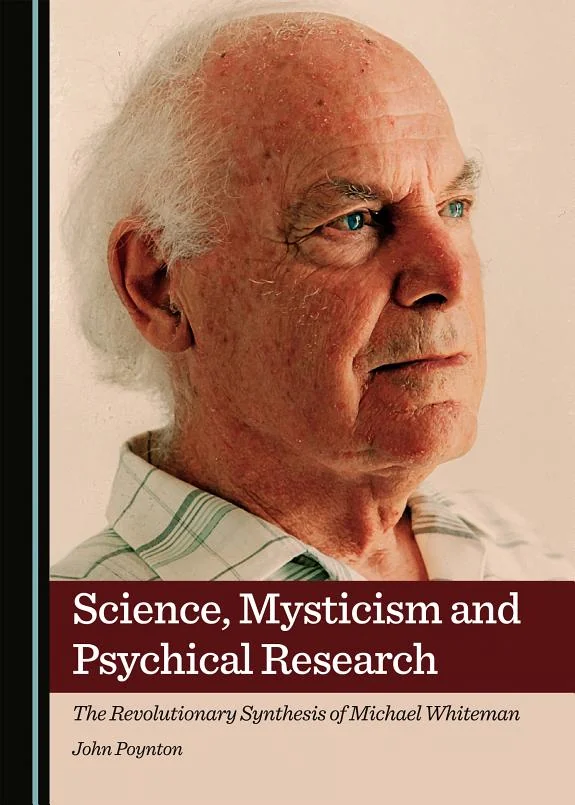
Science, Mysticism and Psychical Research
 82
82

Science, Mysticism and Psychical Research
John Poynton's "Science, Mysticism and Psychical Research" offers a compelling, albeit dense, exploration of Michael Whiteman's ambitious intellectual project. The book's strength lies in its detailed exposition of Whiteman's attempt to harmonize advanced physics with esoteric traditions. Poynton meticulously outlines Whiteman's ability to meld mathematical concepts with insights from Indian Vedanta and Western mysticism, a feat rarely attempted with such rigor. However, the sheer technicality of Whiteman's physics discussions, particularly concerning his mathematical formulations, may prove challenging for readers without a strong background in applied mathematics. A passage discussing the implications of quantum entanglement for psychic phenomena, for instance, is illuminating but demands careful study. The work's limitation is its accessibility; it requires significant reader investment. Ultimately, Poynton's volume serves as a crucial document for understanding Whiteman's unique contribution to integrative thought.
📝 Description
82
John Poynton's 2015 book synthesizes physics, psychical research, and mysticism.
This volume details physicist Michael Whiteman's unique integration of mathematical physics, general science, and the fields of psychical research and mystical traditions. Whiteman, an Associate Professor at the University of Cape Town, drew extensively from Indian and Western esoteric texts throughout his work. His research was further informed by a lifetime of personal psychical and mystical engagement.
The book aims to show how seemingly separate domains can converge, leading to a unified perspective on consciousness and reality. It is written for serious students of consciousness, metaphysics, and the history of science. The work appeals to those questioning the conventional boundaries between empirical study and subjective experience, particularly individuals interested in the intersections of physics, parapsychology, and comparative mysticism.
Published in 2015, this work emerged during a renewed interest in consciousness studies and the connection between science and esoteric thought. It follows a lineage of thinkers who sought to bridge the materialist worldview with the experiential insights of mystical traditions. Whiteman's approach shares similarities with figures like F.W.H. Myers and David Bohm, but his specific grounding in mathematical physics offers a distinctive perspective on these connections.
💡 Why Read This Book?
• Gain a unique framework for understanding consciousness by exploring Michael Whiteman's synthesis of mathematical physics and mystical traditions, as presented in the text's detailed exposition of his theories. • Understand the historical bridge between early 20th-century psychical research movements and contemporary consciousness studies, recognizing the intellectual lineage traced back to figures like F.W.H. Myers. • Appreciate the potential for a unified worldview where scientific rigor meets esoteric experience, learning how Whiteman applied concepts from Vedanta and Western mysticism to modern scientific questions.
⭐ Reader Reviews
Honest opinions from readers who have explored this book.
❓ Frequently Asked Questions
Who was Michael Whiteman and what was his academic background?
Michael Whiteman was an Associate Professor of Applied Mathematics at the University of Cape Town. His academic expertise in physics provided the foundation for his unique approach to integrating scientific and esoteric knowledge.
What is the central argument of "Science, Mysticism and Psychical Research"?
The book's core argument is that Michael Whiteman achieved a significant synthesis, demonstrating how mathematical physics can be reconciled with psychical research and mystical traditions, challenging the perceived dichotomy between science and spirituality.
What esoteric traditions are discussed in the book?
The work references both Indian mystical texts, such as those related to Vedanta, and Western esoteric traditions, integrating their concepts with Whiteman's scientific and psychical research findings.
When was the book first published?
This book was first published on September 4, 2015, placing it within the contemporary landscape of consciousness studies and interdisciplinary research.
What is the primary challenge for readers of this book?
The primary challenge lies in the technical nature of the mathematical physics discussions, requiring a solid understanding of scientific principles to fully grasp Whiteman's synthesis.
What is the significance of Whiteman's work for understanding consciousness?
Whiteman's work is significant for proposing a unified model of consciousness that bridges empirical observation and subjective, mystical experience, using advanced physics as a potential explanatory language.
🔮 Key Themes & Symbolism
Mathematical Physics as a Bridge
The book centers on Whiteman's hypothesis that the abstract structures of mathematical physics, particularly in areas like general relativity and quantum mechanics, can serve as a conceptual bridge to phenomena investigated by psychical research. It explores how mathematical models might describe consciousness, non-local correlations, and subtle energies that elude conventional scientific paradigms. Whiteman's work suggests that the universe's underlying mathematical order is not confined to the physical but extends to the subjective and the supranormal.
Integration of Indian and Western Mysticism
A core aspect is Whiteman's ability to meld scientific inquiry with insights drawn from diverse mystical traditions. The work specifically engages with concepts from Indian Vedanta, such as the nature of Brahman and consciousness, and Western esoteric thought. This integration is not superficial; Whiteman uses these traditions to inform his understanding of psychical phenomena and to provide a qualitative counterpoint to the quantitative language of physics, suggesting a universal basis for spiritual experience.
The Nature of Psychical Research
The book re-evaluates psychical research not as a fringe pseudoscience but as a valid area of inquiry that can be approached with scientific rigor, albeit through novel frameworks. Whiteman's lifetime of personal experience in psychical and mystical pursuits lends credibility and depth to his analysis. The work aims to elevate the study of telepathy, precognition, and other anomalous phenomena by grounding them in a sophisticated theoretical structure derived from advanced science and comparative mysticism.
Whiteman's Unified Worldview
Ultimately, the book showcases Whiteman's "towering synthesis"—a comprehensive worldview attempting to unify objective, scientific knowledge with subjective, spiritual experience. This synthesis challenges the Cartesian dualism and the reductionist materialism that have dominated Western thought. By demonstrating the potential harmony between the empirical and the trans-empirical, Whiteman offers a path towards a more holistic understanding of reality and humanity's place within it.
💬 Memorable Quotes
Direct passages from the work, attributed to the author.
“Whiteman was able to meld mathematical physics and general science with psychical research and Indian and Western mystical texts.”
— This highlights the book's central thesis: the unprecedented integration of highly technical scientific disciplines with esoteric knowledge and empirical investigation into paranormal phenomena.
“The book centres on a towering synthesis achieved by the late Michael Whiteman.”
— This points to Whiteman's profound intellectual achievement as the core subject, emphasizing the comprehensive and integrated nature of his conceptual framework.
“Whiteman’s work draws extensively from both Indian and Western esoteric texts.”
— This emphasizes the eclecticism and breadth of Whiteman's research, showing his willingness to draw parallels between disparate spiritual and philosophical traditions.
“His approach was clarified by a life-time of psychical and mystical experience.”
— This underscores the personal foundation of Whiteman's theories, suggesting that his insights were not purely intellectual but also deeply experiential.
“Science, mysticism, and psychical research are generally thought to be irreconcilable.”
— This sets up the book's primary objective: to challenge the conventional separation and apparent conflict between these fields by proposing a unifying perspective.
🌙 Esoteric Significance
Tradition
This work does not align strictly with a single esoteric lineage but rather seeks a universal synthesis. It bridges the rationalism of Western science with the experiential insights found in traditions like Advaita Vedanta and Western Hermeticism. Whiteman's approach can be seen as a modern attempt to fulfill the Hermetic maxim 'As Above, So Below,' by finding correspondences between the macrocosmic order described by physics and the inner microcosmic reality of consciousness and mystical experience.
Symbolism
While the book is primarily theoretical, the 'synthesis' itself acts as a potent symbol of unity and interconnectedness, challenging dualistic thinking. Mathematical equations, particularly those describing complex physical phenomena, can be viewed symbolically, representing underlying universal principles. Furthermore, concepts like 'consciousness' and 'psychical phenomena' function as symbolic gateways to exploring realities beyond the purely material, hinting at a unified field of existence.
Modern Relevance
Whiteman's work is highly relevant today for thinkers and researchers in fields like consciousness studies, theoretical physics, and transpersonal psychology. Contemporary proponents of a unified field theory, or those exploring quantum consciousness, may find his mathematical and philosophical framework prescient. His efforts to bridge the gap between subjective experience and objective measurement continue to inspire those seeking a more holistic understanding of reality in an increasingly fragmented world.
👥 Who Should Read This Book
• Advanced students of theoretical physics and consciousness: Readers with a strong background in mathematics and physics who are interested in how these disciplines might intersect with phenomena studied in psychical research. • Comparative mysticism scholars: Individuals seeking to understand how ancient esoteric traditions, such as Vedanta, can be reinterpreted through a modern scientific lens. • Researchers in parapsychology: Those looking for theoretical frameworks that attempt to provide a rigorous, scientific basis for psychical phenomena, moving beyond purely empirical observation.
📜 Historical Context
Published in 2015, "Science, Mysticism and Psychical Research" arrives in an era marked by renewed interest in consciousness studies and the potential for dialogue between science and spirituality, a stark contrast to the strict materialism prevalent in mid-20th century academia. Michael Whiteman's work can be seen as a continuation of a long tradition of thinkers who sought to reconcile empirical observation with subjective experience. His approach echoes figures like Aldous Huxley, who explored mescaline's effects alongside mystical texts, and later, scientists involved in the early days of parapsychology, such as those associated with the Society for Psychical Research founded in 1882. However, Whiteman's specific integration of advanced mathematical physics distinguishes his contribution significantly from earlier attempts. While contemporary figures like Dean Radin were also pushing the boundaries of consciousness research, Whiteman's mathematical rigor offered a unique angle, attempting to provide a formal language for phenomena often relegated to anecdotal evidence or qualitative description.
📔 Journal Prompts
Michael Whiteman's synthesis of mathematical physics and mystical traditions.
The perceived irreconcilability of science and mysticism.
The role of personal psychical and mystical experience in Whiteman's research.
Connections between Indian and Western esoteric texts explored in the book.
The implications of Whiteman's work for understanding consciousness.
🗂️ Glossary
Psychical Research
The interdisciplinary study of alleged psychic phenomena and other paranormal claims, including telepathy, clairvoyance, precognition, and psychokinesis, often employing scientific methodologies.
Mathematical Physics
A branch of physics that uses mathematical models and methods to understand and describe physical phenomena, focusing on the abstract and theoretical aspects of physical laws.
Mysticism
The pursuit of achieving communion or identity with, or conscious awareness of, the ultimate reality, the divine, spiritual truth, or God through direct experience, intuition, or insight.
Synthesis
The combination of ideas and theories from different disciplines or traditions to form a more comprehensive or coherent understanding; in this context, Whiteman's integration of science and esotericism.
Vedanta
A school of Hindu philosophy and spiritual thought that deals with the nature of reality, consciousness, and the self, based on the Upanishads, often emphasizing non-dualism (Advaita).
General Science
Refers broadly to the established principles and findings across various scientific disciplines, used here to denote the wider scientific context within which Whiteman's specialized work is situated.
Associate Professor
An academic rank in universities and colleges, typically below a full professor, indicating a senior teaching and research position.
This book appears in 1 collection
🔮 Readers Also Liked
Browse all →









From the “Out-of-Body Experience” Collection
View all →









More Free Occult Philosophy Books
View all →