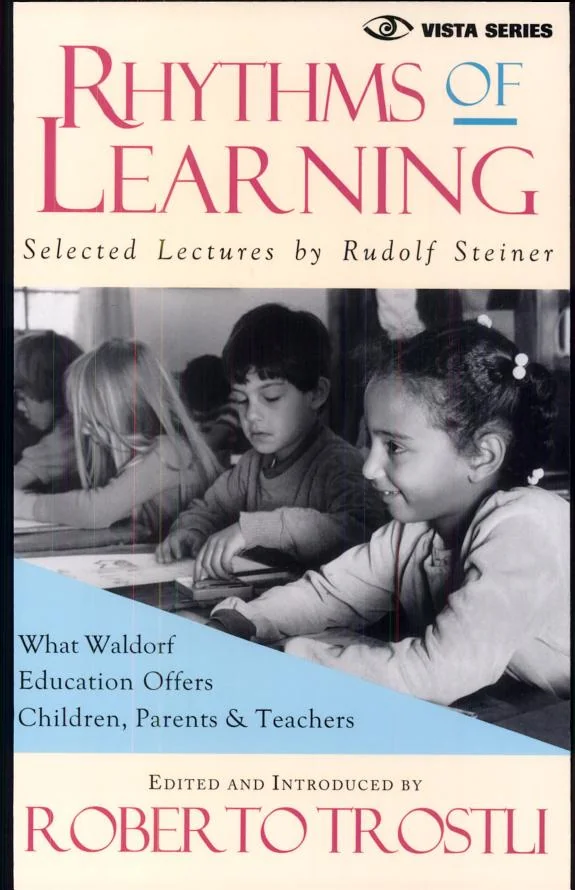
Rhythms of Learning
 74
74

Rhythms of Learning
Rudolf Steiner's "Rhythms of Learning" offers a perspective on education that remains distinct in its emphasis on the spiritual dimensions of child development. The strength of this compilation lies in its presentation of Steiner's core ideas on pedagogy, particularly his concept of developmental stages, making them more approachable than some of his denser works. The selection of lectures thoughtfully addresses the integration of spirit, soul, and body. However, the limitation for a contemporary reader is the inherent esoteric framework; while presented accessibly, understanding Steiner's specific spiritual science requires significant prior engagement or a willingness to accept its premises without empirical validation. A passage discussing the "seven-year cycles" highlights this: while offering a structured view of childhood, it relies on a specific metaphysical understanding of human development that may not resonate with secular educational theories.
This volume serves as a valuable introduction to Steiner's educational philosophy for those already inclined towards it.
📝 Description
74
Rudolf Steiner's "Rhythms of Learning," published in 1998, gathers lectures on child development and pedagogy.
This volume collects key lectures by Rudolf Steiner concerning child development and pedagogy, first published in 1998. The selections center on Steiner's integrated view of education, which connects the spiritual, soul, and physical dimensions of a child's growth. The book aims to make Steiner's substantial educational writings more accessible to a broader readership.
It is intended for educators, parents, and students of Anthroposophy or esoteric educational philosophies. The text addresses those who seek to understand child development from a perspective that goes beyond materialism, offering insights into the energetic and spiritual forces active during formative years. Individuals interested in the foundational principles of Waldorf education will find direct relevance in these discussions.
Steiner's work in this volume falls within the tradition of Anthroposophy, a spiritual philosophy he developed in the early 20th century. Anthroposophy posits a spiritual reality accessible through inner development and provides a framework for understanding the human being as a complex spiritual, soul, and physical organism. This book applies that framework to pedagogy, suggesting that educational practices should correspond to the inner, spiritual rhythms of a child's unfolding life. His approach contrasts with purely materialistic or scientific views of human development prevalent at the time.
💡 Why Read This Book?
• Understand the developmental stages of childhood, specifically the seven-year cycles Steiner outlines, to better align educational practices with a child's evolving spiritual and physical needs. • Gain insight into Anthroposophical pedagogy, a distinct approach to education developed by Rudolf Steiner, which emphasizes the spiritual, soul, and physical aspects of the child. • Explore the concept of 'spiritual science' as applied to education, offering a unique perspective on learning that goes beyond conventional psychological and physiological models.
⭐ Reader Reviews
Honest opinions from readers who have explored this book.
❓ Frequently Asked Questions
When was Rudolf Steiner's "Rhythms of Learning" first published?
The book "Rhythms of Learning" was first published in 1998, compiling key lectures by Rudolf Steiner on education.
What is the central philosophy behind Rudolf Steiner's educational approach discussed in "Rhythms of Learning"?
The central philosophy is Anthroposophy, which views education as nurturing the child's spirit, soul, and physical body through distinct developmental stages, often described in seven-year cycles.
Who is the intended audience for "Rhythms of Learning"?
It is intended for educators, parents, and students interested in esoteric educational philosophies, particularly those drawn to Waldorf education's foundational principles.
Does "Rhythms of Learning" require prior knowledge of Rudolf Steiner's work?
While the book aims for accessibility, understanding Steiner's specific spiritual science framework can be greatly enhanced by some prior familiarity with his broader philosophical or esoteric writings.
What are the key developmental concepts explored in the book?
The book explores the concept of seven-year cycles in child development, detailing the unique spiritual and soul needs pertinent to each stage, from birth through adolescence.
Is this book a primary source for Waldorf education?
Yes, "Rhythms of Learning" presents foundational lectures by Rudolf Steiner, the originator of the Waldorf education movement, making it a key text for understanding its pedagogical underpinnings.
🔮 Key Themes & Symbolism
Child Development Stages
The work meticulously outlines Rudolf Steiner's concept of distinct developmental phases in childhood, typically demarcated into seven-year cycles. Each phase is presented as having unique spiritual, soul, and physiological characteristics that educators and parents should recognize and support. This perspective moves beyond standard psychological models to incorporate energetic and spiritual influences, suggesting that learning and growth are deeply connected to these internal rhythms and the child's evolving relationship with the cosmos.
Holistic Education
"Rhythms of Learning" champions an educational approach that considers the child in their entirety – spirit, soul, and body. Steiner argues that true education involves nurturing all these aspects, fostering not just intellectual capacity but also emotional intelligence, creativity, and moral development. This holistic view posits that the spiritual dimension is as crucial as the physical and psychological for the child's complete unfolding and integration into the world.
Spiritual Science in Pedagogy
A core theme is the application of Steiner's 'spiritual science' to the field of education. This involves understanding the human being as a spiritual entity with a pre-natal and post-mortal existence, and how this spiritual reality informs childhood development. The book explores how educators can work with subtle spiritual forces and insights to guide children, fostering a worldview that integrates the observable with the unobservable, the material with the spiritual.
Rhythm and Imagination
The importance of rhythm – both in daily life and in the broader cycles of development – is emphasized as fundamental to learning and well-being. Steiner connects this to the cultivation of imagination, which he sees as a vital faculty for understanding the world and for spiritual perception. The book suggests that educational activities should be structured to support natural rhythms and to awaken and strengthen the child's imaginative capacities from an early age.
💬 Memorable Quotes
Direct passages from the work, attributed to the author.
“Education is an art, and the educator must be an artist.”
— This statement emphasizes the creative and intuitive nature of teaching according to Steiner's philosophy. It suggests that effective education requires more than just technical knowledge; it demands imagination, sensitivity, and the ability to respond dynamically to the unique needs of each child.
“The child's development follows specific spiritual and soul rhythms.”
— This interpretation highlights Steiner's core concept that a child's growth is not merely a biological or psychological process but is guided by underlying spiritual and soul forces that manifest in observable rhythms and stages.
“The teacher must understand the child's inner life and spiritual heritage.”
— This interpretation points to the teacher's role as not just an instructor but a guide who perceives the child's deeper, spiritual nature and their innate potential, fostering growth from an inner, spiritual perspective.
“Imagination is the organ of spiritual perception.”
— This concept, central to Steiner's thought, posits that imagination is not mere fantasy but a faculty capable of grasping spiritual realities and truths, making it essential for a comprehensive understanding of the world.
💡 Key Ideas
Editorial paraphrase of the work's core concepts — not direct quotes.
True education nurtures the spirit, soul, and body in equal measure.
This paraphrased concept underscores the holistic philosophy of Steiner's pedagogy. It asserts that a complete education must address the child's intellectual, emotional, and spiritual dimensions, rather than focusing solely on cognitive development.
🌙 Esoteric Significance
Tradition
Steiner's work belongs to the Western Esoteric tradition, drawing heavily from Theosophy (though he later diverged to form his own Anthroposophical Society), Hermeticism, and Gnosticism. "Rhythms of Learning" fits within this lineage by positing a spiritual reality underlying physical phenomena and applying it to human development. It departs from more mystical or purely philosophical traditions by attempting to systematize and apply these esoteric principles to practical fields like education, grounding them in a detailed, albeit controversial, spiritual science.
Symbolism
A key motif is the concept of the 'seven-year cycle,' representing stages of human development informed by spiritual influences and cosmic rhythms. Another is the idea of the 'etheric body,' a subtle energetic layer distinct from the physical, which Steiner believed influences growth and learning, particularly in the early years. The cultivation of 'imagination' itself acts as a symbol for the faculty that bridges the material and spiritual worlds, enabling perception beyond the senses.
Modern Relevance
Contemporary educators and parents interested in Waldorf education continue to draw directly from Steiner's pedagogical lectures. His emphasis on holistic development, creativity, and understanding children's spiritual needs appeals to modern critiques of over-academicized or materialistic schooling. Thinkers in fields of transpersonal psychology and integral education often engage with Steiner's work, finding in it a precursor to more comprehensive models of human development that include spiritual and energetic dimensions.
👥 Who Should Read This Book
• Parents and educators seeking alternative pedagogical frameworks that integrate spiritual and soul development alongside intellectual learning, particularly those interested in the foundations of Waldorf education. • Students of Anthroposophy or Rudolf Steiner's broader philosophy, who wish to understand his specific applications of spiritual science to the crucial field of child development and education. • Researchers in comparative education or the history of educational movements, looking to understand the origins and core tenets of a significant esoteric-based pedagogical system that has had global reach.
📜 Historical Context
Rudolf Steiner's educational theories, as presented in compilations like "Rhythms of Learning," emerged from his broader philosophical system of Anthroposophy, which he developed in the early 20th century. He began lecturing on education in 1919, leading to the establishment of the first Waldorf school in Stuttgart that same year. His work stood in contrast to prevailing educational movements of the time, such as the scientific pedagogy championed by figures like John Dewey in the United States, or the child-centered methods of Maria Montessori. While Montessori focused on sensory and practical learning within a materialist scientific framework, Steiner emphasized the child's spiritual development and connection to cosmic forces. Steiner's ideas were often met with skepticism from mainstream academia and religious institutions alike, due to their overtly spiritual and sometimes controversial claims about reincarnation and karma informing pedagogy. Despite this, his influence grew, particularly in Europe and later globally, with the proliferation of Waldorf schools.
📔 Journal Prompts
The seven-year cycles of development as described by Steiner, and their potential impact on learning.
The role of imagination as an organ of spiritual perception in childhood education.
How the integration of spirit, soul, and body informs your understanding of a child's needs.
The artistic nature of teaching as envisioned by Rudolf Steiner.
Connecting the concept of 'rhythm' in the book to daily educational or parenting practices.
🗂️ Glossary
Anthroposophy
A spiritual philosophy founded by Rudolf Steiner, aiming to bridge the spiritual and material worlds through a systematic spiritual science, applied to various fields including education, agriculture, and medicine.
Spiritual Science
Rudolf Steiner's term for his method of investigating the spiritual world using faculties of consciousness beyond ordinary sense perception, aiming for objective, verifiable knowledge of spiritual realities.
Seven-Year Cycles
Steiner's concept of distinct phases of child development, each approximately seven years long, characterized by specific physical, soul, and spiritual needs and capacities for learning and growth.
Etheric Body
In Anthroposophy, a subtle, vital life force or energetic body that organizes physical processes and is considered distinct from the physical body, playing a central role in growth and vitality.
Imagination
In Steiner's view, not merely fantasy, but a higher cognitive faculty capable of perceiving spiritual realities and forming creative, formative forces essential for understanding and shaping the world.
Pedagogy
The method and practice of teaching, especially as an academic subject or theoretical concept. In this context, referring specifically to Steiner's unique approach to educating children.
Holistic Education
An educational philosophy that emphasizes the development of the whole person – intellectually, emotionally, socially, artistically, creatively, and spiritually – rather than focusing narrowly on academic achievement.
This book appears in 1 collection
🔮 Readers Also Liked
Browse all →







From the “Anthroposophy” Collection
View all →







More Free Theosophy & Anthroposophy Books
View all →