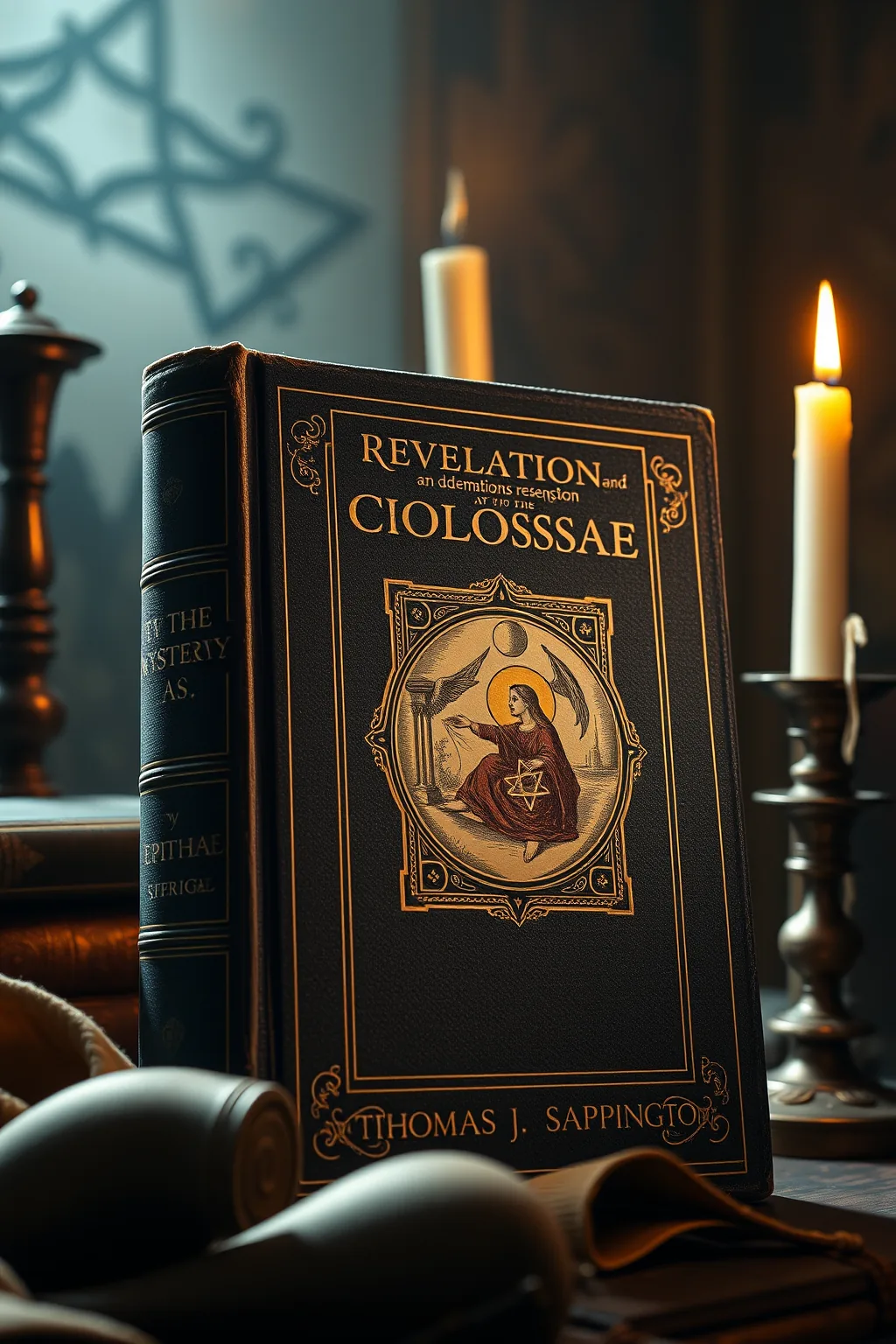
Revelation and redemption at Colossae
 78
78

Revelation and redemption at Colossae
Thomas J. Sappington’s "Revelation and Redemption at Colossae" presents a rigorous academic dissection of the Epistle to the Colossians. The book’s strength lies in its meticulous engagement with textual criticism and its contextualization within the complex religious landscape of 1st-century Asia Minor. Sappington’s exploration of the "elements of the world" (stoicheia) offers a nuanced understanding of the specific threats the author of Colossians sought to counter. However, the prose can occasionally become dense, requiring sustained concentration from the reader. A notable passage that exemplifies Sappington’s detailed approach is his analysis of the Christological claims in chapter 1, which he argues were formulated to establish Christ’s sovereignty over emergent, localized spiritual cults. This work provides a solid, if demanding, contribution to understanding the Epistle. Sappington’s analysis provides significant scholarly value for those engaged in deep textual study.
📝 Description
78
Thomas J. Sappington's 1993 study scrutinizes the Epistle to the Colossians for hidden theological meanings.
Published in 1993, Revelation and Redemption at Colossae by Thomas J. Sappington examines the theological and philosophical currents that shaped early Christian thought. The book provides a close reading of the Epistle to the Colossians, aiming to uncover layers of meaning often missed in standard interpretations. Sappington's work is situated within the academic discourse of the late 20th century, engaging with scholarship on Pauline epistles and the Gnostic movements that drew considerable academic interest during that period. The research reflects a broader trend in the early 1990s toward investigating the social and ideological factors influencing the formation of Christian doctrine, with Sappington contributing by re-examining the Colossian text. The analysis focuses on interpreting the Epistle, particularly its potential critique of syncretistic religious practices found in the 1st-century Roman province of Asia Minor. The book discusses concepts such as the 'elements of the world' (stoicheia), Christ's supremacy, and the cosmology presented in the text.
This study engages with the historical context of early Christianity, a period where diverse philosophical and religious ideas converged. The Epistle to the Colossians itself has been a point of discussion for those interested in how nascent Christian communities interacted with or resisted prevailing Hellenistic and Gnostic currents. Sappington's work contributes to understanding how texts from this formative era can be read for their implications beyond conventional theological exegesis, touching on themes of cosmic powers and spiritual authorities that resonate with esoteric traditions seeking deeper realities.
💡 Why Read This Book?
• Gain a nuanced understanding of the "elements of the world" (stoicheia) as presented in Sappington's analysis of the Colossian context, clarifying potential early Gnostic influences. • Appreciate the specific Christological arguments within the Epistle to the Colossians, as detailed by Sappington, which aimed to establish Christ's supremacy in the 1st century. • Examine the historical and intellectual milieu of 1st-century Asia Minor, understanding the syncretistic religious practices that informed the Epistle's composition.
⭐ Reader Reviews
Honest opinions from readers who have explored this book.
❓ Frequently Asked Questions
What specific historical period does Revelation and Redemption at Colossae focus on?
The book primarily focuses on the 1st-century Roman province of Asia Minor, examining the religious and philosophical landscape that influenced the writing of the Epistle to the Colossians.
What is the main theological debate addressed in the book?
The book addresses debates surrounding Christology and the Epistle to the Colossians' polemic against syncretistic religious practices and early forms of heresy.
Who was Thomas J. Sappington?
Thomas J. Sappington is the author of Revelation and Redemption at Colossae, first published in 1993, known for his scholarly work on early Christian texts.
What does the term 'stoicheia' refer to in the context of this book?
In Sappington's work, 'stoicheia' refers to the 'elements of the world,' interpreted as fundamental spiritual powers or principles that early Christians were cautioned against.
Is this book suitable for general readers or primarily for academics?
While accessible to dedicated general readers interested in early Christianity, the book's dense textual analysis and scholarly approach make it particularly suited for academics and advanced students.
What is the primary source text examined in Revelation and Redemption at Colossae?
The primary source text meticulously examined is the Epistle to the Colossians, a New Testament letter attributed to the Apostle Paul.
🔮 Key Themes & Symbolism
Christological Supremacy
The work meticulously dissects the Epistle to the Colossians' powerful assertions of Christ's preeminence over all cosmic powers and principalities. Sappington examines how the author presents Jesus not merely as a historical figure but as the ultimate mediator and creator, intended to counter any competing spiritual hierarchies or deified rulers that emerged in the diverse religious milieu of 1st-century Asia Minor. This theme is central to understanding the early Church's struggle to define Christ's unique role and authority amidst a complex spiritual landscape.
Gnostic and Syncretistic Threats
A significant focus is placed on the potential influence of Gnostic or syncretistic philosophies on the Colossian church. Sappington explores the author's polemic against practices that may have involved veneration of angels, adherence to Jewish legalistic traditions, and an ascetic lifestyle, all of which were seen as diverting devotion from Christ. The book argues that the Epistle was a direct response to these burgeoning spiritual systems, seeking to anchor believers in a pure, Christ-centered faith.
The 'Elements of the World'
Sappington provides a detailed exegesis of the phrase 'elements of the world' (stoicheia tou kosmou). This concept is explored not merely as basic teachings, but as potentially referring to elemental spirits, cosmic forces, or foundational principles of a pre-Christian worldview. Understanding this concept is crucial for grasping the perceived dangers of the spiritual currents the Epistle sought to refute and redirect believers away from.
Redemption through Christ
The theme of redemption is examined through the lens of Christ's atoning sacrifice and his role in reconciling humanity to God. Sappington analyzes how the Epistle portrays salvation as a gift received through faith in Christ, rather than through adherence to specific rituals or the appeasement of intermediary spiritual entities. This highlights the transformative power of the Christian message in offering liberation from the perceived spiritual bondage of the era.
💬 Memorable Quotes
Direct passages from the work, attributed to the author.
“Christ's supremacy is asserted over all cosmic powers.”
— This concept underscores the central Christological claims Sappington analyzes, emphasizing how the Epistle positioned Jesus as the ultimate authority in the spiritual and cosmic order.
“The 'elements of the world' represented dangerous spiritual forces.”
— This interpretation focuses on Sappington's examination of a key term, suggesting these 'elements' were seen as competing spiritual authorities that believers needed to reject.
“Hellenistic influences shaped early Christian discourse.”
— This interpretation points to Sappington's contextualization of the Epistle within the broader intellectual and religious currents of the Hellenistic world, acknowledging their impact on theological formulation.
💡 Key Ideas
Editorial paraphrase of the work's core concepts — not direct quotes.
The Epistle to the Colossians addresses specific threats to the nascent Christian community.
This paraphrase highlights the book's core argument: that Sappington views the Epistle not as a general theological treatise, but as a targeted response to particular spiritual dangers present in 1st-century Asia Minor.
Redemption is understood as a direct result of Christ's work.
This paraphrase captures the book's focus on the salvific nature of Christ's actions, contrasting it with other systems of spiritual attainment or appeasement.
🌙 Esoteric Significance
Tradition
While Sappington's work is grounded in historical-critical scholarship, its focus on hidden meanings and the spiritual forces described in the Epistle to the Colossians places it adjacent to esoteric traditions. It engages with themes often explored in Gnosticism and Hermeticism, particularly the idea of hidden knowledge (gnosis) and the structure of celestial hierarchies. The book can be seen as an academic exploration of the very esoteric currents the Epistle sought to address or reframe within a Christocentric cosmology.
Symbolism
The Epistle, as analyzed by Sappington, contains potent symbolism. The 'elements of the world' (stoicheia) can be interpreted esoterically as the lower cosmic forces or planetary spheres that exert influence. Christ's supremacy over these 'elements' symbolizes the ultimate liberation from astrological determinism and elemental spiritual bondage. The cross itself, implicitly, becomes a symbol of victory over these forces, representing a spiritual technology for overcoming the material and psychic limitations of the mundane world.
Modern Relevance
Contemporary thinkers in comparative religion and esoteric studies, particularly those interested in the historical roots of Gnosticism and early Christian mystical traditions, find value in Sappington's detailed exegesis. His work informs discussions on the development of Christology and the perennial philosophical questions about humanity's place in the cosmos. Modern practitioners of Western esotericism might use Sappington's analysis to understand the symbolic language and spiritual challenges faced by early believers, drawing parallels to contemporary spiritual seeking.
👥 Who Should Read This Book
• Scholars of New Testament studies and early Christian history seeking rigorous textual analysis of the Epistle to the Colossians. • Students of comparative religion interested in the syncretistic religious environment of 1st-century Asia Minor. • Theologians and philosophers exploring the historical development of Christological doctrines and their engagement with Hellenistic thought.
📜 Historical Context
Published in 1993, Thomas J. Sappington's "Revelation and Redemption at Colossae" emerged during a period of intense scholarly re-evaluation of the Pauline corpus and early Christian origins. The late 20th century witnessed a growing interest in the social-scientific approach to the New Testament and a detailed exploration of the diverse religious range of the Roman Empire. Sappington's work engages with debates surrounding the authorship and context of the Colossian Epistle, particularly its relationship to emergent Gnostic ideas and Jewish mysticism. This era saw scholars like Elaine Pagels re-examining the social implications of early Christian beliefs, and Sappington contributes by focusing on the theological polemics within a specific text. While not explicitly censored, works challenging traditional interpretations of biblical texts often faced scholarly critique, and Sappington's rigorous textual analysis aimed to contribute to this ongoing academic conversation, distinguishing itself from purely devotional interpretations.
📔 Journal Prompts
The Epistle's assertion of Christ's supremacy over cosmic powers.
The concept of the 'elements of the world' (stoicheia).
Early Christian responses to syncretistic religious practices.
The specific theological challenges faced by the Colossian church.
Christ's role in reconciling humanity to God as presented in the Epistle.
🗂️ Glossary
Epistle to the Colossians
A book within the New Testament, traditionally attributed to the Apostle Paul, addressed to the church in Colossae, dealing with Christology and heresy.
Christology
The branch of Christian theology concerned with the nature, person, and work of Jesus Christ.
Syncretism
The merging of different religions, cultures, or schools of thought.
Stoicheia
A Greek term translated as 'elements' or 'rudiments,' interpreted in the Epistle to the Colossians as potentially referring to cosmic powers or foundational spiritual principles.
Gnosticism
A complex and diverse set of religious ideas and systems, originating in the 1st to 3rd centuries AD, emphasizing spiritual knowledge (gnosis) for salvation.
Polemic
A strong verbal or written attack on someone or something.
Exegesis
Critical explanation or interpretation of a text, especially of the Bible.
🔮 Readers Also Liked
Browse all →









More by Thomas J. Sappington
All books →

More Free Occult Philosophy Books
View all →