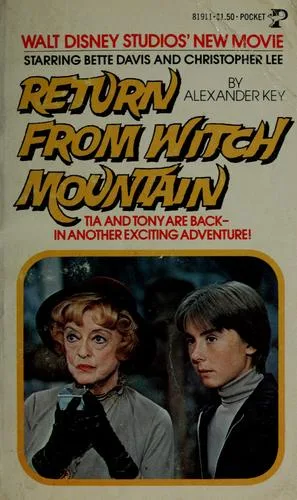
Return from Witch Mountain
 72
72

Return from Witch Mountain
Alexander Key and Malcolm Marmorstein's Return from Witch Mountain presents a compelling, if somewhat dated, vision of a future grappling with the ethics of human augmentation. The novel's strength lies in its earnest portrayal of the children's struggle for acceptance, particularly their inherent sense of justice and their capacity for deep connection, even when faced with systemic oppression. The narrative’s focus on the children’s perspective offers a unique lens through which to view a world that fears and misunderstands them. However, the pacing can occasionally feel uneven, and some of the societal constructs, while relevant to the 1980s, lack the nuanced development that might fully engage a contemporary reader. A particularly striking element is the depiction of the children's innate telepathic abilities as a natural extension of their engineered existence, rather than a supernatural endowment. Ultimately, Return from Witch Mountain offers a thought-provoking exploration of belonging and identity within a scientifically controlled society.
📝 Description
72
Alexander Key and Malcolm Marmorstein's 1984 novel Return from Witch Mountain concerns genetically engineered children fleeing control.
Published in 1984, Return from Witch Mountain envisions a future where humanity's pursuit of advancement has created complex ethical quandaries. The story follows a group of children, engineered for superior abilities, as they escape a rigid society in search of safety and acceptance. Their flight forces them to confront questions of identity, worth, and the fear of the unknown.
The narrative questions the very idea of 'specialness,' presenting it not as innate but as a result of deliberate manipulation. This raises critical issues about what defines an individual and their inherent value. The book contrasts the drive for conformity with the desire for individuality, showing a society that reacts with fear and attempts to suppress what it does not comprehend. The children's journey becomes one of self-understanding, seeking a place where their distinct traits are recognized as valuable rather than dangerous.
While presented as science fiction, Return from Witch Mountain touches upon esoteric themes concerning human potential and societal evolution. The engineered children represent a form of 'awakened' or altered consciousness, distinct from the 'normal' population. Their struggle mirrors esoteric ideas about individuals who transcend conventional limitations, often facing persecution from a society unprepared for their advanced state. The book implicitly asks whether humanity is destined for a controlled, homogenous future or a path of diverse, perhaps difficult, self-discovery and growth.
💡 Why Read This Book?
• Gain insight into the societal implications of genetic manipulation, as depicted in the children's struggle for autonomy and recognition, a concept explored extensively in the novel's 1984 publication context. • Experience a narrative that contrasts engineered abilities with innate morality, examining how characters like Anya and Tony strive for a just existence despite their origins. • Understand the challenges of societal integration for those perceived as 'other,' exemplified by the children's flight from a world that seeks to control their unique genetic makeup.
⭐ Reader Reviews
Honest opinions from readers who have explored this book.
❓ Frequently Asked Questions
When was Return from Witch Mountain first published?
Return from Witch Mountain was first published in 1984, a period marked by significant advancements in genetic science and related ethical discussions.
What are the main themes explored in Return from Witch Mountain?
The novel primarily explores themes of genetic engineering, societal control, individuality versus conformity, and the search for belonging, all viewed through the experiences of genetically advanced children.
Are there any specific characters readers should pay attention to?
Key characters include Anya and Tony, two of the genetically engineered children whose escape and journey form the core of the narrative, alongside other children with unique abilities.
What is the primary conflict in the story?
The central conflict arises from the children's escape from a society that seeks to exploit or control their genetic enhancements, and their subsequent quest for freedom and acceptance.
Does the book offer a hopeful outlook on genetic advancement?
The book presents a nuanced view, highlighting the ethical dangers of unchecked scientific ambition while also suggesting that unique abilities, when coupled with empathy, can lead to positive outcomes.
Is Return from Witch Mountain suitable for younger readers?
While featuring young protagonists, the themes of societal control and genetic ethics are complex and might be more suited for young adults and adults rather than very young children.
🔮 Key Themes & Symbolism
Genetic Engineering's Ethical Maze
The novel confronts the ethical quandaries of genetic engineering, presenting a future where humanity has the power to design children with enhanced abilities. This power, however, is wielded by an authority that views these individuals as tools or threats rather than sentient beings. The narrative questions the morality of creating life with specific traits and the responsibility that comes with such scientific prowess, highlighting the potential for exploitation and the dehumanization of the engineered. The children's very existence sparks a debate about natural versus artificial life and the rights afforded to each.
Societal Control and Fear of the 'Other'
Return from Witch Mountain vividly portrays a society built on control, where deviation from the norm is met with suspicion and suppression. The genetically advanced children, with their unique capabilities, represent the ultimate 'other' in this rigid system. Their escape and pursuit underscore the theme of a populace fearful of what it doesn't understand, leading to attempts to contain or eliminate perceived threats. This reflects broader anxieties about social conformity and the dangers of authoritarianism that seek to homogenize populations.
The Quest for Belonging and Identity
At its heart, the story is about the fundamental human need to belong and understand one's identity. The children, aware of their engineered origins, grapple with who they are beyond their genetic code. Their journey is a search for a place where they are accepted for themselves, not judged by their abilities or their creators' intentions. This quest for a true home and a sense of self challenges the notion that identity is solely determined by external factors or genetic blueprints, emphasizing internal experiences and relationships.
Innate Morality Versus Engineered Purpose
A significant theme is the conflict between the purpose for which the children were engineered and their own developing moral compass. Despite their artificial origins, they exhibit a strong sense of justice, compassion, and loyalty. This contrasts sharply with the cold, calculating motives of those who created and sought to control them. The book suggests that true humanity and ethical grounding are not solely a matter of biology or design but emerge from experience, empathy, and conscious choice, questioning whether purpose can be dictated.
💬 Memorable Quotes
Direct passages from the work, attributed to the author.
“Their minds were not like ours, but they were minds.”
— This statement highlights the novel's core argument: that 'different' does not equate to 'lesser.' It challenges the reader to consider the nature of consciousness and intelligence, suggesting that it can manifest in forms beyond conventional human understanding, regardless of origin.
“Fear makes people do strange things.”
— This interpretation reflects a recurring idea in the book, suggesting that the antagonists' actions are driven by fear of the unknown and the children's unique abilities. It points to fear as a primary motivator for control and persecution.
“Finding a place where you are not hunted is its own kind of freedom.”
— This captures the essence of the children's journey. Their quest is not just for safety but for a fundamental liberty – the freedom to exist without constant threat, implying that security is a prerequisite for true self-expression.
“They learned that even in a world of science, some things could not be programmed.”
— This interpretation emphasizes the emergent, unpredictable qualities of the children's humanity. It suggests that empathy, connection, and a sense of justice are not simply biological functions but aspects that develop organically, defying purely scientific design.
💡 Key Ideas
Editorial paraphrase of the work's core concepts — not direct quotes.
We are not tools. We are children.
This paraphrased sentiment captures the children's plea for recognition of their personhood. It directly confronts the idea that their engineered nature makes them mere instruments for others' purposes, asserting their inherent right to individuality and autonomy.
🌙 Esoteric Significance
Tradition
While not strictly aligned with a single esoteric tradition, Return from Witch Mountain touches upon themes resonant with Gnosticism and certain branches of modern occultism that explore the concept of 'special' souls or engineered beings with unique destinies. It departs from traditional lineage by grounding these concepts in explicit scientific manipulation rather than divine or cosmic intervention, offering a secularized interpretation of exceptionalism and inherent knowledge.
Symbolism
The children themselves symbolize humanity's future potential, both for self-destruction and transcendence, shaped by scientific endeavor. Their telepathic abilities can be seen as a metaphor for expanded consciousness or collective awareness, a concept explored in Theosophy and New Age thought. The oppressive society represents the material world or a lower psychic state that fears and attempts to suppress spiritual or intellectual evolution.
Modern Relevance
Contemporary discussions on transhumanism, artificial intelligence, and bioethics echo the novel's central concerns. Thinkers exploring the ethical frameworks for advanced AI or genetically modified organisms might find parallels in the book's exploration of rights and societal integration for non-human or altered intelligences. The novel's critique of fear-driven societal control remains relevant in discussions of technological advancement and social progress.
👥 Who Should Read This Book
• Students of speculative fiction who are interested in the evolution of science fiction themes from the 1980s, particularly concerning bioethics and societal control. • Readers drawn to narratives featuring young protagonists navigating complex ethical landscapes and fighting for their autonomy against oppressive systems. • Individuals curious about fictional explorations of genetic engineering and its potential consequences for identity and societal structure, offering a unique perspective from its 1984 publication date.
📜 Historical Context
Published in 1984, Return from Witch Mountain emerged during a period of intense public and scientific fascination with genetic engineering. The Human Genome Project was gaining momentum, and ethical debates surrounding DNA manipulation, cloning, and artificial life were prominent in both academic circles and popular culture. This era saw science fiction authors like Margaret Atwood (The Handmaid's Tale, 1985) and Ursula K. Le Guin exploring the societal impacts of scientific overreach and control. The novel's depiction of engineered children resonated with contemporary anxieties about the potential for science to create beings with rights and societal implications that were not yet fully understood. While not facing specific censorship, the book tapped into a broader cultural conversation about the boundaries of scientific inquiry and the definition of humanity.
📔 Journal Prompts
The children's engineered abilities and their struggle for acceptance.
Reflect on the societal fear of the 'other' as depicted in the novel.
The contrast between programmed purpose and emergent morality.
Consider the concept of 'belonging' for individuals with unique origins.
Anya and Tony's journey towards self-definition.
🗂️ Glossary
Genetic Engineering
The direct manipulation of an organism's genes using biotechnology. In the novel, this is used to create children with enhanced physical and mental capabilities, raising ethical questions about its application.
Specialness
A term used within the narrative to describe the unique, enhanced qualities of the children, often perceived as a threat by the controlling society.
Autonomy
The right or condition of self-governance. The children's primary goal is to achieve autonomy from the authorities who seek to control them.
Conformity
Behavior in accordance with socially accepted conventions or standards. The novel contrasts the children's individuality with the pressure to conform to societal norms.
Telesthesia
A term that could be interpreted as a form of enhanced perception or telepathic ability, possessed by some of the engineered children in the story.
Societal Control
Mechanisms and practices used by a society or government to regulate individual and group behavior. This is a central theme, with the authorities attempting to control the genetically modified children.
Identity
The qualities, beliefs, personality, looks and/or expressions that make a person or group. The children grapple with their identity, questioning whether it is defined by their creators or themselves.
🔮 Readers Also Liked
Browse all →









More Free Occult Philosophy Books
View all →