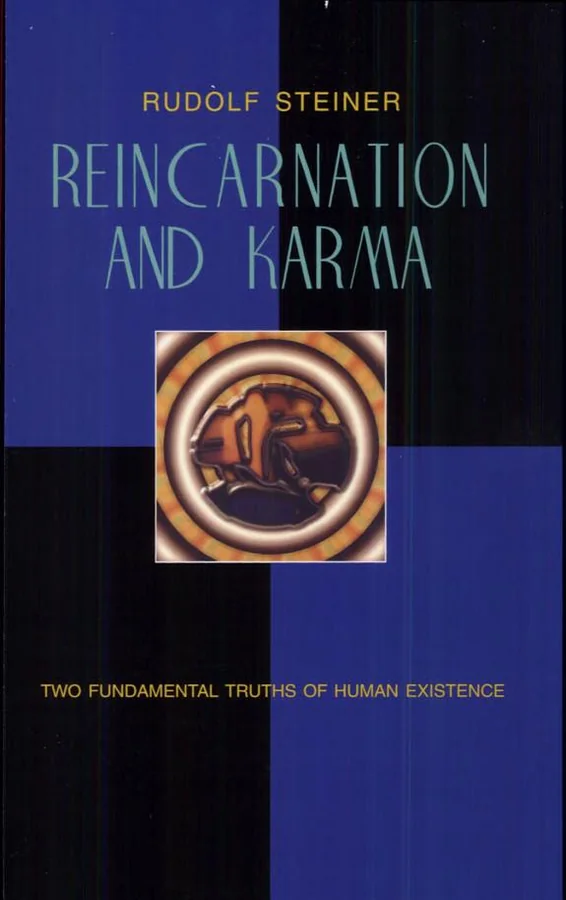
Reincarnation and Karma
 72
72

Reincarnation and Karma
Steiner's "Reincarnation and Karma" offers a systematic, if dense, exposition of his spiritual scientific understanding of existence. Unlike the more poetic explorations of reincarnation found in popular literature, Steiner provides a rigorous, almost forensic, breakdown of the mechanics of karma and rebirth. His assertion in the 1912 lectures that "our own age is ready for the ideas of reincarnation and karma to be brought into the general consciousness of humanity" feels prescient, yet his specific descriptions can be challenging for the uninitiated. The limitation here lies in the sheer density of his conceptual framework, which requires significant prior engagement with Anthroposophy for full comprehension. A particular strength is his methodical approach to the 'Etheric Body' and its role in memory across lifetimes, a concept elaborated with typical Steinerian precision. Ultimately, it serves as a foundational text for understanding his complex cosmology.
📝 Description
72
Rudolf Steiner delivered five lectures on reincarnation and karma in early 1912.
Rudolf Steiner's "Reincarnation and Karma" presents five lectures given in Berlin and Stuttgart between January and March 1912. The collection, cataloged as 135, aimed to introduce fundamental ideas about reincarnation and karma to a broader audience. Steiner suggested that the modern era was ready for these concepts, much like past eras accepted discoveries in astronomy. These lectures detail the evolution and transformation of individuals across lifetimes, forming a systematic approach to spiritual science.
This book is for those seeking a structured intellectual understanding of life beyond a single existence. It will appeal to readers interested in the ethical and causal relationships that shape human experience, particularly within Anthroposophy. Students of spiritual science and individuals contemplating destiny and personal responsibility will find value in Steiner's detailed explanations of spiritual processes and their impact on human evolution.
These lectures were given during a period of significant spiritual and intellectual exploration in Europe, with Anthroposophy emerging as a distinct movement. The broader cultural atmosphere showed interest in theosophy, spiritualism, and Eastern philosophies, making the Western engagement with karma and rebirth a notable development. Steiner's work offered a specific, individualized perspective and a detailed cosmology, setting it apart from other spiritual currents of the time. These talks were part of his larger project to articulate a spiritual scientific view of humanity and the universe.
💡 Why Read This Book?
• Gain a methodical framework for understanding life's continuity, moving beyond vague notions of past lives by engaging with Steiner's detailed descriptions of the Etheric Body's role in memory, as presented in the 1912 lectures. • Explore the ethical implications of cause and effect through Steiner's specific articulation of how actions in one incarnation directly influence future circumstances, offering a practical spiritual science perspective. • Understand your personal evolution within a broader cosmic context by examining Steiner's concepts of successive incarnations and spiritual transformation, as detailed in Collection 135.
⭐ Reader Reviews
Honest opinions from readers who have explored this book.
❓ Frequently Asked Questions
What is the primary focus of Rudolf Steiner's "Reincarnation and Karma"?
The book focuses on presenting a detailed, scientific understanding of reincarnation and karma, aiming to integrate these concepts into general human consciousness. It offers concrete descriptions of individual transformation across successive lives.
When and where were the lectures in "Reincarnation and Karma" originally given?
The five lectures were delivered in Berlin and Stuttgart between January and March of 1912, forming Collection 135 in Rudolf Steiner's collected works.
Does Steiner provide practical exercises for understanding karma?
While the lectures focus on intellectual and spiritual understanding, they lay the groundwork for practical application by explaining the causal connections between actions and their consequences across lifetimes, encouraging conscious awareness.
How does Steiner's view of karma differ from common interpretations?
Steiner presents karma not as fatalistic punishment but as a spiritual-scientific law of cause and effect that individuals actively shape through their choices, emphasizing personal responsibility and evolutionary development.
Is prior knowledge of Anthroposophy necessary to read this book?
While not strictly necessary, some familiarity with Anthroposophical concepts can enhance understanding, as Steiner builds upon a comprehensive spiritual scientific worldview. However, the book stands as an introduction to these core ideas.
What is the significance of the Copernican theory mentioned in the book's introduction?
Steiner uses the analogy of the Copernican revolution to illustrate how readily accepted scientific paradigms can shift. He suggests humanity is now prepared to accept reincarnation and karma as fundamental truths, akin to the shift in understanding our place in the cosmos.
🔮 Key Themes & Symbolism
Spiritual Evolution of Consciousness
Steiner frames reincarnation and karma as fundamental mechanisms driving the evolution of human consciousness. He details how souls undertake successive incarnations to learn specific lessons and develop faculties, moving from simpler forms of awareness to more complex spiritual understanding. The process is not random but guided by spiritual laws, with each life presenting opportunities for growth and refinement of the human spirit.
The Mechanics of Karma
This work elaborates on karma as a precise law of cause and effect, extending beyond simple retribution. Steiner explains how actions, thoughts, and intentions create karmic consequences that manifest in future lives. He introduces concepts like the 'Etheric Body' as the vehicle for carrying karmic imprints, illustrating how past deeds shape present circumstances and future destinies in a complex, interwoven pattern.
Transformation Across Incarnations
Steiner provides concrete descriptions of how individuals transform through multiple lifetimes. He outlines the stages of development, the challenges faced, and the spiritual forces at play. The emphasis is on the soul's continuous journey, shedding old forms and acquiring new capacities, driven by an inherent impulse towards self-perfection and spiritual realization.
Anthroposophical Cosmology
The lectures are situated within Steiner's broader Anthroposophical framework, which views the human being as a complex spiritual entity. This perspective integrates the physical, soul, and spirit realms, explaining the interplay between earthly existence and the spiritual world. Concepts like the evolution of consciousness and the workings of karma are presented as integral parts of this comprehensive cosmological vision.
💬 Memorable Quotes
Direct passages from the work, attributed to the author.
“Just as an age was once ready to receive the Copernican theory of the universe, so is our own age ready for the ideas of reincarnation and karma to be brought into the general consciousness of humanity.”
— This statement highlights Steiner's belief that the historical moment was ripe for a widespread intellectual and spiritual acceptance of reincarnation and karma, comparing it to the rethinking brought about by Copernicus's heliocentric model.
“The lectures offer concrete descriptions of the way individuals transform during the course of successive incarnations.”
— This indicates that Steiner moves beyond abstract theory, providing specific details and explanations about the processes of personal change and development that occur across multiple lifetimes.
“Steiner introduced the West to his detailed, scientific knowledge of reincarnation and karma.”
— This statement positions Steiner's work as a significant contribution to Western thought, presenting his views on these Eastern-influenced concepts with a method he characterized as 'spiritual science'.
“The lectures were delivered in Berlin and Stuttgart in early 1912.”
— This factual quote grounds the origin of the material in specific historical and geographical details, providing context for the lectures' delivery and initial reception.
💡 Key Ideas
Editorial paraphrase of the work's core concepts — not direct quotes.
The work explores the specific nature of the Etheric Body and its function in retaining memory across lifetimes.
This paraphrased concept emphasizes a key element of Steiner's teaching: the Etheric Body as the energetic substratum that holds and transmits experiences, enabling a form of continuity and memory beyond physical death.
🌙 Esoteric Significance
Tradition
Steiner's work belongs to the Western Esoteric Tradition, specifically within the lineage of Spiritual Science and Anthroposophy, which he founded. While drawing inspiration from Gnosticism, Hermeticism, and Eastern philosophies (particularly Hinduism and Buddhism regarding karma and rebirth), Steiner sought to create a modern, scientifically-oriented path. His approach departs from earlier esoteric systems by focusing on the direct, conscious experience and development of spiritual faculties by the individual, aiming for a verifiable, empirical study of the spiritual world.
Symbolism
A key symbolic element is the concept of the 'Etheric Body,' representing the vital, life-giving forces and the vehicle for karmic memory. Another motif is the 'spiritual hierarchy,' representing organized spiritual beings who guide cosmic and human evolution. The cyclical nature of 'successive incarnations' itself serves as a potent symbol for learning, growth, and the unfolding destiny of the human soul through recurring earthly experiences.
Modern Relevance
Steiner's concepts of karma and reincarnation continue to influence contemporary esoteric thought, spiritual psychology, and alternative education. Thinkers and practitioners in fields like Waldorf education, biodynamic agriculture, and various forms of spiritual healing draw upon his ideas. His detailed cosmology provides a framework for understanding consciousness, ethics, and human development that appeals to those seeking a holistic, spiritual perspective in the 21st century.
👥 Who Should Read This Book
["• Students of Anthroposophy: To gain a foundational understanding of Steiner's core teachings on reincarnation and karma as presented in the early 20th century.", '• Researchers of Esoteric History: To examine how concepts of karma and rebirth were presented and integrated into a distinct Western spiritual movement.', "• Individuals exploring life's purpose and causality: To find a structured, spiritual-scientific perspective on the relationship between actions, consequences, and personal growth across lifetimes."]
📜 Historical Context
Delivered in 1912, these five lectures by Rudolf Steiner occurred during a vibrant period for spiritual inquiry in Europe. Steiner, having broken with the Theosophical Society to found his own movement, Anthroposophy, was actively disseminating his unique spiritual scientific worldview. The era was marked by a widespread fascination with spiritualism, Eastern religions, and esoteric philosophies, a stark contrast to the prevailing materialism. Steiner's approach distinguished itself through its emphasis on rigorous, albeit spiritual, observation and detailed cosmology, differentiating it from more generalized spiritual movements. Contemporaries like Annie Besant were popularizing Eastern concepts, but Steiner offered a more individualized, psychologically detailed path. His lectures aimed to establish reincarnation and karma not as mere beliefs, but as demonstrable laws of spiritual evolution, challenging the dominant scientific paradigms of the time and met with significant interest from those seeking a spiritual counterpoint to scientific materialism.
📔 Journal Prompts
The Etheric Body's role in karmic memory.
Experiences of transformation across successive incarnations.
The readiness of the modern age for reincarnation and karma.
Rudolf Steiner's scientific approach to the spiritual.
The relationship between actions and future consequences.
🗂️ Glossary
Karma
In Steiner's context, karma is understood as a precise spiritual-scientific law of cause and effect governing the moral and spiritual development of human beings across multiple lifetimes.
Reincarnation
The process whereby the spiritual individuality of a human being lives through successive earthly existences, each offering unique opportunities for learning and evolution.
Etheric Body
Also known as the life or formative body, it is the energetic counterpart to the physical body, responsible for life processes, growth, and, crucially, for carrying karmic imprints and memories across incarnations.
Spiritual Science
Rudolf Steiner's term for his method of investigating the spiritual world through disciplined consciousness, aiming for verifiable, repeatable results akin to natural science.
Incarnation
The process of a spiritual being taking on a physical form and human consciousness within a specific earthly life.
Anthroposophy
The spiritual philosophy founded by Rudolf Steiner, seeking to understand the human being and the universe through spiritual insight and scientific investigation.
Collection 135
The catalog number assigned by the Rudolf Steiner Archive to the specific series of lectures given in Berlin and Stuttgart in early 1912, now published as 'Reincarnation and Karma'.
This book appears in 1 collection
🔮 Readers Also Liked
Browse all →









From the “Karma” Collection
View all →









More Free Occult Philosophy Books
View all →