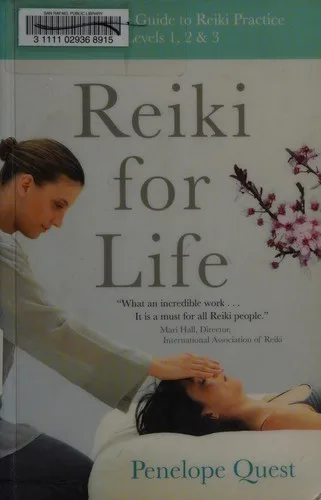
Reiki for life
 72
72

Reiki for life
Penelope Quest's "Reiki for Life" provides a grounded, accessible entry into the world of Usui Reiki. Unlike many texts that lean into overly mystical jargon, Quest offers clear, step-by-step instructions for both self-treatment and working with others. Her explanation of the Five Precepts, for instance, is particularly lucid, framing them as practical ethical guidelines rather than abstract spiritual pronouncements. A potential limitation is that for advanced practitioners already deeply immersed in complex Reiki lineages, the coverage might feel somewhat introductory. However, for the intended audience of beginners and intermediate students seeking a solid foundation, the book excels. The detailed hand-position diagrams are a definite strength, offering visual clarity that text alone cannot provide. Quest’s work stands as a reliable, well-structured manual for those beginning their Reiki journey.
📝 Description
72
Penelope Quest's 2016 book, Reiki for Life, details Reiki's philosophy and practice.
Reiki for Life presents the Japanese energy healing system not just as a method for physical or emotional relief, but as a complete system for personal growth and spiritual advancement. Penelope Quest covers the fundamental principles of Reiki, including specific hand placements and techniques for self-treatment and for assisting others. The book also maps out the different stages of Reiki instruction, from initial learning to more advanced levels. Quest shows readers how to incorporate Reiki energy work into their daily lives to improve overall well-being. It is written for anyone interested in learning or expanding their understanding of Reiki, whether they are new to energy work or have prior experience. The book is also relevant for those studying spiritual traditions, alternative healing methods, or mindfulness, and for individuals focused on self-improvement, stress reduction, and achieving greater life balance.
Published in 2016, Reiki for Life enters a contemporary environment where energy healing practices are more widely accepted. While Mikao Usui established Reiki in the early 20th century, Quest's book connects his teachings to modern wellness concepts. The work acknowledges Usui's lineage and its significant spread in the West after the 1980s, particularly through figures like Hawayo Takata. Quest's perspective shows Reiki evolving from its initial therapeutic use to a recognized spiritual path for many.
💡 Why Read This Book?
• Gain practical, step-by-step guidance on initiating Reiki self-healing practices, directly referencing the foundational hand positions detailed in the book, which are crucial for beginners to grasp. • Understand the core philosophy of Usui Reiki Ryoho, including the Five Precepts, as presented by Quest, offering a framework for integrating spiritual principles into daily life beyond mere technique. • Explore the concept of 'Ki' energy channeling as explained in the book, providing a clear understanding of how Reiki works and its potential for personal well-being and spiritual growth.
⭐ Reader Reviews
Honest opinions from readers who have explored this book.
❓ Frequently Asked Questions
What is the origin of Reiki as presented in Penelope Quest's book?
Penelope Quest's "Reiki for Life" traces Reiki's origins to Mikao Usui, a Japanese Buddhist who developed the system in the early 20th century. The book highlights Usui's intention to create a spiritual path for self-improvement and healing.
How does "Reiki for Life" explain the attunement process?
The book describes attunement as a vital initiation given by a qualified Reiki Master. This process is understood as a way to open the practitioner's energy channels, enabling them to channel Reiki effectively.
What are the Five Precepts of Reiki?
Quest outlines the Five Precepts as ethical guidelines for a Reiki practitioner's life, including 'Just for today, I will not worry,' 'Just for today, I will not anger,' and others, focusing on mindfulness and present-moment living.
Is "Reiki for Life" suitable for someone with no prior energy healing experience?
Yes, the book is specifically designed for beginners. It offers clear explanations of fundamental concepts, hand positions, and self-treatment methods, making it an accessible starting point for newcomers to Reiki.
Can Reiki be used for something other than physical ailments?
Absolutely. Quest emphasizes Reiki's holistic nature, explaining its use for emotional balance, mental clarity, and spiritual development. The book covers its application for overall well-being beyond just physical symptoms.
What is the role of 'Ki' in Penelope Quest's Reiki teachings?
Quest explains 'Ki' as the universal life force energy. Reiki practitioners learn to channel this 'Ki' through their hands to promote healing and balance in themselves and others, as detailed in the book.
🔮 Key Themes & Symbolism
Usui Reiki Principles
The work centers on the foundational principles of Usui Reiki Ryoho, as developed by Mikao Usui. These are often presented as the 'secret of inviting happiness' and the 'spiritual means of inviting sickness.' Quest breaks down these seemingly paradoxical statements, emphasizing that true happiness and health come from spiritual cultivation and aligning one's actions and thoughts with universal principles, rather than passively waiting for good fortune. The book explores how internal states influence external reality, a core tenet of many esoteric practices.
The Five Precepts
A significant portion of the book is dedicated to the Five Precepts, which serve as ethical and mindful guidelines for daily living. These are not merely abstract rules but practical directives for cultivating peace and well-being: 'Just for today, I will not worry,' 'Just for today, I will not anger,' 'Just for today, I will be grateful,' 'Just for today, I will do my work honestly,' and 'Just for today, I will respect all living things.' Quest explains how embodying these precepts aids in energy flow and personal transformation.
Energy Channeling and Hand Positions
Central to the practice of Reiki is the ability to channel universal life force energy, known as 'Ki.' Quest provides detailed explanations and illustrations of the specific hand positions used to direct this energy to oneself or others. These positions correspond to major energy centers and organs, allowing for targeted healing and balancing. The book clarifies the process, making it accessible for beginners to understand the mechanics of energy transfer.
Holistic Healing and Self-Development
Reiki for Life presents a holistic view of healing, extending beyond the physical body to encompass emotional, mental, and spiritual well-being. Quest advocates for Reiki as a path for continuous self-development, encouraging practitioners to integrate its principles into their lives for lasting positive change. The book suggests that by working with Reiki energy, individuals can achieve greater balance, reduce stress, and foster a deeper connection with themselves and the universe.
💬 Memorable Quotes
Direct passages from the work, attributed to the author.
“The secret of inviting happiness is to understand that all things are connected.”
— This concept underscores the interconnectedness of all beings and phenomena, a common theme in esoteric thought. It suggests that our well-being is intrinsically linked to the well-being of the whole, and by fostering positive connections, we invite happiness into our lives.
“Just for today, I will not worry.”
— This precept highlights the importance of present-moment awareness in Reiki practice and in life. By focusing on the 'now,' individuals can release anxieties about the past or future, fostering a sense of peace and enabling energy to flow more freely.
“Reiki is a way of life, not just a technique.”
— This interpretation emphasizes that the principles and energy of Reiki are meant to be integrated into one's daily existence. It suggests a commitment to personal growth and mindful living, where healing and spiritual awareness become ongoing aspects of one's being.
“True healing addresses the root cause, not just the symptoms.”
— This interpretation suggests that Reiki aims for deep, systemic change rather than superficial relief. By working with the underlying energy imbalances, the practice seeks to restore harmony at a fundamental level, leading to more lasting well-being.
💡 Key Ideas
Editorial paraphrase of the work's core concepts — not direct quotes.
The hands are the instruments through which universal energy flows.
This paraphrased concept points to the physical channel through which Reiki practitioners direct energy. It highlights the hands as sacred tools, empowered by intention and the connection to the universal life force, to facilitate healing and balance.
🌙 Esoteric Significance
Tradition
Reiki for Life is rooted in the Esoteric tradition, specifically drawing from Japanese spiritual practices and Mikao Usui's synthesis of various Eastern philosophies. While not strictly Hermetic or Kabbalistic, it shares with these traditions an emphasis on channeling subtle energies for personal transformation and healing. It represents a modern esoteric lineage that seeks to make spiritual principles and practices accessible for everyday well-being and self-discovery, moving beyond purely academic or monastic pursuits.
Symbolism
A key symbol in Reiki, as explored in the book, is the concept of 'Ki' (or 'Qi') itself—the vital life force energy that permeates all existence. The hand positions used in Reiki practice also carry symbolic weight, representing the focused intent and connection points for channeling this energy. The attunement process, a ritualistic initiation, symbolizes the awakening and activation of the practitioner's innate ability to connect with and direct this universal energy.
Modern Relevance
Contemporary thinkers and practitioners in holistic health, mindfulness, and somatic therapies often draw inspiration from or integrate Reiki principles. Schools of energy medicine and alternative healing continue to explore the concepts of vital force and energetic balancing that Quest elucidates. Its emphasis on self-care and stress reduction aligns with modern psychological approaches, making it relevant for those seeking non-pharmacological methods for emotional and mental well-being.
👥 Who Should Read This Book
• Beginners interested in energy healing who seek a clear, practical introduction to the Usui Reiki system and its core principles. • Individuals looking for self-care techniques to manage stress, enhance well-being, and foster personal growth through a spiritual practice. • Holistic health practitioners and students of esoteric traditions wishing to expand their understanding of energy work and its applications for themselves and others.
📜 Historical Context
Penelope Quest's "Reiki for Life," published in 2016, arrived at a time when alternative and complementary therapies had achieved significant mainstream acceptance. While Usui Mikao developed Reiki in Japan in the early 20th century, its widespread adoption in the West largely began in the latter half of that century, notably influenced by figures like Hawayo Takata in the 1970s and 80s. Quest's work sits within this lineage, offering a modern interpretation accessible to a global audience. The book acknowledges the spiritual underpinnings of Usui's system, differentiating it from purely secular wellness trends. It emerged in an era where practices like mindfulness meditation, yoga, and various forms of energy work were increasingly studied and integrated into holistic health approaches, positioning Reiki as a key practice within this evolving landscape.
📔 Journal Prompts
Reflect on the integration of the Five Precepts into your daily interactions.
Consider the concept of 'Ki' and its presence in your environment.
Explore the self-healing hand positions and their energetic effects.
How can the 'spiritual means of inviting sickness' principle inform your current challenges?
Journal about a personal experience of channeling energy, however subtle.
🗂️ Glossary
Ki
The Japanese term for the universal life force energy that flows through all living things. In Reiki, practitioners learn to channel Ki to promote healing and balance.
Attunement
A sacred initiation process performed by a Reiki Master to open a student's energy channels, enabling them to channel Reiki energy effectively. It is considered essential for practicing Reiki.
Reiki Master
A practitioner who has completed the highest level of Reiki training and is qualified to teach Reiki and perform attunements for others.
Five Precepts
Ethical guidelines for living a mindful and harmonious life, central to Usui Reiki practice, focusing on present-moment awareness and positive intention.
Hand Positions
Specific placements of the hands used in Reiki to direct energy to different parts of the body for healing and balancing, both for self-treatment and for others.
Usui Reiki Ryoho
The original system of Reiki healing developed by Mikao Usui, often translated as 'Usui Reiki Healing Method,' emphasizing both spiritual development and physical healing.
Chakra
Energy centers within the subtle body, often discussed in relation to energy healing practices like Reiki, where energy flows and can become blocked or imbalanced.
🔮 Readers Also Liked
Browse all →









More by Penelope Quest
All books →





More Free Occult Philosophy Books
View all →