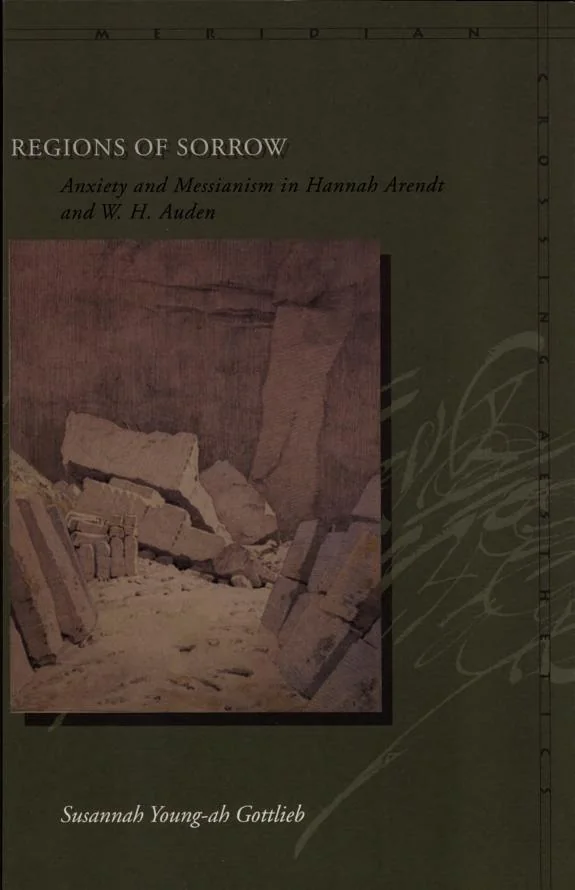
Regions of Sorrow
 81
81

Regions of Sorrow
Susannah Young-ah Gottlieb’s Regions of Sorrow offers a compelling, if dense, argument for the shared philosophical ground between W. H. Auden and Hannah Arendt. The book’s strength lies in its meticulous tracing of thematic parallels, particularly in their mutual engagement with the specter of totalitarianism and the nature of political action. Gottlieb’s exposition of Arendt’s concept of plurality, as mirrored in Auden’s later poetry, provides a nuanced understanding of their post-war intellectual projects. A notable limitation is the academic prose, which can sometimes obscure the emotional core of the writers being discussed. For instance, Gottlieb’s interpretation of Auden’s "September 1, 1939," in light of Arendtian thought, is illuminating, but requires significant reader investment. The work ultimately succeeds in demonstrating a profound, often overlooked, resonance between two crucial 20th-century thinkers.
📝 Description
81
Susannah Young-ah Gottlieb's 2003 book examines the intellectual kinship between W. H. Auden and Hannah Arendt.
Regions of Sorrow analyzes the intellectual connections between poet W. H. Auden and philosopher Hannah Arendt. Gottlieb argues that both figures developed similar responses to the political and social crises of the mid-twentieth century. Despite their different fields, they arrived at a shared understanding of human plurality and its inherent vulnerability. The book places their ideas within the context of World War II and the Holocaust, a period that prompted significant reassessment of Western thought and political structures.
Gottlieb focuses on concepts like the 'insuperable condition of plurality,' which captures their shared view of human existence as fundamentally multiple, and the ethical questions this raises. She also identifies an 'unexpected and inconspicuous messianism' in their work, not in a religious sense, but as a recognition of shared human conditions. The analysis requires some familiarity with Auden's poetry and Arendt's philosophy.
While not overtly occult, this work engages with profound questions about human existence and political realities that resonate within esoteric traditions. The focus on the fragility of human plurality and the search for meaning in times of crisis echoes themes found in existentialist philosophy and certain strains of mystical thought. Gottlieb's examination of Auden and Arendt's intellectual responses to historical trauma offers a framework for understanding how individuals and societies confront overwhelming circumstances, a concern often present in esoteric inquiries into consciousness and collective destiny.
💡 Why Read This Book?
• Gain a distinct perspective on W. H. Auden and Hannah Arendt's shared critique of 20th-century political catastrophes, understanding their "insuperable condition of plurality" as articulated in the post-war era. • Explore the concept of an "unexpected and inconspicuous messianism" as presented by Gottlieb, revealing how Auden and Arendt found meaning in human frailty and contingency, not divine intervention. • Grasp the intellectual context of 2003 when this analysis was first published, situating Gottlieb's scholarship alongside prevailing discussions on totalitarianism and existential thought.
⭐ Reader Reviews
Honest opinions from readers who have explored this book.
❓ Frequently Asked Questions
What is the primary focus of Susannah Young-ah Gottlieb's Regions of Sorrow?
The book examines the intellectual and thematic parallels between the poet W. H. Auden and the philosopher Hannah Arendt, particularly their responses to the catastrophic events of the mid-20th century and their shared ideas on human plurality.
When was Regions of Sorrow first published?
Regions of Sorrow was first published in 2003.
What does Gottlieb mean by 'insuperable condition of plurality'?
This refers to Auden and Arendt's shared philosophical stance that human existence is inherently multiple and diverse, a condition that cannot be overcome and which has significant ethical and political implications.
Does the book discuss W. H. Auden's poetry or Hannah Arendt's philosophy in isolation?
No, the book's central aim is to explore the 'remarkable affinity' between their works, analyzing how their individual writings converge on similar themes and concerns regarding the human condition.
What kind of 'messianism' does the book identify in Auden and Arendt's work?
Gottlieb discusses an 'unexpected and inconspicuous messianism,' not in a religious sense, but as a found grace in human contingency, frailty, and the unpredictable nature of existence.
Who would benefit most from reading Regions of Sorrow?
Scholars, students, and general readers interested in 20th-century literature, philosophy, political theory, and the intellectual responses to historical trauma would find this book valuable.
🔮 Key Themes & Symbolism
Plurality and the Human Condition
The work centrally examines the "insuperable condition of plurality," a concept Gottlieb attributes to both Auden and Arendt. This theme explores the inherent multiplicity and diversity of human beings as a fundamental aspect of existence, particularly in the wake of mid-20th century societal ruptures. It looks at how this irreducible diversity shapes political life and personal meaning, suggesting that attempts to homogenize or control this plurality lead to catastrophe. The esoteric angle lies in recognizing this condition as a form of existential ground, a foundational truth about being that transcends simple social constructs.
Messianism in Contingency
Gottlieb identifies an "unexpected and inconspicuous messianism" within Auden and Arendt's writings. This is not a traditional religious salvation but a form of grace found in the acknowledgment of contingency, human frailty, and the unpredictable nature of life. It suggests that meaning and a sense of the sacred can emerge from embracing imperfection and the spontaneous unfolding of events, rather than from imposing rigid order or seeking absolute certainty. This appeals to certain mystical traditions that find divinity in the imperfect and the ephemeral.
Response to Historical Catastrophe
The book is framed by the catastrophic events of the mid-20th century, such as World War II and the Holocaust. Auden and Arendt are presented as thinkers who grappled directly with the enormity of these phenomena. Their work, as analyzed by Gottlieb, offers a profound reflection on how individuals and societies respond to overwhelming historical trauma. The esoteric significance lies in understanding these historical moments not just as political failures, but as crucible events that reveal deeper truths about human nature and the potential for spiritual insight amidst despair.
Affinity Between Poetry and Philosophy
Regions of Sorrow highlights the remarkable intellectual kinship between a poet, W. H. Auden, and a philosopher, Hannah Arendt. It demonstrates how distinct modes of expression can arrive at similar conclusions about fundamental aspects of human existence. The book implicitly argues for the power of both artistic and philosophical inquiry to apprehend and articulate complex realities. This synthesis underscores an esoteric principle: truth can be accessed and expressed through diverse pathways, be they lyrical or logical, emotional or intellectual.
💬 Memorable Quotes
Direct passages from the work, attributed to the author.
“Auden and Arendt give voice to an unexpected and inconspicuous messianism.”
— This points to a form of redemption or profound meaning found not in grand pronouncements or divine intervention, but in the quiet acknowledgment of life's inherent unpredictability and human vulnerability.
“They sought to respond to the enormity of the novel phenomena they witnessed.”
— This highlights their generation's direct confrontation with unprecedented historical and political events, and their intellectual labor to comprehend and articulate the significance of these experiences.
“The insuperable condition of plurality.”
— This concept underscores the idea that human society is fundamentally composed of distinct, irreducible individuals, and this inherent diversity is a constant, unchangeable aspect of existence that shapes all interactions.
“Messianism in which contingency, frailty, and the unexpected are central.”
— This clarifies that the book's notion of messianism is grounded in accepting the uncertain and imperfect nature of life, finding value and a form of grace within these very limitations.
“The remarkable affinity between their works.”
— This phrase expresses the core thesis of the book: that despite their different disciplines, Auden and Arendt arrived at strikingly similar insights regarding the human condition and its political manifestations.
🌙 Esoteric Significance
Tradition
While not explicitly aligned with a single esoteric lineage, Regions of Sorrow touches upon themes resonant with Gnostic and existentialist traditions. The emphasis on the 'insuperable condition of plurality' and the search for meaning within human frailty echoes Gnostic concerns with the imperfections of the material world and the inherent limitations of human existence. The focus on individual response to historical trauma and the finding of grace in contingency aligns with existentialist thought, which itself has often been a philosophical precursor or parallel to esoteric explorations of the self and its place in the cosmos.
Symbolism
The 'Regions of Sorrow' itself can be interpreted symbolically as the existential field of human suffering and historical trauma. The 'unexpected and inconspicuous messianism' functions as a symbol of immanent grace, suggesting that moments of useful insights or redemption are not found in grand, external miracles, but within the fabric of everyday life, in the acceptance of our shared vulnerabilities and the unpredictable flow of events. The 'affinity' between Auden and Arendt symbolizes the potential for profound connection and shared wisdom across different intellectual disciplines.
Modern Relevance
In contemporary discourse, Gottlieb's analysis of plurality and the human condition remains highly relevant. Thinkers exploring post-identity politics, radical democracy, and the ethics of care often draw upon similar concepts of irreducible difference and the importance of acknowledging human fragility. The book's exploration of finding meaning in contingency offers solace and a framework for reading through the uncertainties of the 21st century, resonating with therapeutic modalities and mindfulness practices that emphasize acceptance and presence. It speaks to contemporary anxieties about societal fragmentation and the search for authentic connection.
👥 Who Should Read This Book
• Scholars of 20th-century literature and philosophy: to deepen their understanding of W. H. Auden and Hannah Arendt, particularly their shared responses to historical crises and their concepts of plurality. • Students of political theory: to gain insight into the philosophical underpinnings of human diversity and its implications for political life, as articulated by Gottlieb's analysis. • Readers interested in existential thought and the search for meaning: to explore how fragility and contingency can be sources of grace and useful insights, as presented in the context of post-war intellectualism.
📜 Historical Context
Published in 2003, Susannah Young-ah Gottlieb’s Regions of Sorrow emerged during a period of renewed interest in 20th-century political thought and its engagement with trauma. The intellectual currents of the time were grappling with the legacies of totalitarianism, the Cold War, and the rise of identity politics. Gottlieb’s work engages directly with the post-war intellectual landscape, particularly the philosophical responses to Nazism and Stalinism. Key contemporaries whose ideas were implicitly or explicitly debated include thinkers like Giorgio Agamben and Slavoj Žižek, who were also re-examining sovereignty and political violence. While not a direct engagement, the book’s focus on Auden and Arendt's profound analysis of human plurality offered a counterpoint to more structuralist or deconstructionist approaches prevalent in some academic circles, emphasizing instead the irreducible human element in political experience. The reception of Arendt's work itself saw significant scholarly attention throughout the late 20th and early 21st centuries.
📔 Journal Prompts
The insuperable condition of plurality as a lens for understanding contemporary social divisions.
Reflecting on Auden and Arendt's 'unexpected and inconspicuous messianism' in moments of personal challenge.
The "novel phenomena" of the mid-20th century and their lingering impact on individual consciousness.
How does the "affinity" between poetry and philosophy illuminate complex human experiences?
Interpreting "Regions of Sorrow" as a metaphor for personal or collective periods of hardship.
🗂️ Glossary
Insuperable Condition of Plurality
A concept suggesting that human existence is fundamentally characterized by irreducible multiplicity and diversity, a state that cannot be overcome and significantly shapes political and social realities.
Unexpected and Inconspicuous Messianism
Gottlieb's term for a form of grace or profound meaning found not through divine intervention, but through the acceptance of life's contingency, human frailty, and unpredictable occurrences.
Novel Phenomena
Refers to the unprecedented historical and political events of the mid-20th century, such as totalitarian regimes and global warfare, which demanded new modes of intellectual and ethical response.
Affinity
In this context, it signifies a deep intellectual and thematic connection or resemblance between the works and ideas of W. H. Auden and Hannah Arendt.
Contingency
The state of being subject to chance or accident; unpredictability. In philosophy, it refers to that which is possible but not necessary.
Frailty
The condition of being weak or delicate; susceptibility to harm or error. In this context, it refers to inherent human vulnerability and imperfection.
Regions of Sorrow
The title itself evokes a metaphorical space or condition defined by suffering, loss, and the difficult realities of the human experience, particularly as shaped by historical events.
This book appears in 1 collection
🔮 Readers Also Liked
Browse all →








From the “Messianism” Collection
View all →









More Free Occult Philosophy Books
View all →