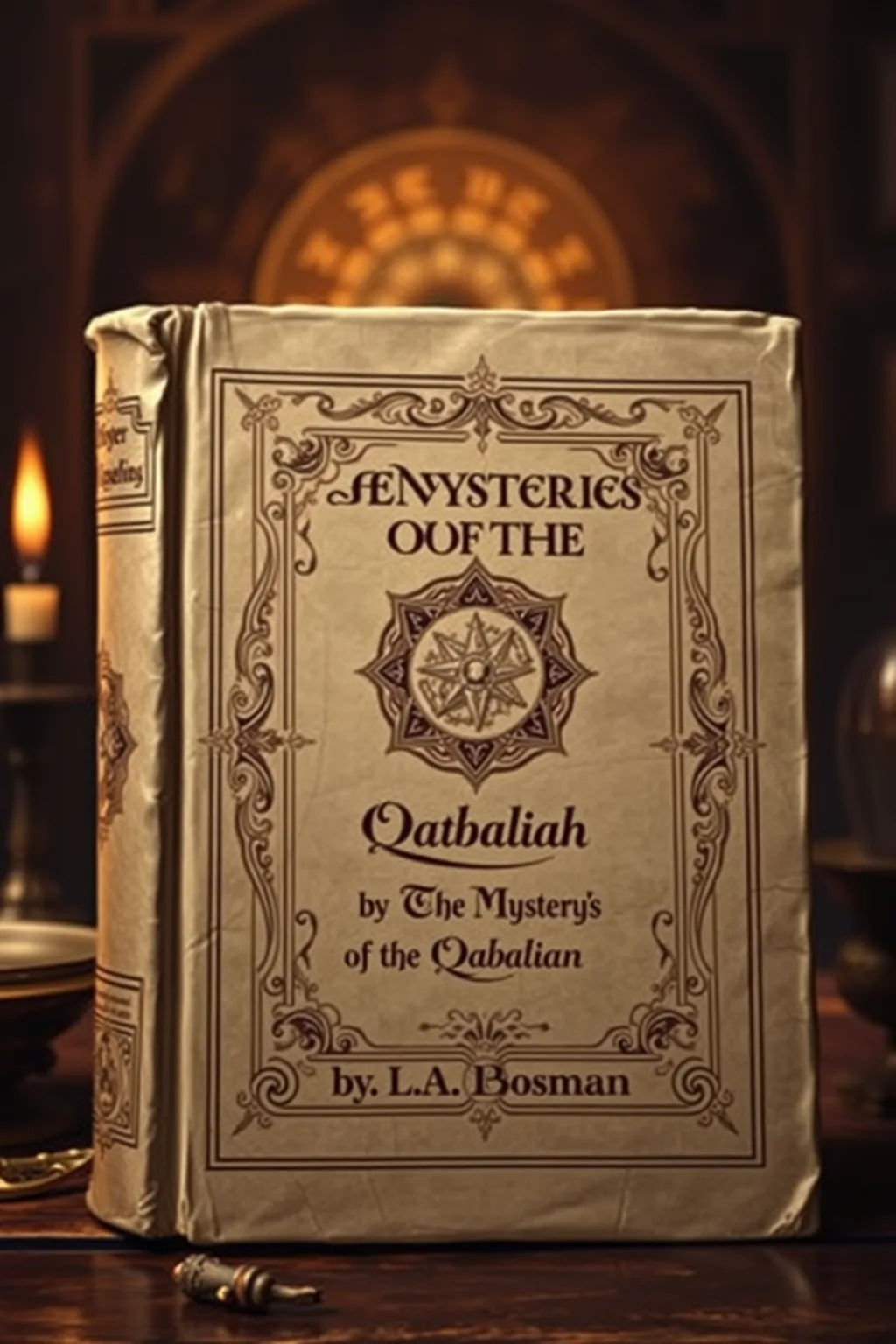
The Mysteries of the Qabalah
 74
74

The Mysteries of the Qabalah
L. A. Bosman's "The Mysteries of the Qabalah" offers a sober, academic approach to a subject often shrouded in speculative obscurity. The strength of this 1913 work lies in its systematic presentation of the Sephiroth and the paths of the Tree of Life, providing a clear, if somewhat dry, cartography of the Kabbalistic cosmos. Bosman avoids the more overtly magical interpretations prevalent in his era, focusing instead on the philosophical and theological underpinnings. However, the book's limitation is its inherent distance from the lived, experiential aspect of Kabbalistic practice. For instance, the discussion of Kether feels more like an intellectual construct than a direct apprehension of the 'Crown.' While the original publication date of 1913 situates it within a fascinating period of esoteric revival, its scholarly tone might not satisfy those seeking practical application or a more mystical narrative. It serves best as a foundational reference for understanding the architecture of Kabbalistic thought.
📝 Description
74
L. A. Bosman's 'The Mysteries of the Qabalah' was first published in 1913.
This book examines the Kabbalistic system, a mystical tradition originating in medieval Jewish thought. Bosman's work, first printed in 1913, seeks to explain the doctrines and symbolic language within Kabbalah. It is aimed at students of Western esotericism, occult philosophy, and comparative religion. Readers interested in a structured introduction to Kabbalistic ideas, especially their historical development and symbolic structures, will find this text useful. It focuses on theoretical foundations rather than practical magical applications.
Published in an era of renewed interest in esoteric ideas, Bosman's study engages with the intellectual currents of the early 20th century. This period saw figures like Aleister Crowley and groups such as the Hermetic Order of the Golden Dawn investigating and blending various mystical systems, including Kabbalah. Bosman's account offers a particular perspective on the Tree of Life and its related concepts, distinct from the more magic-oriented interpretations that were also gaining attention at the time.
Bosman's work emerged in the early 20th century, a time when esoteric traditions were being actively studied and reinterpreted across Europe and North America. This era saw significant figures and organizations, such as Aleister Crowley and the Hermetic Order of the Golden Dawn, engaging with systems like Kabbalah. Bosman's text fits within this milieu, providing a scholarly examination of Kabbalistic concepts, particularly the Tree of Life, situated alongside other concurrent explorations of mystical thought.
💡 Why Read This Book?
• Gain a structured understanding of the Sephiroth and the paths of the Tree of Life, as presented in a scholarly manner distinct from magical grimoires. • Appreciate the Kabbalistic cosmology as it was being systematically studied in the early 20th century, providing historical context for later developments. • Grasp the symbolic importance of the Hebrew alphabet and its letters within the Kabbalistic framework, as explored in Bosman's detailed exposition.
⭐ Reader Reviews
Honest opinions from readers who have explored this book.
❓ Frequently Asked Questions
What is the original publication year of L. A. Bosman's "The Mysteries of the Qabalah"?
The original edition of "The Mysteries of the Qabalah" by L. A. Bosman was first published in 1913, predating many later occult interpretations of Kabbalistic principles.
Does "The Mysteries of the Qabalah" focus on practical magic or theoretical study?
This book primarily focuses on the theoretical and philosophical aspects of Kabbalah, examining its structure, symbolism, and cosmology rather than providing practical magical instructions.
What is the Tree of Life as discussed in the book?
The Tree of Life is a central diagram in Kabbalah, representing the divine emanations (Sephiroth) and the paths connecting them, used to map the cosmos and the path of spiritual development.
Is this book suitable for absolute beginners to esoteric studies?
While informative, the book's scholarly tone and depth may be more suitable for those with some prior exposure to esoteric concepts or comparative religion.
What distinguishes this edition from the original 1913 publication?
This is a new release of the original 1913 edition, meaning it aims to present the content as Bosman originally intended, without later annotations or revisions.
What role does the Hebrew alphabet play in Bosman's explanation of Qabalah?
Bosman explores the Hebrew alphabet's integral role in Kabbalistic interpretation, detailing the mystical significance attributed to its letters and their potential for permutation and symbolic meaning.
🔮 Key Themes & Symbolism
The Ten Sephiroth
The book elaborates on the Sephiroth, the ten fundamental divine attributes or emanations that constitute the structure of the Kabbalistic Tree of Life. Bosman explains each Sephirah, such as Kether (Crown) and Malkuth (Kingdom), detailing their symbolic meanings and their position within the cosmic hierarchy. This systematic exposition is crucial for understanding the Kabbalistic map of creation and divine manifestation, serving as a foundational element for deeper esoteric study.
Paths of the Tree of Life
Central to the Kabbalistic system are the paths that connect the Sephiroth on the Tree of Life diagram. Bosman's work details these pathways, often associated with the Hebrew alphabet and the Tarot trumps. The exploration of these paths reveals the dynamic interplay between the divine emanations, illustrating the process of spiritual ascent and descent. Understanding these connections is key to comprehending the intricate mechanics of the Kabbalistic worldview.
Symbolism of the Hebrew Alphabet
The Hebrew alphabet is not merely a writing system within Kabbalah; it is a profound symbolic language. Bosman's text explores the mystical significance of each Hebrew letter, their numerical values (Gematria), and their potential for permutation. This aspect highlights how the very structure of the divine language is seen as a blueprint for reality, offering a method for interpretation and a key to unlocking deeper layers of meaning within the Kabbalistic tradition.
Cosmological Framework
The Mysteries of the Qabalah outlines a specific cosmological model derived from Kabbalistic thought. This framework explains the emanation of the universe from the Ein Sof (the Infinite) through the Sephiroth. Bosman presents this structure as a means to comprehend the relationship between the divine and the manifest world, providing readers with a conceptual map of existence as understood within this esoteric tradition.
💬 Memorable Quotes
Direct passages from the work, attributed to the author.
“The Sephiroth are the ten divine emanations which form the basis of the Kabbalistic Tree of Life.”
— This statement captures the core structural element of Kabbalah, identifying the Sephiroth as fundamental divine attributes through which creation manifests and the cosmos is understood.
“Each path connecting the Sephiroth holds its own unique symbolic meaning and correspondence.”
— This highlights the dynamic nature of the Tree of Life, emphasizing that the connections (paths) between the divine emanations are as significant as the emanations themselves for Kabbalistic interpretation.
“The Hebrew alphabet serves as a key to unlocking deeper Kabbalistic mysteries.”
— This points to the integral role of Hebrew letters, their numerical values, and their permutations as tools for esoteric interpretation and understanding within the Kabbalistic system.
“Kabbalistic cosmology maps the descent of divine energy into the material world.”
— This interpretation explains the purpose of the Kabbalistic worldview as a framework for understanding how the infinite divine principle expresses itself through a structured, hierarchical emanation into existence.
“Understanding the Qabalah requires attention to its intricate symbolic language.”
— This emphasizes that Kabbalah is not a literal philosophy but a symbolic system, where understanding the meaning behind symbols, diagrams, and correspondences is paramount for grasping its teachings.
🌙 Esoteric Significance
Tradition
This work is firmly rooted in the Western Esoteric tradition, specifically concerning the Kabbalistic lineage. It engages with the Neoplatonic and Hermetic influences that have shaped Kabbalistic interpretation since the Renaissance, particularly through texts like the Zohar and later Kabbalistic commentaries. Bosman's approach aligns with a more scholarly, structural exposition of Kabbalah, often seen as a precursor to or companion piece for those engaging with the Kabbalistic elements within systems like the Golden Dawn's curriculum.
Symbolism
The central symbol is the Tree of Life, a diagram comprising ten Sephiroth and twenty-two paths. Bosman explores the meaning of each Sephirah, such as Binah (Understanding) and Geburah (Strength), as divine emanations. He also details the symbolism of the paths, often correlating them with the Hebrew alphabet and Tarot cards, illustrating the interconnectedness and flow of divine energy within the Kabbalistic cosmology.
Modern Relevance
Contemporary practitioners of Western Hermeticism and ceremonial magic continue to reference foundational texts like Bosman's for a clear understanding of the Kabbalistic framework. Its structured approach remains valuable for students of comparative mysticism and those seeking to grasp the theoretical underpinnings of systems that heavily integrate Kabbalistic principles, such as modern occult orders and esoteric psychology.
👥 Who Should Read This Book
• Students of Western Esotericism seeking a clear, systematic exposition of Kabbalistic theory, particularly the structure of the Tree of Life and the Sephiroth. • Comparative religion scholars interested in understanding the historical development and symbolic language of Jewish mysticism as interpreted in the early 20th century. • Aspiring occultists who need a solid theoretical foundation in Kabbalah before exploring its practical applications or magical correspondences.
📜 Historical Context
L. A. Bosman's "The Mysteries of the Qabalah," first published in 1913, emerged during an important era for Western esoteric thought. The early 20th century witnessed a resurgence of interest in Kabbalah, fueled by movements like the Hermetic Order of the Golden Dawn and individual researchers such as Aleister Crowley, who were actively integrating Kabbalistic concepts into their magical systems. While figures like Eliphas Lévi had already popularized Kabbalistic ideas decades earlier, Bosman's work represents a more academic, descriptive approach, focusing on the structure of the Tree of Life and its symbolic associations. This period also saw the rise of Theosophy, which offered its own interpretations of ancient wisdom traditions, sometimes diverging significantly from Kabbalistic specifics. Bosman's text, by contrast, sought to present the system with a degree of scholastic rigor, offering a counterpoint to the more syncretic or occult-focused analyses gaining traction at the time.
📔 Journal Prompts
The symbolic representation of Malkuth on the Tree of Life.
The correspondence between Hebrew letters and the paths of the Tree of Life.
The hierarchical structure of the Sephiroth as presented by Bosman.
The concept of divine emanation within Kabbalistic cosmology.
The significance of Kether as the initial divine outpouring.
🗂️ Glossary
Sephiroth
The ten divine emanations or attributes through which God manifests and creates the universe, forming the structure of the Kabbalistic Tree of Life.
Tree of Life
A central diagram in Kabbalah consisting of ten Sephiroth and twenty-two paths, representing the structure of the cosmos, divine creation, and the path of spiritual ascent.
Ein Sof
The Kabbalistic concept of the Infinite or Limitless Godhead, the unknowable essence that precedes all manifestation.
Kether
The first Sephirah on the Tree of Life, often translated as 'Crown,' representing the highest divine emanation, will, or the initial spark of creation.
Malkuth
The tenth and final Sephirah, 'Kingdom,' representing the material world, the Earth, and the culmination of divine emanation into physical existence.
Gematria
A Kabbalistic method of interpreting the Hebrew Bible by calculating the numerical value of words and phrases, finding deeper meanings through numerical correspondences.
Path
The connections or links between the Sephiroth on the Tree of Life, often associated with letters of the Hebrew alphabet, Tarot cards, or specific spiritual concepts.