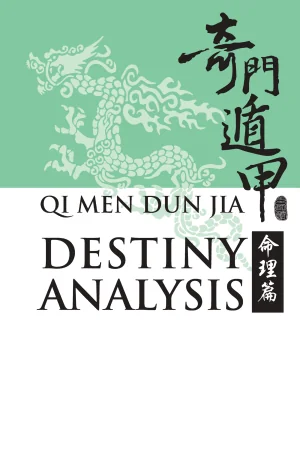
Qi Men Dun Jia Destiny Analysis
 72
72

Qi Men Dun Jia Destiny Analysis
Joey Yap's "Qi Men Dun Jia Destiny Analysis" attempts to tame a notoriously intricate system, presenting it in a digestible format. The book's strength lies in its clear, step-by-step breakdown of chart interpretation, effectively transforming a potentially overwhelming subject into a practical tool. The "look-up-and-refer" style is genuinely useful for quickly accessing specific analytical points. However, while simplification is the goal, some of the nuance of Qi Men's deeper philosophical underpinnings might be lost for the seasoned practitioner. The discussion of the Eight Doors, for instance, provides functional meanings but perhaps less on their subtle energetic interplay. Nevertheless, for those seeking a direct method to decode personal destiny charts without years of theoretical study, this work offers a valuable entry point. It succeeds in making complex divination accessible.
📝 Description
72
Joey Yap's 2011 book demystifies Qi Men Dun Jia for personal destiny analysis.
This book breaks down the complex Chinese art of Qi Men Dun Jia into manageable parts for interpreting an individual's fate. It provides a straightforward, reference-style guide for beginners to analyze a Qi Men Destiny Chart directly. The aim is to clarify personality traits, career paths, relationships, health, and academic potential.
The system itself has a history of over two thousand years in China, originally used for military strategy. Yap adapts these ancient principles for modern personal destiny analysis, focusing on the core components of a Qi Men Destiny Chart. These include the interactions between Heavenly Stems, Earthly Branches, the Eight Doors, Nine Stars, and Eight Deities, simplified for broader understanding.
Qi Men Dun Jia, originating in ancient China over two millennia ago, is a sophisticated system historically applied to military strategy and divination. Its adaptation for personal destiny analysis, as seen in this contemporary guide, draws upon its intricate mathematical and cosmological frameworks. The practice seeks to map human life experiences onto cyclical cosmic patterns, a pursuit shared with other esoteric traditions that link celestial movements to earthly events and individual lives.
💡 Why Read This Book?
• You will learn to interpret the unique interactions of Heavenly Stems and Earthly Branches within a Qi Men Destiny Chart, moving beyond superficial astrological readings to understand specific life potentials as detailed in the book's analytical framework. • Gain practical skills in identifying auspicious and inauspicious patterns related to career and relationships by studying the specific functions of the Eight Doors and Nine Stars, as outlined in the book's structured analysis sections. • Understand the foundational principles of Qi Men Dun Jia as applied to personal destiny, enabling you to analyze your own chart or that of others using the simplified, "look-up-and-refer" method introduced by Joey Yap.
⭐ Reader Reviews
Honest opinions from readers who have explored this book.
❓ Frequently Asked Questions
What is Qi Men Dun Jia Destiny Analysis?
Qi Men Dun Jia Destiny Analysis is a Chinese metaphysical art that uses a specific chart structure, derived from an individual's birth date and time, to interpret personality, career, relationships, and health. It's known for its complexity but is simplified in this book for easier understanding.
How does Qi Men Dun Jia differ from other Chinese astrological systems like Bazi?
While Bazi (Four Pillars of Destiny) focuses on the four pillars of birth time, Qi Men Dun Jia incorporates a more dynamic and spatial element, often visualized as a palace system. It's historically been used for strategic planning and divination, offering a different analytical perspective.
Is this book suitable for beginners in Chinese metaphysics?
Yes, the book is designed with a "look-up-and-refer" format to make the complex Qi Men Dun Jia system accessible. It breaks down chart analysis into manageable components for those new to the subject.
What specific areas of life can be analyzed using this method?
The book covers analysis for personality, career, business, relationships, family, health, and academic pursuits, providing insights into various facets of an individual's life through their Qi Men Destiny Chart.
When was the first edition of Qi Men Dun Jia Destiny Analysis published?
The first edition of 'Qi Men Dun Jia Destiny Analysis' by Joey Yap was published on May 1, 2013.
What are the key components of a Qi Men Destiny Chart?
A Qi Men Destiny Chart is composed of elements like the Heavenly Stems, Earthly Branches, the Eight Doors, Nine Stars, and Eight Deities, which interact to reveal an individual's destiny.
🔮 Key Themes & Symbolism
Destiny Chart Structure
The book systematically breaks down the construction and interpretation of a Qi Men Destiny Chart. It details how the arrangement of Heavenly Stems, Earthly Branches, the Nine Stars, Eight Doors, and Eight Deities within the chart's palaces provides a blueprint for an individual's life. Emphasis is placed on understanding the interactions between these components, rather than just their individual meanings, to reveal specific potentials and challenges across various life domains.
Practical Application
A core theme is the practical utility of Qi Men Dun Jia for everyday life. The book moves beyond theoretical exposition to offer a direct method for analyzing specific questions about personality, career, relationships, and health. The "look-up-and-refer" format is central to this theme, enabling users to quickly find relevant interpretations without needing to master the entire system's complexities upfront.
Simplified Interpretation
Recognizing the inherent complexity of Qi Men Dun Jia, the author prioritizes simplification. This theme involves presenting the system's analytical tools in an accessible manner, making it feasible for newcomers to engage with chart readings. The focus is on providing clear, actionable interpretations derived from chart configurations, clarifying the process for a broader audience interested in personal development.
Holistic Life Analysis
The book frames Qi Men Dun Jia as a comprehensive tool for understanding the many-sided nature of human existence. By applying the chart analysis to diverse areas such as academic pursuits, family dynamics, and business acumen, it suggests that this ancient system offers a holistic perspective. The interconnectedness of different life aspects is explored through the unified lens of the destiny chart.
💬 Memorable Quotes
Direct passages from the work, attributed to the author.
“The entire system is simplified to create a 'look-up-and-refer' style format.”
— This highlights the book's primary design goal: to make the intricate Qi Men Dun Jia system accessible. It suggests a practical, user-friendly approach focused on direct application rather than deep theoretical study.
“Dive down to the core of analyzing a Qi Men Destiny Chart - hassle-free.”
— This emphasizes the book's promise of efficiency and ease of use. It positions the work as a direct pathway to understanding a complex subject without undue difficulty or prolonged effort.
“Contains all the necessary information that helps to unravel the burning questions about you.”
— This asserts the book's comprehensiveness in addressing personal inquiries. It suggests that by consulting this guide, readers can find answers to significant life questions through the lens of Qi Men analysis.
“Whether it is on Personality, Career, Business, Relationship, Family, Health and Academic Pursuits.”
— This phrase outlines the broad scope of life areas covered by the Qi Men Dun Jia analysis presented in the book, indicating its applicability to many different aspects of a person's life.
“Qi Men Dun Jia Destiny Analysis is a very complex system.”
— This acknowledges the inherent difficulty of the subject matter. It sets the stage for the author's subsequent efforts to simplify and explain the system for the reader.
🌙 Esoteric Significance
Tradition
Qi Men Dun Jia is deeply rooted in Taoist cosmology and philosophy, particularly its principles of cyclical time, energy flow (Qi), and the interplay of Yin and Yang. It draws heavily from the I Ching and the Lo Shu grid. Within the broader spectrum of Chinese metaphysics, it is considered one of the 'Three Oracles' alongside Tai Yi and Liu Ren. Its esoteric significance lies in its intricate system of calculating auspicious timings and directions, believed to align human actions with cosmic forces for success and protection.
Symbolism
Key symbols include the Eight Doors (Open, Rest, Life, Injury, Scenery, Death, Fear, and Five Ghosts), representing different types of energies and outcomes associated with actions or events. The Nine Stars (e.g., Heavenly King, Great Yang, Death, Life) symbolize celestial influences and the character of energies. The Eight Deities (e.g., Chief, Elite, Cloud, Fog) represent spiritual forces that can aid or hinder endeavors. Their precise arrangement in the chart is crucial for interpretation.
Modern Relevance
Contemporary practitioners and thinkers in Feng Shui, Bazi, and other Chinese metaphysical arts often incorporate Qi Men Dun Jia principles for advanced analysis, particularly concerning timing and strategic decision-making. Its application extends to modern business strategy, personal development, and even some forms of psychological profiling, demonstrating its adaptability. Thinkers like Lillian Too and Raymond Lo have also contributed to the popularization and study of Chinese metaphysics, creating an environment where works like Yap's can find an interested audience.
👥 Who Should Read This Book
• Individuals seeking a structured, step-by-step method for personal destiny analysis using ancient Chinese principles, who may find other systems too abstract. • Practitioners of Bazi or Feng Shui looking to expand their toolkit with a system known for its predictive accuracy and strategic applications. • Curious newcomers to Chinese metaphysics who want a practical, "look-up-and-refer" guide to understanding a complex divination system without extensive foundational study.
📜 Historical Context
Qi Men Dun Jia, a system with origins dating back over two millennia in Chinese history, was initially developed for military strategy and statecraft, predating Sun Tzu's "The Art of War." Its application to personal destiny analysis, as popularized in contemporary works like Joey Yap's, represents a significant evolution from its strategic roots. The system's sophisticated mathematical framework, entwined with Taoist philosophy, positions it alongside other complex Chinese metaphysical arts such as Bazi (Four Pillars of Destiny) and I Ching divination. While systems like I Ching have seen extensive study and commentary in the West since the mid-20th century, Qi Men Dun Jia has remained more specialized. The 2013 publication of Yap's book reflects a modern trend of making these intricate traditions more accessible to a global audience, moving them from specialized monastic or scholarly circles into broader public engagement.
📔 Journal Prompts
The arrangement of the Eight Doors in your Destiny Chart and their implications for your approach to challenges.
How the specific placement of the Nine Stars influences your core personality traits as depicted in the chart.
Analyzing the interaction between your Day Master and other elements within the Qi Men Destiny Chart.
Reflecting on the potential impact of the Eight Deities on significant life decisions.
Mapping the core components of a Qi Men Destiny Chart to specific life events or tendencies.
🗂️ Glossary
Qi Men Dun Jia
An ancient Chinese metaphysical art, often translated as 'Mysterious Doors Escaping Jia', used for divination, strategy, and destiny analysis. It involves complex calculations based on astronomical and calendrical data.
Heavenly Stems
The ten cyclical signs (Jia, Yi, Bing, Ding, Wu, Ji, Geng, Xin, Ren, Gui) that form the basis of the Chinese calendar and are fundamental components in Qi Men charts.
Earthly Branches
The twelve cyclical signs (Zi, Chou, Yin, Mao, Chen, Si, Wu, Wei, Shen, You, Xu, Hai) associated with the zodiac animals, also crucial for forming the structure of a Qi Men chart.
Eight Doors
A set of eight symbolic doors (Open, Rest, Life, Injury, Scenery, Death, Fear, Five Ghosts) within the Qi Men chart, each representing different types of energies and outcomes relevant to specific actions or questions.
Nine Stars
Nine celestial stars (e.g., Heavenly King, Great Yang, Life, Death) that are incorporated into the Qi Men chart, influencing the character and potential of different palaces or sectors.
Eight Deities
Eight spiritual entities or forces (e.g., Chief, Elite, Cloud, Fog) that are placed within the chart, signifying external influences or spiritual assistance/hindrance.
Destiny Chart
The specific configuration of Heavenly Stems, Earthly Branches, Doors, Stars, and Deities generated for an individual's birth date and time, used for analysis.
This book appears in 1 collection
🔮 Readers Also Liked
Browse all →









From the “Divination” Collection
View all →









More Free Astrology & Cosmology Books
View all →
![Mrs. Davis, (no. 7.) Crown Court, Little Poultney Street, Wardour Street, Soho, ... name and clock face on the door. Who has studied the occult sciences under the most learned sages after many years studious application; answers all adimssable [sic] questions in astrology, ... 1780](/img/thumb/mrs-davis-no-7-crown-court-little-poultney-street-wardour-street-soho-name-and-clock-face-on-the-door-who-has-studied-the-occult-sciences-under-the-most-learned-sages-after-many-years-studious-applica.webp)