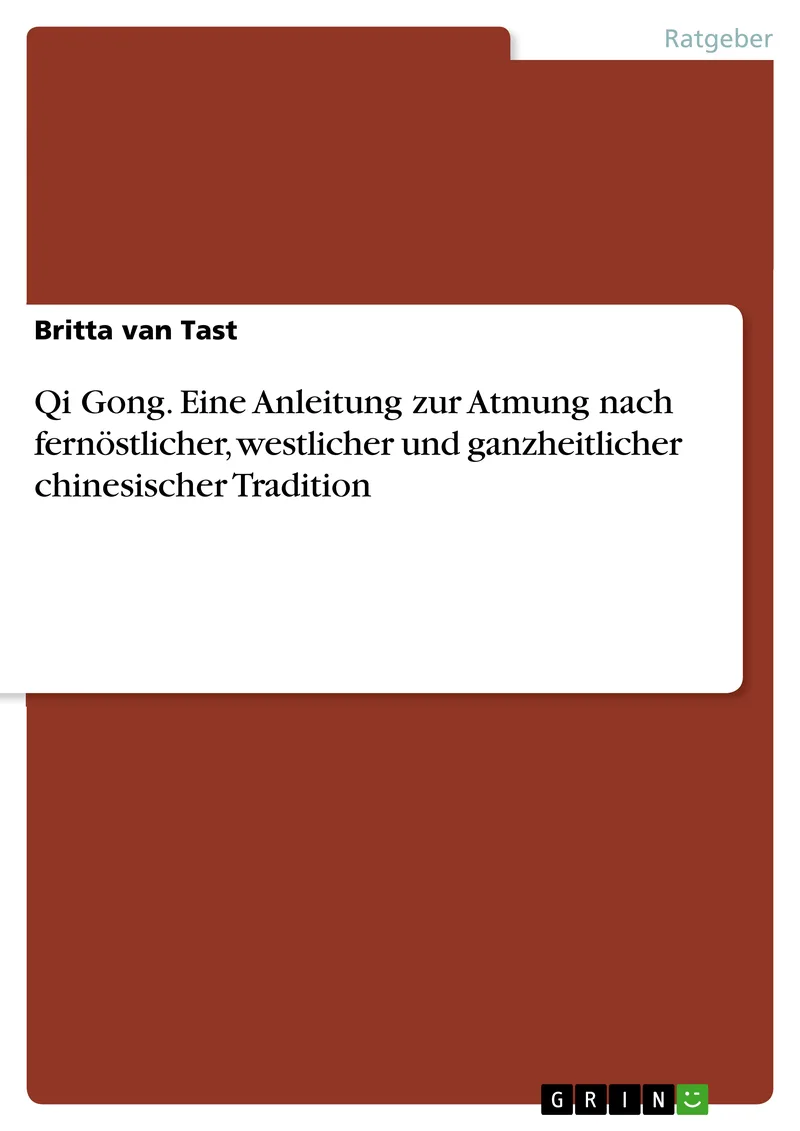
Qi Gong. Eine Anleitung zur Atmung nach fernöstlicher, westlicher und ganzheitlicher chinesischer Tradition
 79
79

Qi Gong. Eine Anleitung zur Atmung nach fernöstlicher, westlicher und ganzheitlicher chinesischer Tradition
Britta van Tast's 2017 guide offers a commendable effort to synthesize disparate views on breath. Its strength lies in its systematic approach, moving from the empirically verifiable Western model of respiration to the more subtle energetic concepts of Chinese tradition. The author avoids the pitfalls of New Age jargon, presenting information with academic rigor. However, the sheer breadth of coverage occasionally dilutes the impact of individual techniques. For instance, the section detailing Western physiological responses to breath holding, while accurate, feels somewhat detached from the later exploration of *Qi* circulation. A more sustained integration throughout the text would have been beneficial. Despite this, the book serves as a valuable reference for anyone seeking a nuanced understanding of breath as a bridge between the physical and energetic realms.
📝 Description
79
Britta van Tast's 2017 book connects Western respiration science with Chinese Qi Gong traditions.
Published in 2017, Qi Gong. Eine Anleitung zur Atmung by Britta van Tast examines breath from Western scientific and traditional Chinese perspectives. The author details various breathing techniques, comparing and contrasting different cultural understandings of respiration. This work aims to bridge the gap between scientific views on oxygen exchange and the Eastern concept of breath as a vital life force.
The book is intended for students of esoteric practices, health practitioners interested in cross-cultural approaches, and those curious about the philosophy behind breathwork. It is particularly valuable for readers familiar with Western physiology who want to understand Eastern energetic concepts. Van Tast's research connects empirical observation with metaphysical ideas, offering a comparative analysis often missing in popular discussions of Qi Gong.
Central to the text are the concepts of *Qi* and its cultivation through breath. It contrasts the Western biological imperative of oxygen intake with the Chinese view of breath as a conduit for life energy. The book also discusses 'whole-person' health, integrating physical, mental, and energetic aspects through specific exercises.
This book enters the discourse on mind-body practices prominent in the late 2010s. It addresses a Western audience increasingly interested in Eastern traditions like Qi Gong, but often lacking deep comparative analysis. Van Tast's work seeks to integrate scientific understanding of breath with traditional Chinese energetic models, contrasting with earlier works that might have focused on a single tradition. It situates breathwork within a broader context of integrating physical, mental, and energetic dimensions for health.
💡 Why Read This Book?
• Gain a comparative understanding of breathwork by exploring both Western scientific models and traditional Chinese energetic concepts, as detailed in the book's comparative sections. • Learn specific breathing techniques rooted in Chinese tradition, differentiating them from Western physiological approaches to respiration, as presented in the book's detailed exercises. • Appreciate the 2017 publication's contribution to integrating holistic health perspectives, connecting the physical body's mechanics to vital energy cultivation as outlined by Britta van Tast.
⭐ Reader Reviews
Honest opinions from readers who have explored this book.
❓ Frequently Asked Questions
What is the primary focus of 'Qi Gong. Eine Anleitung zur Atmung'?
The book's primary focus is the comprehensive exploration of breath as a fundamental life resource, bridging Western scientific understanding with Eastern (specifically Chinese) energetic traditions and practices.
When was Britta van Tast's book on Qi Gong first published?
Britta van Tast's 'Qi Gong. Eine Anleitung zur Atmung nach fernöstlicher, westlicher und ganzheitlicher chinesischer Tradition' was first published on September 14, 2017.
Does the book offer practical breathing exercises?
Yes, the book details various breathing techniques derived from Chinese tradition, aiming to cultivate vital energy and promote holistic well-being, contrasting them with Western physiological perspectives.
What makes this book's approach to breath unique?
Its uniqueness lies in its comparative approach, examining breath from a Western scientific, a Far Eastern (Chinese) traditional, and a holistic perspective, seeking to find connections and contrasts.
Who would benefit most from reading this guide?
Students of esoteric sciences, health practitioners interested in cross-cultural approaches, and individuals seeking a deeper, researched understanding of breathwork beyond popular trends would benefit.
Is the book suitable for beginners in Qi Gong?
While it offers detailed information, its scholarly and comparative nature suggests it is best suited for those with some existing interest or background in health sciences or esoteric traditions.
🔮 Key Themes & Symbolism
Breath as Vital Energy
The work posits breath not merely as a biological function for oxygen intake but as the primary vehicle for *Qi*, or vital life force, central to Chinese energetic philosophies. It contrasts this with the Western scientific view of respiration, highlighting how conscious control of breathing can influence energetic states and overall vitality, a core tenet in many esoteric traditions.
Holistic Health Integration
Van Tast advocates for a holistic model of health that integrates physical, mental, and energetic well-being. The book demonstrates how breathwork, drawing from both Western physiological understanding and Eastern practices, can serve as a powerful tool to harmonize these dimensions, moving beyond purely symptomatic treatment towards cultivating fundamental life energy.
Comparative Esoteric Frameworks
A significant theme is the comparative analysis between Western scientific perspectives on respiration and traditional Chinese energetic practices. The book seeks to build bridges, showing how seemingly different paradigms can offer complementary insights into the profound influence of breath on human consciousness and physiology, a common pursuit in comparative esoteric studies.
Bridging East and West
The central narrative revolves around creating a dialogue between Eastern and Western thought regarding breath. It explores how concepts from natural science can inform an understanding of ancient energetic practices, and vice versa, suggesting that a unified approach to breath can unlock deeper potentials for personal development and health.
💬 Memorable Quotes
Direct passages from the work, attributed to the author.
“Western science explains *how* we breathe; Chinese tradition explains *why* and *what* the breath does energetically.”
— This interpretive statement highlights the book's comparative method, suggesting that Western physiology details the mechanics of respiration, while Eastern philosophies explore its deeper role in vital energy circulation and spiritual cultivation.
“The cultivation of Qi through specific breath patterns.”
— This phrasing points to the practical application of the book's teachings, indicating that the text offers guidance on employing particular breathing exercises designed to enhance and direct the body's vital energy, or Qi.
“Integrating breathwork for a balanced, whole-person approach to health.”
— This interpretation emphasizes the book's holistic philosophy, suggesting that breath is presented not as an isolated technique but as a foundational element for achieving comprehensive well-being across physical, mental, and energetic levels.
“Understanding respiration from empirical facts to energetic flows.”
— This captures the book's methodical progression, illustrating how it moves from established scientific facts about breathing to exploring the more esoteric concepts of energetic movement and influence associated with breath.
💡 Key Ideas
Editorial paraphrase of the work's core concepts — not direct quotes.
Breath as the bridge between the material and energetic worlds.
This paraphrased concept captures the book's core argument: that the act of breathing is not confined to the physical body but serves as a crucial interface, connecting our tangible existence with subtle energetic flows and states of consciousness.
🌙 Esoteric Significance
Tradition
This work engages with the broad lineage of Taoist and traditional Chinese medicine, which forms a significant pillar of esoteric thought globally. It specifically addresses the concept of *Qi* cultivation, a practice central to Taoist internal alchemy and numerous martial arts. While not strictly Hermetic or Kabbalistic, its focus on vital energy and breath as a transformative force appeals to universal esoteric principles concerning microcosm-macrocosm correspondences.
Symbolism
The primary symbol is *Qi* itself, representing the invisible life force that animates all things, often depicted metaphorically as flowing water or wind. Breath, as the tangible manifestation and conduit of *Qi*, becomes a potent symbol of connection between the physical body, the mind, and the energetic universe. The 'whole-person' approach symbolizes the integration of disparate aspects of self into a unified, balanced whole.
Modern Relevance
Contemporary practitioners of mindfulness, yoga, and somatic therapies draw on similar principles of breath-focused awareness and energy cultivation. Thinkers and practitioners in fields like bioenergetics, psychoneuroimmunology, and integral health often explore the mind-body connection in ways that echo the holistic integration proposed by van Tast, seeking to bridge scientific understanding with experiential practices.
👥 Who Should Read This Book
• Health practitioners and therapists interested in comparative models of human physiology and energy work, seeking to integrate Western scientific data with Eastern energetic concepts. • Dedicated students of Qi Gong or Traditional Chinese Medicine looking for a scholarly text that contextualizes breathing techniques within a broader philosophical and scientific framework. • Esoteric researchers and practitioners interested in the cross-cultural understanding of vital life forces and their manipulation through conscious practice, particularly concerning breath.
📜 Historical Context
Published in 2017, Britta van Tast's "Qi Gong. Eine Anleitung zur Atmung" emerged during a period of sustained Western interest in complementary and alternative medicine, including traditional Chinese practices. This era saw a proliferation of popular books on Qi Gong, often focusing on simplified exercises. Van Tast's work distinguished itself by offering a more academic and comparative approach, specifically contrasting Western scientific understandings of respiration with Chinese energetic models. This was in contrast to earlier, more purely descriptive texts that might have emerged in the late 20th century. The book's detailed examination of breathwork, aiming to bridge empirical science with esoteric tradition, aligns with a broader intellectual current seeking to validate and integrate ancient wisdom within modern frameworks, rather than succumbing to the purely spiritual or pseudo-scientific interpretations sometimes prevalent in popular wellness circles.
📔 Journal Prompts
The concept of Qi as a bridge between Western physiology and Eastern energetics.
Western understanding of respiration versus Chinese energetic interpretations.
The role of conscious breathing in cultivating holistic health.
Bridging the gap between empirical facts and energetic flows in breath.
The practice of specific breath patterns for Qi cultivation.
🗂️ Glossary
Qi (Chi)
In traditional Chinese culture, Qi refers to the vital life force or energy that flows through all living things. It is considered the fundamental substance and animating principle of the universe.
Qi Gong
An ancient Chinese system of coordinated body posture and movement, breathing, and meditation used for health, spirituality, and martial arts training. It aims to cultivate and balance Qi.
Holistic
Characterized by the belief that the parts of something are interconnected and can only be fully understood in relation to the whole; emphasizing the interconnectedness of mind, body, and spirit.
Respiration
The process of inhaling and exhaling air; in a physiological context, it refers to the exchange of gases (oxygen and carbon dioxide) between an organism and its environment.
Energetic Traditions
Systems of belief and practice that focus on the existence and manipulation of subtle energies within the body and the environment, common in many ancient cultures and esoteric philosophies.
Comparative Approach
A method of study that involves examining similarities and differences between two or more subjects, in this case, Western scientific views and Eastern traditional practices concerning breath.
Vital Force
A hypothetical force believed to be responsible for the characteristics of living organisms, often equated with concepts like Qi in Eastern traditions or 'élan vital' in some Western philosophies.