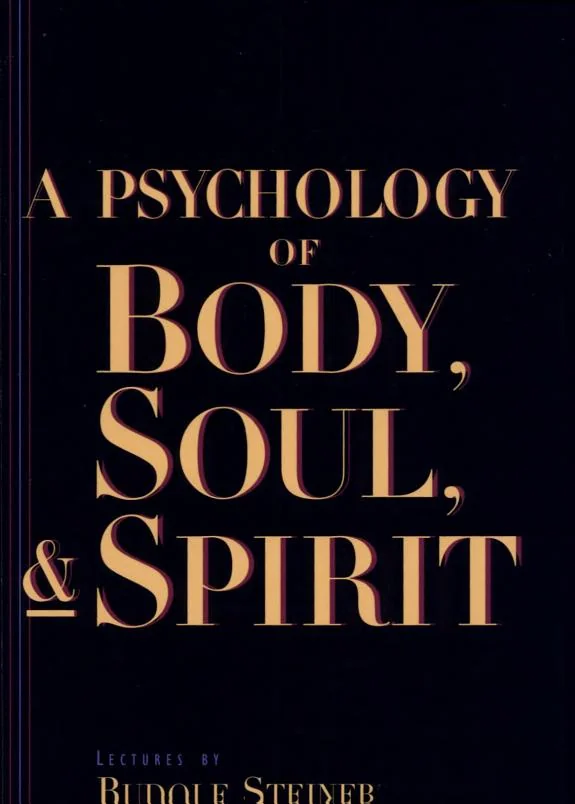
Psychology of Body, Soul, and Spirit
 76
76

Psychology of Body, Soul, and Spirit
Steiner's "Psychology of Body, Soul, and Spirit" offers a challenging but rewarding exploration of the human constitution from a spiritual-scientific viewpoint. The strength of this collection lies in its detailed delineation of the soul's various sheaths and their relationship to physical processes, providing a framework for understanding subjective experience that feels more holistic than many contemporary psychological models. A limitation, however, is the density of the material; Steiner's conceptual language, while precise within his system, can require considerable effort to grasp without prior familiarity with his broader work. The passage discussing the 'consciousness soul' as the organ for understanding the spiritual world, distinct from mere intellect, is particularly striking for its ambition to bridge empirical observation with supersensible cognition. Ultimately, this book provides a robust, albeit demanding, esoteric map of the human being.
📝 Description
76
Rudolf Steiner delivered twelve lectures on the human being's constitution between 1909 and 1911.
Rudolf Steiner's "Psychology of Body, Soul, and Spirit" offers a perspective on human consciousness that moves beyond purely materialistic or phenomenological views. The lectures, given between 1909 and 1911, lay out principles for what Steiner termed spiritual psychology. He details the human being's makeup, differentiating between physical, soul, and spiritual components and how they interact. Steiner explains how sensory input shapes the soul and how less apparent processes influence our lives.
This volume is for anyone wanting a complete model of human consciousness that includes physical, psychic, and spiritual aspects. It is especially relevant for those studying Anthroposophy, comparative psychology, or philosophy, and for readers seeking alternatives to conventional psychological theories. Those interested in the deeper forces shaping human development, from sensory perception to spiritual insight, will find this work valuable. The lectures were presented in Berlin during a time of significant spiritual inquiry, contrasting with prevailing scientific materialism and early psychoanalytic ideas, and articulating a spiritual-scientific view of the psyche.
These lectures emerged from Rudolf Steiner's developing esoteric philosophy in the years before World War I. Steiner, then a figure in the Theosophical Society and later founder of Anthroposophy, presented a spiritual-scientific approach to understanding the human psyche. This perspective contrasted with the era's scientific materialism and burgeoning psychoanalytic theories. The work articulates a worldview that sees the human being as a complex, multi-layered entity with distinct physical, soul, and spiritual components.
💡 Why Read This Book?
• You will gain a unique framework for understanding the human being as a composite of physical, soul, and spiritual elements, moving beyond purely materialistic psychology, as detailed in the lectures from Berlin, 1909-1911. • You will learn Steiner's specific approach to the soul's relationship with sensory activity, differentiating between the life, feeling, and consciousness soul bodies, offering insights unavailable in standard psychological texts. • You will discover the foundational principles of spiritual science as applied to the human psyche, providing a path for developing inner perception as described in the lectures which form CW 115.
⭐ Reader Reviews
Honest opinions from readers who have explored this book.
❓ Frequently Asked Questions
What is Rudolf Steiner's core concept of the human being in "Psychology of Body, Soul, and Spirit"?
Steiner presents the human being as a threefold entity: physical body, soul (with its various sheaths like life, feeling, and consciousness souls), and spirit (the eternal 'I'). This model is central to his spiritual-scientific psychology.
When and where were the lectures that comprise "Psychology of Body, Soul, and Spirit" originally given?
These twelve lectures were delivered in Berlin, Germany, between October 23, 1909, and December 16, 1911. This period is significant for Steiner's philosophical development.
How does Steiner's psychology differ from conventional psychology?
Unlike conventional psychology, which often focuses solely on the observable or subconscious mind, Steiner's approach includes the spiritual dimensions of the human being and posits methods for their direct experience.
What is the 'consciousness soul' according to Steiner in this work?
The consciousness soul, as presented in the lectures, is the part of the soul that allows for conscious awareness and is the organ through which humanity can apprehend spiritual realities.
Does this book offer practical exercises for self-development?
While the book lays the theoretical groundwork for spiritual development, it primarily focuses on understanding the structure of the human being. Practical exercises are often detailed in other works by Steiner.
What is the significance of the 'I' in Steiner's psychology?
The 'I' represents the immortal, spiritual core of the human being, the true self that reincarnates and guides the evolution of the soul and body through successive lives.
🔮 Key Themes & Symbolism
The Threefold Human Being
Steiner posits that the human being is not a singular entity but a composite of physical, soul, and spiritual elements. The lectures meticulously dissect these components, detailing the 'body soul' (linked to physical processes), the 'life soul' (connected to vitality and instinct), the 'feeling soul' (seat of emotions and desires), and the 'consciousness soul' (the field of thought and self-awareness). Finally, the eternal 'I' or spirit is introduced as the unifying and evolving principle guiding this complex structure through earthly existence and beyond.
Sensory Perception and Soul Formation
A significant portion of the lectures addresses how the external world, perceived through the senses, directly shapes the inner life of the soul. Steiner explains that sensory experiences are not merely passive inputs but active forces that build the soul's substance and consciousness. He differentiates between the impact of physical senses and the more subtle processes through which the soul assimilates and transforms these experiences, laying the groundwork for understanding how our external reality molds our internal landscape.
The Path to Spiritual Knowledge
Beyond describing the human constitution, Steiner outlines a path toward direct spiritual perception. He contrasts this 'spiritual science' with purely intellectual or materialistic knowledge, arguing that the higher aspects of the human being can be known through dedicated inner development. The lectures touch upon the capacity for clairvoyance and higher cognition, suggesting that the same faculties that enable sensory perception can, with training, be turned towards perceiving spiritual realities.
Karma and Reincarnation
Implicit within the discussion of the soul's development is the concept of karma and reincarnation, foundational to Steiner's worldview. The lectures suggest that the current life and the formation of the soul are outcomes of past experiences and predispositions carried across lifetimes. This perspective provides a framework for understanding individual destiny, character, and the ongoing process of spiritual evolution that transcends a single earthly existence.
💬 Memorable Quotes
Direct passages from the work, attributed to the author.
“Through the senses, the outer world is built into the soul.”
— This statement emphasizes the active role of sensory experience in shaping our inner psychological reality, suggesting that our perceptions are not merely reflections but formative elements of the soul.
“The consciousness soul is the organ for understanding the spiritual.”
— This concept posits that the highest aspect of the human soul, the consciousness soul, is not limited to rational thought but is capable of directly apprehending supersensible realities, a key tenet of spiritual science.
“The 'I' is the eternal human being, the spiritual core.”
— This concise statement defines the 'I' as the unchanging, immortal spiritual principle within the human being, responsible for individuality and continuity across lifetimes.
💡 Key Ideas
Editorial paraphrase of the work's core concepts — not direct quotes.
The human being is not just a physical organism but a spiritual being temporarily housed within it.
This paraphrased concept highlights Steiner's central thesis: that the physical body is a vessel for a deeper, enduring spiritual identity and soul complex, moving beyond a purely biological understanding of humanity.
True knowledge of the soul requires observation of its subtle processes, not just theory.
This paraphrased idea underscores Steiner's emphasis on direct inner observation and the study of subtle, non-physical aspects of the soul, advocating for an empirical approach to esoteric phenomena.
🌙 Esoteric Significance
Tradition
This work is deeply rooted in the Western esoteric tradition, particularly drawing from Theosophy and Anthroposophy, which Steiner himself founded. It seeks to synthesize elements from various streams, including Neoplatonism, Gnosticism, and Hermeticism, but reframes them through a unique 'spiritual-scientific' methodology. Unlike purely mystical traditions that emphasize direct experience without detailed conceptualization, Steiner provides a structured, almost scientific, cosmology and anthropology for understanding the soul and spirit's journey.
Symbolism
While not heavily reliant on overt symbolism in the manner of alchemy or Kabbalah, Steiner's work uses core concepts as symbolic representations of spiritual realities. The 'I' functions as the ultimate spiritual symbol of individuality and divine spark. The concept of the 'threefold human being' (body, soul, spirit) acts as a symbolic map of consciousness, and the various 'soul bodies' (life, feeling, consciousness) symbolize distinct levels of subjective experience and interaction with the world.
Modern Relevance
Steiner's model of the human being continues to influence contemporary esoteric thought, Waldorf education, biodynamic agriculture, and anthroposophical medicine. Thinkers and practitioners in these fields draw upon his detailed psychology to understand child development, psychological well-being, and the connection between the physical and spiritual realms. His work provides a foundational text for those seeking alternative frameworks for understanding consciousness, personal growth, and the spiritual dimensions of human life.
👥 Who Should Read This Book
• Students of Anthroposophy seeking a foundational text on Steiner's understanding of the human psyche and its development across lifetimes. • Psychologists and philosophers interested in comparative approaches to consciousness and exploring non-materialistic models of the human being. • Individuals on a spiritual path looking for a detailed esoteric framework to understand their inner life, the nature of the soul, and the potential for spiritual perception.
📜 Historical Context
Delivered in Berlin between 1909 and 1911, these lectures by Rudolf Steiner occurred during a period of intense intellectual and spiritual ferment. Steiner, a leading figure in the Theosophical Society, was actively developing Anthroposophy, his own esoteric philosophy. This work positioned itself against the rising tide of materialistic science and early psychoanalytic thought, notably Sigmund Freud's theories which were gaining traction. Steiner's approach offered a 'spiritual-scientific' alternative, positing that the human being possessed higher spiritual faculties and bodies beyond the physical and psychological. While Steiner's ideas were influential within esoteric circles, they often stood in stark contrast to mainstream academic psychology and philosophy of the era, which largely dismissed or ignored spiritual explanations for human consciousness and behavior.
📔 Journal Prompts
The interplay between sensory perception and the formation of the consciousness soul.
The distinct roles of the life soul, feeling soul, and consciousness soul.
The nature of the 'I' as the eternal spiritual core.
Methods for observing the subtle processes of the soul.
The relationship between physical processes and soul experiences.
🗂️ Glossary
I (Ego)
In Anthroposophy, the 'I' is the eternal, immortal spiritual self or individuality that reincarnates, guiding the development of the soul and body through successive lives.
Body Soul
The aspect of the human being that is directly connected to the physical body's processes, including metabolism, growth, and decay. It is the principle of physical existence.
Life Soul
Associated with the vital forces of the organism, the life soul governs instinctual life, rhythm, and the processes of life itself, distinct from purely physical functions.
Feeling Soul
The seat of emotions, desires, passions, and subjective experience. It is through the feeling soul that humans experience pleasure, pain, joy, and suffering.
Consciousness Soul
The highest aspect of the soul in earthly life, responsible for conscious thought, intellect, memory, and self-awareness. It is the organ for perceiving the spiritual world.
Spiritual Science (Geisteswissenschaft)
Steiner's term for a methodology aimed at investigating spiritual realities through developed inner perception and clairvoyance, presented in a systematic and verifiable manner.
CW (Collected Works)
Abbreviation for Rudolf Steiner's Collected Works, indicating the specific volume or series of his writings and lectures.
This book appears in 1 collection
🔮 Readers Also Liked
Browse all →




From the “Anthroposophy” Collection
View all →




More Free Theosophy & Anthroposophy Books
View all →