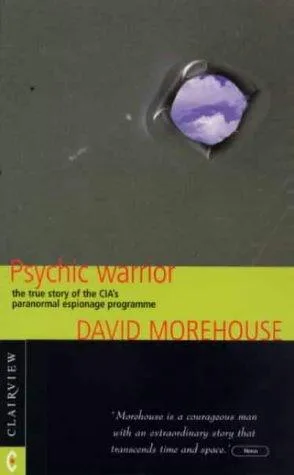
Psychic warrior
 75
75

Psychic warrior
David Morehouse’s "Psychic Warrior" bypasses the usual mystical fog often surrounding psychic phenomena, presenting a starkly pragmatic account of the U.S. military's remote viewing program. Morehouse details the practical steps and protocols involved, offering a rare glimpse into a classified world. His description of the "data dump" phase, where raw impressions are recorded before analysis, is particularly illuminating, showcasing the program's attempt to formalize subjective experience. However, the book occasionally leans into the anecdotal, and a more rigorous examination of the program’s scientific validity, beyond its operational success, would have strengthened its impact. Despite this, "Psychic Warrior" remains a significant primary source for understanding the operationalization of remote viewing.
📝 Description
75
David Morehouse's 1996 book, "Psychic Warrior," details his involvement in a U.S. military remote viewing program.
Published in 1996, "Psychic Warrior" is David Morehouse's firsthand account of his participation in a classified U.S. military program focused on remote viewing. Morehouse recounts his personal transition from initial skepticism to becoming an instructor within this initiative, which aimed to investigate parapsychological abilities for intelligence purposes. The book covers the training methods employed, the theoretical basis for remote viewing as explained by program leadership, and the intended practical applications of these psychic capabilities.
This work is of interest to those focused on the practical applications of psychic phenomena, particularly remote viewing. It speaks to readers curious about the intersection of consciousness studies, military intelligence, and less conventional practices. Anyone looking to understand the structured development of psychic abilities within a formal government project will find value here, as will those who question established scientific views on the mind.
"Psychic Warrior" sits within the broader esoteric tradition of exploring human consciousness beyond conventional sensory perception. It connects to historical interests in telepathy and clairvoyance, particularly as these were explored by various groups and governments throughout the 20th century. The book's focus on a structured, albeit secret, military program reflects a specific moment where parapsychological research intersected with governmental funding and intelligence gathering, a practice that has roots in earlier occult and spiritualist movements seeking hidden knowledge.
💡 Why Read This Book?
• Learn the specific protocols and training methods used in a government-sanctioned remote viewing program, offering a structured approach to psychic perception distinct from purely intuitive practices. • Understand the operational challenges and successes of the STAR GATE project, gaining insight into how psychic phenomena were integrated into military intelligence efforts during the late 20th century. • Explore the concept of "associative remote viewing" as detailed by Morehouse, a specific methodology designed to enhance the accuracy and reliability of psychic impressions.
⭐ Reader Reviews
Honest opinions from readers who have explored this book.
❓ Frequently Asked Questions
What is remote viewing as described in Psychic Warrior?
Remote viewing, as detailed in "Psychic Warrior," is a protocol for acquiring information about a distant or unseen target using mental abilities, guided by structured steps and designed to overcome subjective bias.
What was the purpose of the government's remote viewing program?
The U.S. government's remote viewing program, such as the one Morehouse details, aimed to explore and potentially utilize psychic capabilities for intelligence gathering and reconnaissance purposes.
Did David Morehouse actually serve in a government psychic program?
Yes, David Morehouse claims to have served as an instructor and participant in classified U.S. military programs focused on remote viewing, as extensively documented in "Psychic Warrior."
What are the key stages of remote viewing according to the book?
Key stages often mentioned include initial perception, data collection (associative remote viewing), and the analysis of these impressions to identify actionable intelligence about a target.
Is the book Psychic Warrior considered a manual for remote viewing?
While it describes the methods, "Psychic Warrior" is more of a memoir and exposé of the program. It offers insights into the techniques but is not a step-by-step instructional manual in the traditional sense.
When was the U.S. government's remote viewing program active?
The government's involvement in remote viewing, including projects like STAR GATE, spanned several decades, roughly from the 1970s through the mid-1990s, with "Psychic Warrior" being published near its conclusion.
🔮 Key Themes & Symbolism
Operational Remote Viewing
The book focuses on remote viewing not as a mystical art but as a trainable skill with operational protocols. Morehouse emphasizes the structured methodology developed within the U.S. military, detailing specific phases like data collection and analysis. The work highlights the program's attempts to standardize subjective experiences into verifiable intelligence, differentiating it from more esoteric or purely intuitive approaches to psychic perception. It underscores the practical application and development of these abilities within a formal, classified context.
The STAR GATE Program
Morehouse provides a firsthand account of his involvement in the U.S. government's classified research into psychic phenomena, specifically the STAR GATE project. He details the environment, the objectives, and the methodologies employed by this initiative, which ran for over two decades. The book serves as a primary source for understanding the internal workings and the perceived utility of such programs from a participant's perspective, offering a rare look at how psychic research was integrated into intelligence operations.
Skepticism to Belief
A central theme is Morehouse's personal journey from an initial position of skepticism regarding psychic abilities to becoming a proponent and instructor within the military program. He recounts his own experiences and observations that challenged his prior assumptions, illustrating how direct exposure to the phenomena and the structured training protocols fostered his belief. This narrative arc highlights the transformative potential of encountering and systematically exploring the unexplained.
Consciousness and Perception
The work implicitly challenges conventional Western understandings of consciousness and perception. By detailing how individuals could allegedly perceive information beyond the limitations of physical senses, Morehouse points to a broader, less understood aspect of human consciousness. The book explores the potential for consciousness to interact with reality in ways not accounted for by current scientific models, suggesting a deeper, interconnected nature of awareness.
💬 Memorable Quotes
Direct passages from the work, attributed to the author.
“The protocols were designed to eliminate guesswork and subjective interpretation.”
— This statement highlights the program's core endeavor: to mechanize and standardize psychic perception, treating it like any other intelligence-gathering discipline that requires rigorous methodology to ensure accuracy and reliability.
“I went from being a skeptic to an instructor in a program I once thought was impossible.”
— This expresses Morehouse's personal journey and the transformative nature of his experience within the remote viewing program, emphasizing the profound shift in his worldview prompted by direct involvement.
“Associative remote viewing links sensory impressions to potential target descriptions.”
— This describes a specific technique within remote viewing, where initial, often abstract, sensory data is methodically connected to concrete elements of a target to build a coherent picture.
“The data dump was crucial for capturing raw impressions before the analytical mind intervened.”
— This refers to a critical phase in the remote viewing process, emphasizing the importance of recording unfiltered psychic impressions immediately to preserve their integrity from conscious editing or bias.
“The program aimed to explore the untapped potential of the human mind.”
— This reflects the overarching goal of the military's psychic research efforts, suggesting a belief in latent human capabilities that could be harnessed for strategic advantage.
🌙 Esoteric Significance
Tradition
Morehouse's work does not align neatly with established esoteric traditions like Hermeticism or Kabbalah. Instead, it represents a modern, secularized approach to psychic phenomena, stemming from Cold War-era military research. It departs from traditional occultism by emphasizing structured protocols and empirical observation, albeit within a classified context, rather than mystical initiation or ancient lore. It can be seen as a practical offshoot of consciousness studies that intersects with parapsychology, seeking to operationalize subjective experience.
Symbolism
While not rich in traditional symbolism, the book's core concept of "remote viewing" itself can be seen as symbolic of transcending physical limitations and accessing hidden information. The idea of a "target" represents the unknown or the unseen, and the process of "viewing" it symbolizes the mind's potential to penetrate veils of perception. The "protocols" act as a modern, secularized ritual, guiding the practitioner towards a desired state of awareness and information retrieval.
Modern Relevance
Contemporary thinkers and practitioners in fields like consciousness research, applied remote viewing, and even certain branches of fringe science continue to draw upon the methodologies and experiences documented in works like "Psychic Warrior." The book informs discussions on the potential for psi abilities and the scientific investigation thereof. It is often referenced by those seeking to understand the practical, applied aspects of remote viewing as distinct from its more theoretical or spiritual interpretations.
👥 Who Should Read This Book
• Individuals fascinated by the intersection of consciousness, espionage, and military history, seeking to understand the practical application of psychic phenomena in a classified context. • Researchers and students of parapsychology interested in firsthand accounts of government-funded psi programs like STAR GATE and their methodologies. • Skeptics and open-minded individuals curious about the operational aspects of remote viewing and the author's journey from disbelief to expertise in the field.
📜 Historical Context
Published in 1996, "Psychic Warrior" emerged at the tail end of a significant period of U.S. government investment in parapsychological research, primarily within the context of the Cold War. Projects like STAR GATE (officially declassified in 1995) explored remote viewing and other psychic phenomena from the 1970s onwards, driven by concerns that the Soviet Union might be gaining an advantage in this area. Morehouse’s account provides a firsthand perspective on the operationalization of these studies, which ran parallel to more publicly visible esoteric movements like New Age spirituality. While academic parapsychology continued its research, often facing skepticism from mainstream science, government programs like STAR GATE represented a more pragmatic, albeit secret, exploration of consciousness. The book’s release coincided with a growing public awareness of these programs, fueled by declassifications and media attention, offering a counterpoint to purely theoretical discussions of psi.
📔 Journal Prompts
The concept of "data dump" and its role in capturing raw psychic impressions.
The author's transition from skepticism to instructor within the remote viewing program.
How "associative remote viewing" attempts to structure subjective experience.
The perceived ethical implications of using psychic abilities for intelligence gathering.
Reflecting on the nature of perception beyond the five senses as presented in the book.
🗂️ Glossary
Remote Viewing (RV)
A parapsychological technique for acquiring information about a distant or unseen target using subjective perception, guided by specific protocols.
STAR GATE
The codename for a series of U.S. government programs (spanning from the 1970s to 1995) that investigated the potential use of psychic phenomena, including remote viewing, for intelligence purposes.
Associative Remote Viewing (ARV)
A specific protocol within remote viewing that links initial psychic impressions to a set of predefined targets or outcomes, often used for prediction.
Data Dump
The process of recording all immediate, unfiltered sensory and intuitive impressions received during a remote viewing session before analytical thought can interfere.
Protocol
A set of rules, procedures, and methodologies designed to ensure consistency, accuracy, and reliability in the practice of remote viewing.
Target
In the context of remote viewing, the specific person, place, object, or event that the viewer is attempting to perceive information about.
Perceptual Bias
The tendency for subjective interpretation or pre-existing beliefs to influence the perception and reporting of information, which remote viewing protocols aim to minimize.
🔮 Readers Also Liked
Browse all →









More by David Morehouse
All books →

More Free Occult Philosophy Books
View all →